
The Ultimate Guide to Wholesale LED Driver Procurement: 10 Key Decisions for Selection, Certification, and Supply Chain
For professional procurement managers, luminaire manufacturers (OEMs), or project engineers, wholesale LED driver procurement is never just a "price comparison."
Choosing a driver is like choosing a "heart" for your project.
A single wrong decision—whether a minor parameter mismatch, a missing certification, or a flawed environmental assessment—will erupt 6 months to 2 years after project delivery in the form of "soaring maintenance costs," "client complaints," or even "safety incidents."
Most guides on the market stop at "the difference between Constant Current and Constant Voltage." This is not enough.
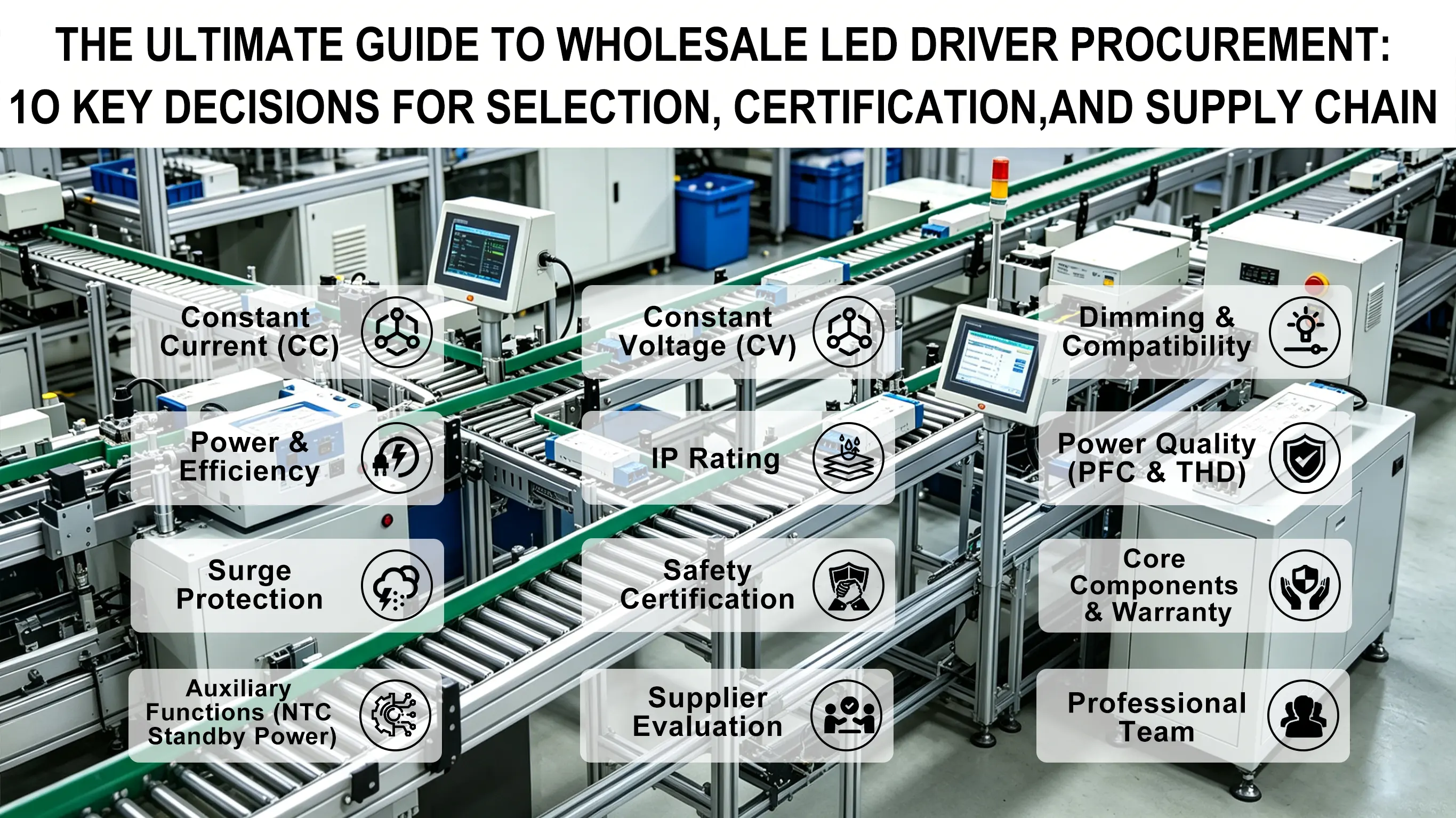
As a deep-level partner in LED driver solutions, we have prepared this ultimate 2025 procurement guide for you. This is not a product list; it is a professional B2B decision-making framework. It will walk you through the 10 critical decision points that every professional buyer must evaluate, ensuring every purchase you make achieves the optimal balance of "long-term reliability" and "Total Cost of Ownership (TCO)."
Decision Point 1: Constant Current (CC) vs. Constant Voltage (CV) — The Foundation of Application
This is the most basic choice, and one you cannot get wrong.
Constant Current (CC) Driver:
How it Works: Outputs a stable current (e.g., 350mA, 700mA), while the voltage automatically adjusts to the load (number of LED chips).
B2B Application: This is the only choice for the vast majority of professional LED luminaires (panel lights, downlights, track lights). You are powering the LED chips directly and must use constant current to ensure brightness and color consistency, and to prevent over-current burnout.
Constant Voltage (CV) Driver:
How it Works: Outputs a stable voltage (e.g., 12V, 24V), while the current varies with the load.
B2B Application: Primarily used for loads that already include a current-limiting component. The most common are LED strips, signage, and some landscape lighting modules.
Procurement Pitfall: Never use a CV driver to directly power an LED luminaire designed for CC, or vice versa. This will lead to instantaneous burnout or severe light decay.
Decision Point 2: Power & Efficiency (W & %) — The Dual Gamble on Cost and Lifespan
Don't just look at "wattage (W)." For B2B procurement, efficiency (%) is the first core indicator of a driver's quality.
Power (W): You must leave sufficient headroom for your load, but more is not always better. Drivers operate most efficiently at 70%-90% load.
Efficiency (%): What's the difference between a 93% efficient driver and an 88% efficient one?
Direct Cost: In a warehouse project with 1,000 units of 100W drivers, 93% efficiency saves thousands of dollars in electricity bills annually compared to 88%.
Hidden Cost (More Important): 88% efficiency means 12W of power is wasted as "heat." 93% wastes only 7W. This extra 5W of heat continuously "bakes" the driver's internal electrolytic capacitors, slashing their lifespan (following the "10-Degree Rule," every 10°C rise in temperature halves the lifespan).
B2B Insight: High efficiency is, first and foremost, synonymous with "long life," and secondly, "energy savings."
Decision Point 3: Dimming Method & Compatibility — The Key to Project Success
The failure of a dimming system is the most expensive mistake in large-scale commercial projects. You must ensure the driver is 100% compatible with your control system.
0-10V (or 1-10V): Analog dimming. Stable, reliable, and cost-effective. The mainstream choice for commercial lighting.
DALI / DALI-2: Digital dimming. Allows for individual addressing, grouping, and scene control. The top choice for high-end hotels and smart buildings.
Triac Dimming: Primarily for residential markets replacing traditional incandescent bulbs. Rarely used in new B2B projects and prone to compatibility issues.
Procurement Pitfall: Flicker, an inability to dim-to-off, and unsynchronized control.
B2B Insight: Dimming issues are extremely complex, involving a "three-way match" between the driver, the dimmer, and the luminaire.
To fully understand how to avoid these pitfalls, you must read our special guide:
"Beyond the Switch: How to Correctly Select DALI/0-10V Dimmable LED Drivers for Large Projects"
Decision Point 4: IP Rating & Operating Environment — Indoor or Outdoor?
The IP (Ingress Protection) rating determines the driver's "survival environment."
IP20: Open frame or vented case. For use inside dry, indoor luminaires only.
IP42-IP54: Protects against dripping or splashing water. Used in damp locations like kitchens/bathrooms, but not direct rain.
IP65-IP67: Fully dust-tight and protects against water jets or temporary immersion. This is the "entry ticket" for outdoor drivers.
Procurement Pitfall: Buying IP67 drivers for an outdoor billboard and assuming all is well.
B2B Insight: IP67 only protects against "water." The real killers in the outdoor environment are "surges" and "extreme temperatures."
IP67 alone cannot guarantee 5-year reliability. We strongly recommend you read this TCO analysis:
"Beyond IP67: Why Your Outdoor LED Billboard Needs High Surge Protection and Wide Temperature Drivers"
Decision Point 5: Power Quality (PFC & THD) — Avoiding Grid Penalties
This is what separates a professional buyer from an amateur. PFC (Power Factor Correction) and THD (Total Harmonic Distortion) are directly related to your power grid quality and operational costs.
PFC: Measures the driver's efficiency in using electricity. PFC=1 is perfect.
THD: Measures the "pollution" the driver causes to the power grid.
B2B Insight: In large-scale industrial, warehouse, or retail projects (using hundreds or thousands of fixtures), if drivers have a PFC < 0.9 or THD > 20%, they generate significant reactive power and harmonic currents. This not only wastes a huge amount of money on electricity but can also trigger hefty fines from the utility company and interfere with other sensitive equipment on the same line.
Procurement Standard: For professional B2B projects, you must demand drivers with PFC > 0.9 (the higher, the better) and THD < 20% (the lower, the better).
Decision Point 6: Surge Protection — Defending Against "Spikes"
A surge is an instantaneous, ultra-high voltage spike in the power grid (from lightning, heavy equipment start-up, etc.). It is the primary culprit for "sudden death" in LED drivers.
Indoor Standard: Even for indoor projects, do not accept drivers with less than 2KV surge protection. For commercial spaces (like factories), 4KV/6KV (Differential/Common mode) protection is recommended for reliability.
Outdoor Standard: Must use at least 6KV. High-risk areas (like highways, mining sites) should use 10KV surge protection.
Decision Point 7: Safety Certification — Your Global Market Passport
Certification is not an "option"; it is the bottom line for safety and law. It is also your product's "passport" to high-end markets.
North America: UL or cUL (Class 1 or Class 2).
Europe: CE (self-declaration) + ENEC (a third-party, authoritative certification far more valuable than CE).
Other Regions: CB, SAA (Australia), PSE (Japan), etc.
B2B Insight (For OEM Clients): Purchasing a driver that already has UL Class P or ENEC certification means you can vastly simplify the certification process for your entire luminaire, saving tens of thousands of dollars in testing fees and months of time-to-market.
Decision Point 8: Core Components & Warranty — The Promise of Lifespan
Don't just look at the warranty period (e.g., "5-Year Warranty"). You must question whether this promise is a "marketing slogan" or an "engineering reality."
B2B Insight: The difference lies in the core components. Ask your supplier to confirm:
Electrolytic Capacitors: Does it use 105°C long-life capacitors (e.g., Rubycon, Nichicon) or cheap 85°C capacitors?
Main IC & Other Chips: Are they from top-tier brands (e.g., TI, ST, Infineon)?
A driver using 105°C capacitors will have a real-world lifespan several times longer in an 80°C environment than one using 85°C caps. This is the real confidence behind a "5-year warranty."
Decision Point 9: Auxiliary Functions (NTC, Standby Power) — Details That Show Professionalism
These features distinguish a "high-end driver" from a "basic driver."
NTC (Thermal Protection): An internal or external NTC thermistor. When the luminaire (or driver) overheats, the driver doesn't just "endure" it until it burns out; it actively reduces power (dims down), providing smart thermal protection.
0-10V Standby Power: When you "turn off" the light via a 0-10V dimmer, is the driver truly off (e.g., <0.5W, supporting Dim-to-Off), or is it in a "zombie" state, still drawing 2-3W of standby power? In a 1,000-room hotel, this "vampire load" is a significant, hidden cost.
Decision Point 10: Supplier Evaluation — Finding a "Technical Partner," Not a "Trader"
Finally, the most important decision point: Who are you doing business with?
In B2B wholesale procurement, your supplier's capability is just as important as the product itself.
Technical Support: Does your supplier have an FAE team that can speak the same language as your engineers? Can they provide DALI compatibility test reports?
Supply Chain Capability: Do they have a stocking program? Can they handle your urgent orders and customization requests?
Long-Term View: Are they just focused on this one order, or are they concerned with your project's TCO over the next 5 years?
Your Procurement, Your Project's Future
LED driver procurement is a multi-dimensional, highly technical decision process. It starts with the basic "CC/CV" selection, moves through efficiency, dimming, environmental protection, power quality, and certifications, and finally lands on the long-term value of your supplier.
Escape the "price-only" trap. Start from "Total Cost of Ownership (TCO)" and "long-term reliability," and for every project in your hands, choose a strong, stable, and efficient "heart."
Need more than just a product, but a solution?
Before you finalize your procurement plan, we invite you to contact our team of technical experts. We are happy to provide a free "Selection Risk Assessment" and "TCO Analysis" for your project to ensure your decision is foolproof.


