
Beyond IP67: Why Your Outdoor LED Billboard Needs High Surge Protection and Wide Temperature Drivers
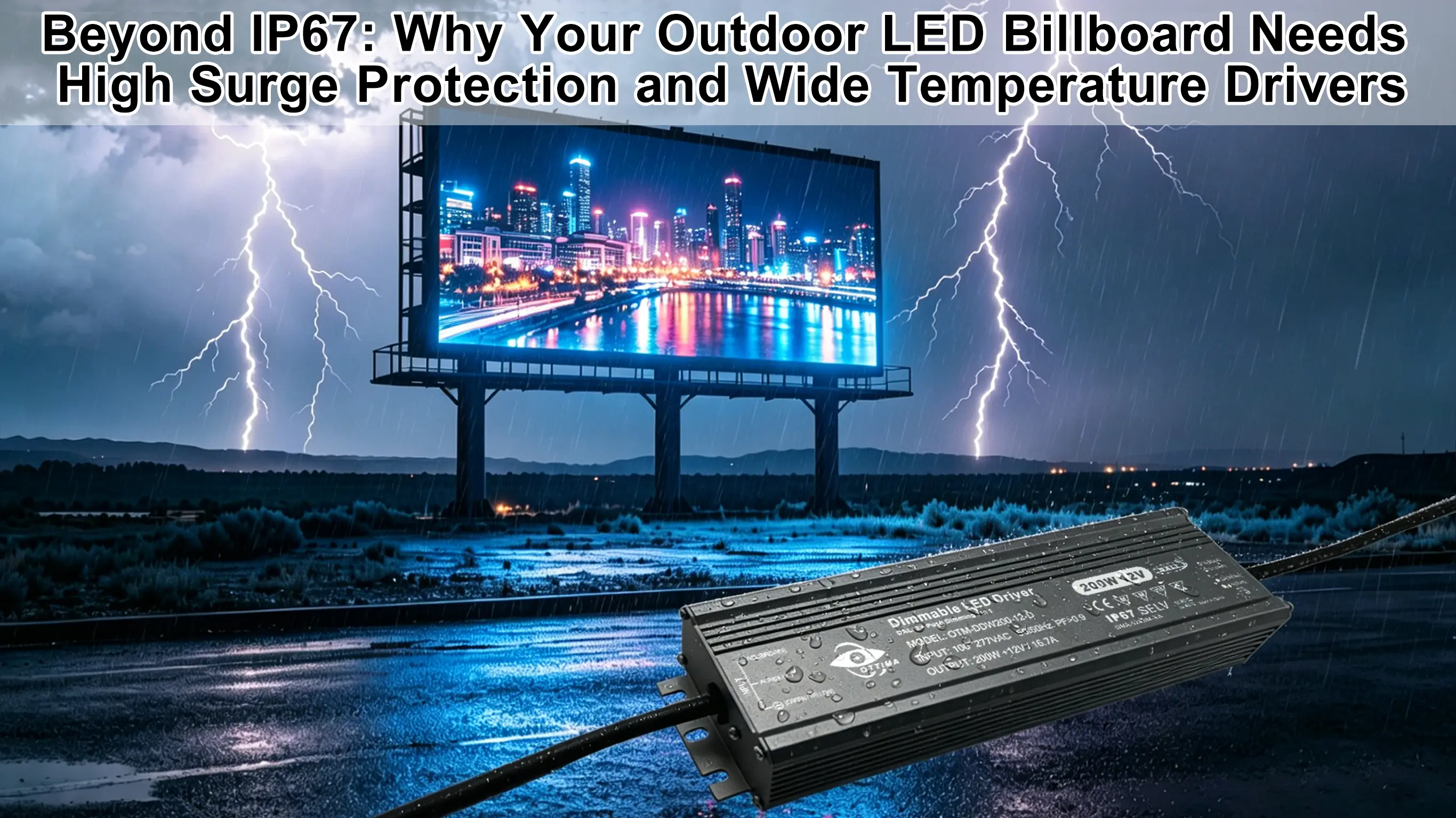
After a thunderstorm, one-third of the modules on your city-center LED billboard have gone dark.
Your maintenance team arrives, opens the sealed driver enclosure, and finds no water inside—after all, it's IP67-rated. Yet, the driver is completely burned out.
Why?
For outdoor billboard manufacturers, municipal contractors, and landscape lighting specialists, this is an expensive lesson: IP67 waterproofing is merely the "entry ticket" for an outdoor LED driver, not a "guarantee of reliability."
In the harsh outdoor environment, the real killers aren't rainwater, but two threats hidden beneath the waterproof shell: power surges and extreme temperatures. This article will provide a deep dive into why focusing on these two factors, rather than just IP67, will significantly lower your Total Cost of Ownership (TCO).
Myth 1: Does IP67/IP68 = Peace of Mind?
The IP (Ingress Protection) rating only represents the enclosure's ability to protect against solids and liquids. IP67 means "completely dust-tight" and "can be temporarily immersed in water."
This is, of course, necessary. But it fails to solve three core problems:
1. It Doesn't Stop Surges: Grid fluctuations or nearby lightning strikes can create instantaneous voltage spikes of several thousand volts (KV), directly puncturing the internal electronic components.
2. It Doesn't Stop "Internal Seepage": If a cheap driver's sealing process is poor, prolonged exposure to sun, rain, and thermal expansion (hot/cold cycles) can still cause the seals to fail, allowing moisture to slowly creep in.
3. It Hinders Heat Dissipation: A sealed enclosure means internal components (especially electrolytic capacitors) will accumulate heat during summer exposure, like a "pressure cooker," accelerating their aging.
Relying on IP67 is like wearing a raincoat in a minefield. You're protected from the rain, but not from the real danger.
The Real Killer (1): Power Surges — The "One-Time" Catastrophe
Outdoor LED drivers are connected to the vast AC power grid, which is constantly under threat.
Threat Sources: Lightning strikes (doesn't have to be a direct hit; nearby induced lightning creates massive surges), the start-up/shutdown of nearby heavy equipment (like HVAC or elevators), and grid maintenance switching.
What is Surge Protection (KV): It measures how high an instantaneous voltage spike the driver can "withstand" without damage. This is split into "differential mode" (Line-to-Neutral) and "common mode" (Line/Neutral-to-Ground).
The Industry Pain Point: Many cheap drivers that only boast about IP67 may have surge protection as low as 2KV. An outdoor induced lightning surge can easily reach 4KV to 6KV.
The result: After one thunderstorm, a small grid fluctuation causes a mass "die-off" of your billboards.
Professional Solution: Make "Surge Protection" a Core Metric
For outdoor applications, especially billboards installed in high or open areas, we must demand:
Standard Configuration: At least 4KV (differential) / 6KV (common mode) surge protection.
High-Risk Areas (frequent thunderstorms, highways): Must select drivers with 10KV surge protection capability.
This small increase in cost is negligible compared to the thousands of dollars in maintenance fees for dispatching an engineering team (including labor, vehicles, traffic control, and downtime).
The Real Killer (2): Extreme Temperatures — The "Chronic" Culprit
If a surge is a "sudden death," extreme temperature is a "chronic illness."
The most fragile component in an LED driver, and the one that most impacts its lifespan, is the electrolytic capacitor. Its life follows the "10-Degree Rule": for every 10°C rise in operating temperature, its lifespan is cut in half.
1. The Summer "Baking" Mode
Ambient Temp: 38°C (100°F) on a summer day.
Sealed Box: Your driver is in a black, unventilated metal box, under direct sunlight.
Internal Temp: The temperature inside the box easily soars to 60℃ (140℉).
Driver's Own Heat: The driver itself (e.g., at 90% efficiency) converts the other 10% of energy into heat.
Final Result: Your electrolytic capacitor is operating at a "hellish temperature" of 80℃(176℉) or higher.
If your driver uses cheap, 85℃-rated capacitors, its theoretical lifespan will plummet from tens of thousands of hours to just a few thousand. It might not even survive one summer.
2. The Winter "Cold Start" Challenge
In northern regions, winter temperatures of -20℃(-4°F) or even -40℃present another challenge. Cheap components may "fail to start" at extreme low temperatures, or their parameters may drift significantly, causing lights to flicker or fail to turn on.
Professional Solution: Focus on "Wide Operating Temp" and "Quality Components"
1. Operating Temp Range: Ensure the driver's operating temperature range is wide enough, e.g., -40℃to +85℃ (Case Temperature). This signifies the manufacturer has designed for extreme conditions.
2. Core Components: Ask your supplier if the driver uses 105℃long-life electrolytic capacitors (e.g., Japanese brands). This seemingly small detail is the key to whether the driver will outlive its 3 or 5-year warranty.
Let's Do the Math: Why TCO (Total Cost of Ownership) Matters More Than Price
Let's do a simple TCO calculation for a project with 100 outdoor drivers under a 5-year warranty:
Comparison | Plan A: Cheap Driver | Plan B: Professional Outdoor Driver |
Specs | IP67, 2KV Surge, 85°C Capacitors | IP67, 10KV Surge, -40~85°C Op., 105°C Capacitors |
Unit Price | $100 | $130 (+30%) |
Total Purchase Cost | $10,000 | $13,000 |
5-Yr Est. Failure Rate | 15% (3%/yr, storms + heat) | < 2% (Sufficient design margin) |
Est. Failure Count | 15 units | 2 units |
Single Maint. Cost | $1,500 | $1,500 |
(Labor + Truck + Downtime) | ||
5-Yr Total Maint. Cost | 15 x $1,500 = $22,500 | 2 x $1,500 = $3,000 |
5-Year Total Cost (TCO) | $10,000 + $22,500 = $32,500 | $13,000 + $3,000 = $16,000 |
Procurement Decision: How to Choose a Professional Outdoor LED Driver
On your next outdoor project bid or purchase order, don't just ask, "Is it IP67?" You need a professional partner who understands and solves the TCO problem.
Your Professional Procurement Checklist:
1. IP Rating: Is the IP67 or IP68 rating from an accredited lab? (This is the baseline.)
2. Surge Protection: What are the Common Mode and Differential Mode surge ratings in KV? (Demand at least 6KV; 10KV for high-risk areas.)
3. Operating Temperature: What is the rated ambient operating temp range? (Demand at least -40°C.)
4. Core Components: Does it use 105°C or 85°C rated electrolytic capacitors?
5. Warranty: How many years is the warranty, and do the terms cover surge-related damage?
Pay for Reliability, Not for Repairs
For wholesale procurement of outdoor LED drivers, the decision criteria must shift from "price-sensitive" to "reliability-first."
IP67 only solves the basic problem of "survival." High surge protection and wide temperature design are what determine "how long it survives." Choosing a robust driver built with quality components and proven in harsh environments is an investment in your operational profits and brand reputation for the next 5 years.
Is your outdoor project still plagued by high maintenance costs?
Contact our technical experts for an "Environmental Risk & Driver Selection Assessment" tailored to your project's location. We help you design reliability from the ground up and end the cycle of buying drivers that are just "waterproof," but not "bulletproof." This is a strong concluding section. However, the table ends abruptly, and the transition to this section is a bit sharp.


