
How to Correctly Select DALI/0-10V Dimmable LED Drivers for Large Projects
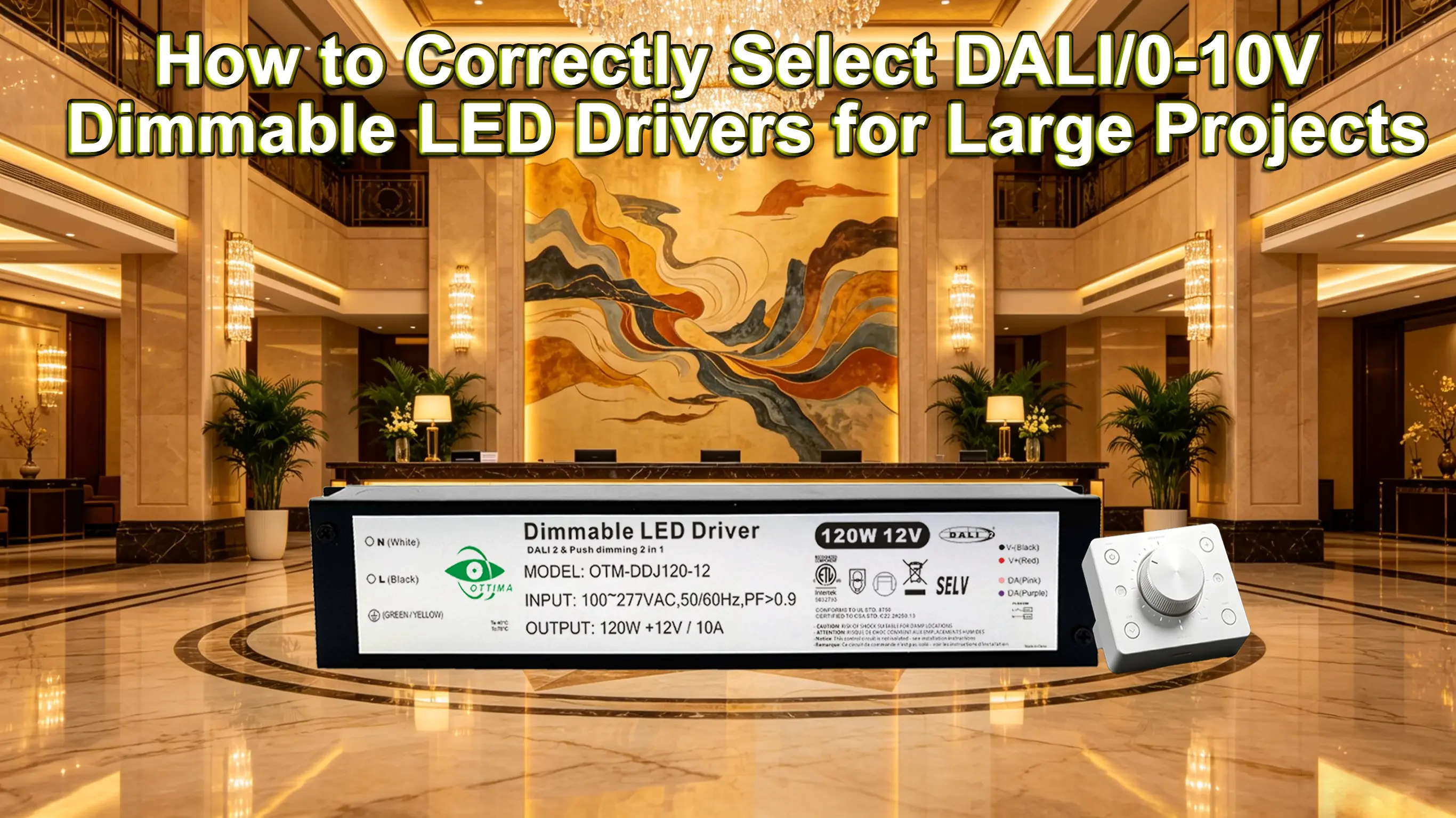
Imagine this: you're about to hand over a high-end hotel ballroom project. As the lights dim slowly, instead of an elegant ambiance, you see a visible flicker; on the other side of the room, no matter how you commission the system, a few lights refuse to sync with the control panel, or worse, won't turn off completely.
This isn't a luminaire problem, and it isn't the dimmer's fault. This is the "dimmable driver compatibility" nightmare.
For electrical contractors, lighting designers, and system integrators, the stability of a dimming system is the project's lifeline. A single cheap or poorly selected dimmable LED driver is all it takes to ruin the entire lighting effect, leading to endless rework and client complaints.
As a professional supplier specializing in LED driver solutions, we've found that 90% of dimming failures stem from ignoring two core issues during the planning phase: dimming method (flicker) and signal compatibility.
This article provides a deep dive into these two challenges and gives you a clear procurement checklist to ensure your next large-scale project is a perfect success.
Challenge 1: Flicker - The "Invisible" Killer and Low-Quality Dimming
Flicker, especially during deep dimming (e.g., <20% brightness), is the number one enemy of commercial lighting. It not only causes eye strain and headaches but also produces obvious (and highly unprofessional) banding during video conferences or when filming with a smartphone.
Why Does Flicker Happen? The Root is in the Dimming Technology
Many entry-level drivers use simple PWM (Pulse Width Modulation) dimming to save costs.
How PWM Works: Imagine flicking a light switch on and off very quickly. In one second, if the light is "on" 80% of the time and "off" 20% of the time, the human eye is tricked into seeing 80% brightness.
The Problem: When you need 10% brightness, the driver keeps the light "on" for 10% of the time and "off" for 90%. If this switching frequency (PWM frequency) isn't high enough (e.g., below 1000Hz), the human eye and cameras can capture these "off" gaps, resulting in flicker.
The Professional Solution: Choose "Flicker-Free" Technology
For professional commercial projects, you must look for the following technologies when selecting a dimmable LED driver:
1. CCR (Constant Current Reduction) / Analog Dimming: This is the ideal dimming method. It doesn't dim by "switching" but by genuinely reducing the electrical current flowing through the LED chip. As the current decreases, the brightness smoothly decreases, eliminating flicker at the source.
2. Hybrid Dimming: This is the hallmark of a high-end driver. It combines the advantages ofboth methods:
From 100%-25% brightness, it uses CCR (Analog Dimming) for smooth control.
In the 25%-1% deep dimming range, it switches to an imperceptible ultra-high-frequency PWM (typically >3KHz) to ensure dimming accuracy and color consistency.
3. High-Frequency PWM Output: If you must use a PWM driver, ensure its datasheet explicitly states "Flicker-Free" or "High-Frequency Dimming (>3KHz)" and complies with industry standards like IEEE 1789.
Challenge 2: The Compatibility Nightmare - DALI & 0-10V "Mismatches"
"I bought a 0-10V driver and a 0-10V dimmer. Why aren't they compatible?" This is a frequent question. Signal compatibility is far more complex than just matching the connectors.
1. 0-10V Dimming: The Classic Analog Puzzle
0-10V (or 1-10V) is an analog signal. It seems simple, but the devil is in the details.
Core Pain Point A: The "Sink" vs. "Source" Mismatch
How it Works: The dimmable LED driver has a "SINK" circuit, which actively draws a tiny signal current (typically 0.1-2mA) from the dimmer. The dimmer (controller) is responsible for "SOURCE-ing" this current.
The Nightmare Scenario: A controller's "source" limit might be 10mA. If you parallel 60 drivers on one circuit, each with a 0.2mA "sink" (total demand: 12mA), you will overload the controller.
The Result: Some drivers become unresponsive, the dimming curve is chaotic, and the controller burns out.
Core Pain Point B: The "Dim-to-Off" Failure
0-10V vs. 1-10V: A 1-10V signal can only dim down to 1V (about 10% brightness). It requires a separate relay or switch to cut the AC power and turn the light "off."
0-10V: Theoretically, the signal going to 0V can turn the light off, but this depends entirely on whether the driver has a "Dim-to-Off" feature built-in.
The Nightmare Scenario: You turn the dimmer all the way down, expecting the light to go off, but it stays on at a 10% glow. This is because the driver doesn't support Dim-to-Off, and you missed that critical relay.
2. DALI Dimming: The Digital Protocol Trap
DALI (Digital Addressable Lighting Interface) is the top choice for large commercial projects, allowing you to individually address and control every single light. But "digital" also means more complex protocols.
Core Pain Point A: Mixing DALI-1 vs. DALI-2
DALI-1: An older standard. "Interoperability" between different manufacturers was more of a "gentleman's agreement" and often failed.
DALI-2: The current, mandatory certification standard. DALI-2 devices must pass rigorous testing to ensure 100% compatibility.
The Nightmare Scenario: Using a DALI-2 controller but mixing in DALI-1 and uncertified "DALI-compatible" drivers. This leads to frequent system dropouts, addressing failures, and lost functionality (like color temperature control).
Core Pain Point B: DT6 vs. DT8 - Are You Using DALI Efficiently?
DT6 (Device Type 6): A standard dimming driver. If you want to control tunable white (e.g., 2700K to 6500K), you need two DALI addresses (one for intensity, one for color temp).
DT8 (Device Type 8): A tunable white driver. It's more advanced, using only one DALI address to control both intensity and color. This is critical for saving address space on the DALI bus (which is limited to 64 addresses).
The Nightmare Scenario: Your project requires smart color tuning, but you procured DT6 drivers. This not only doubles your addressing needs but may prevent your smart control panel from executing its pre-programmed "circadian rhythm" scenes.
B2B Procurement: How to Choose a Professional Dimmable Driver & Supplier
In large projects, driver selection shouldn't be an afterthought; it must be part of the initial plan. A professional supplier doesn't just sell you a product; they provide a "system compatibility solution."
Your Professional Selection Checklist
Before your next bulk purchase of dimmable LED drivers, confirm the following with your supplier:
Regarding Flicker:
1. Is this driver PWM, CCR, or Hybrid dimming?
2. If PWM, what is the output frequency? (Demand >3KHz)
3. Can you provide a "Flicker-Free" test report compliant with IEEE 1789?
Regarding 0-10V Compatibility:
4. What is the driver's "Sink Current" in milliamps (mA)? (Used to calculate circuit load)
5. Is the dimming curve linear or logarithmic? (Must match the controller)
6. Does it support "Dim-to-Off"? Or must I add an external relay?
Regarding DALI Compatibility:
7. Is this driver officially DALI-2 certified? (Ask for the certification, not just "compatible")
8. For tunable white, is it DT6 or DT8?
9. Can the supplier provide a compatibility test list with major DALI systems (e.g., Lutron, Crestron, Helvar)?
The Most Expensive Driver is the One That Fails
Flicker and compatibility issues are the most expensive costs in any large lighting project. They don't just cost materials; they cost valuable labor, time, and your professional reputation.
When selecting LED drivers, especially for wholesale procurement, don't just look at the price and basic specs. You need a partner who understands your project's requirements—a solutions expert who can join you in the design phase to help you avoid every one of these "traps."
Ready to de-risk your next large project?
Before you place your order, contact our technical team. We are happy to provide a free dimming system compatibility assessment for your project to ensure the drivers you select are a 100% match for your control system.


