
The Foundry's Ticking Time Bomb: Why Ta=50°C High Bay Lights Can't Survive Their First Summer
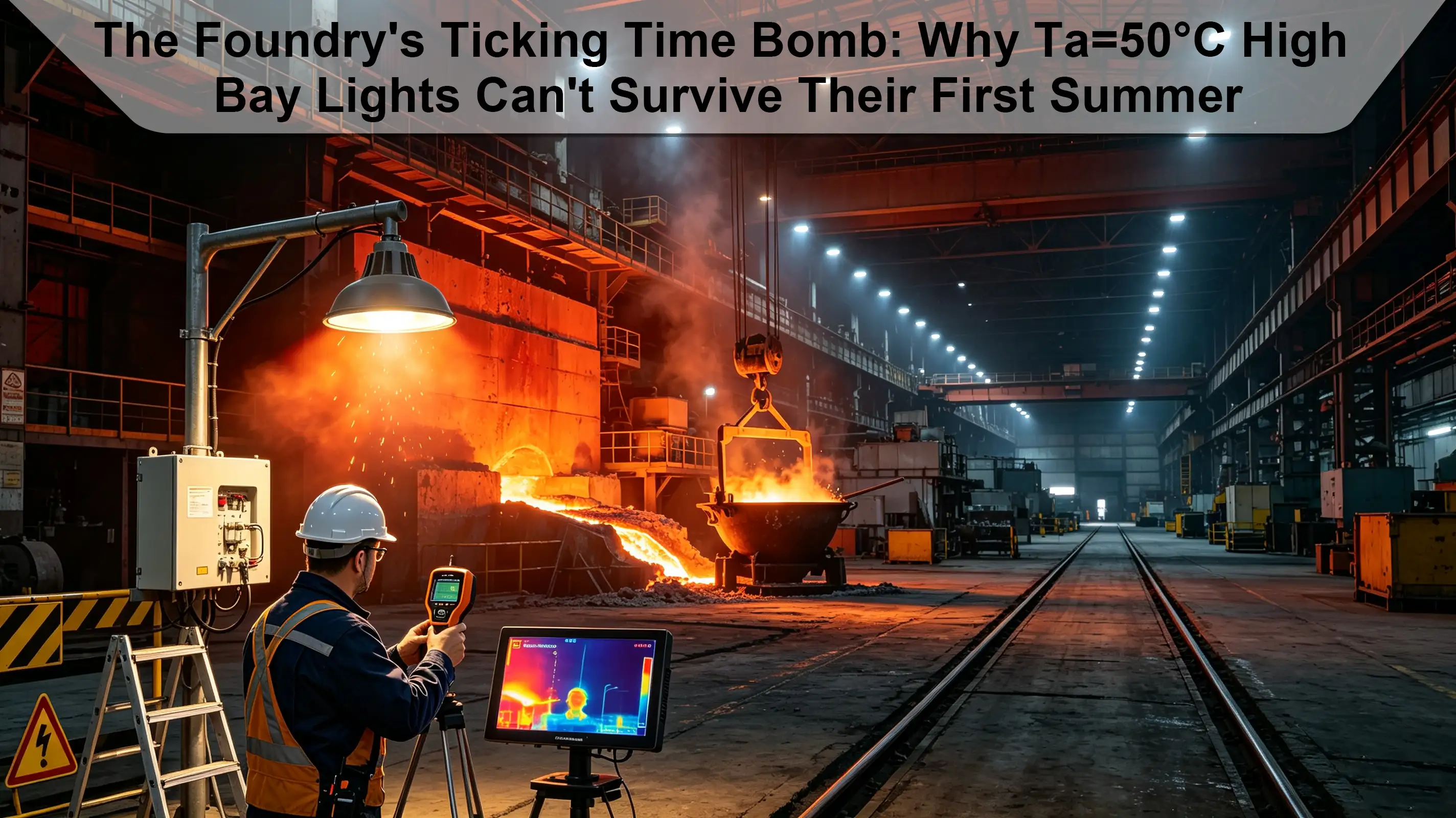
If you manage facilities for a steel mill, a glass manufacturing plant, or a logistics hub in the Middle East, you already know the nightmare. You install a brand-new batch of 200W LED High Bay lights. The spec sheet proudly claims: Max Ambient Temperature (Ta) = 50°C (122°F). Everything works perfectly during the winter. But when July arrives, the lights start dropping like flies. Some flicker uncontrollably; others dim to 30% of their brightness, creating severe safety hazards on the factory floor; and many simply go dark permanently.
You call the supplier, and they blame your power grid. But the truth lies in a fundamental engineering deception: A standard Ta=50°C rating is a laboratory illusion that fundamentally ignores the thermodynamics of heavy industrial environments.
Here is the unvarnished engineering truth about why standard LED drivers melt down in extreme environments, and why you must rethink your sourcing strategy.
1. The Altitude Trap: The Floor is 40°C, but the Roof is 65°C
The first mistake most EPC contractors make is measuring the temperature at eye level. Heat rises. In a heavy industrial facility (like die-casting or smelting) or a non-air-conditioned warehouse in Dubai, the ambient temperature at the ground level might be a manageable 40°C.
However, at 15 meters (50 feet) high, right where your High Bay fixtures are mounted near the uninsulated metal roof, the trapped heat creates a microclimate. The actual ambient temperature (Ta) up there easily exceeds 60°C to 65°C. You are already pushing the driver 15 degrees past its absolute maximum design limit before the light is even turned on.
2. The "Ta" vs. "Tc" Deception
When a budget LED driver manufacturer claims "Ta=50°C," they test the bare driver in an open-air, temperature-controlled chamber. But in the real world, the driver is bolted inside a sealed, die-cast aluminum High Bay housing.
When the LED chips generate heat, that heat radiates upward, baking the driver from below.
Ta (Ambient Temperature) is the air around the fixture.
Tc (Case Temperature) is the hottest point on the driver's outer shell.
In a 50°C environment, a standard driver operating at full load will easily reach a Tc of 85°C to 90°C. If the driver is not engineered with aerospace-grade thermal potting compound (designed to rapidly transfer heat away from internal components) and premium 105°C-rated electrolytic capacitors, the internal electrolyte literally boils and vaporizes. The driver dies of thermal exhaustion.
3. The "Thermal Derating" Illusion: You Aren't Getting the Light You Paid For
To prevent their budget drivers from catching fire, many manufacturers sneak an aggressive Thermal Derating (NTC protection) curve into the firmware.
Here is how the deception works:
When the driver senses the internal temperature getting too high (which happens daily in a Middle Eastern summer), it automatically slashes the output current to reduce heat. Your 200W high bay is suddenly operating at 100W.
Yes, the driver "survives," but the factory floor is plunged into semi-darkness. Forklift drivers can't see properly, quality control inspections fail, and accident rates spike. You paid for 30,000 lumens, but you are only getting 15,000. In heavy industry, a light that secretly dims itself is just as dangerous as a light that burns out.
4. The TCO Disaster: Changing a Light in a Steel Mill
In an office building, changing a lightbulb takes a ladder and 10 minutes. In a heavy industrial plant, replacing a burnt-out High Bay is a logistical nightmare:
1. You must halt the production line.
2. You must lock out overhead heavy cranes.
3. You must hire specialized high-altitude rigging crews.
The cost to replace a single failed driver can easily exceed $1,000 in labor and lost production time. Saving $20 by specifying a standard Ta=50°C driver is the most expensive mistake a procurement officer can make.
The Solution: Sourcing True High-Temp LED Drivers
If you are equipping a heavy industrial facility, you cannot rely on commercial-grade components. You must specify LED drivers engineered for Ta=65°C or Ta=70°C, with a verified Tc point of 90°C+.
Look for drivers that utilize high-thermal-conductivity potting silicone (≥1.5 W/m·K) and robust topologies that maintain ≥94% efficiency (because less wasted energy means less internal heat).
Don't let the spec sheet illusion blind you. In the crucible of heavy industry, only genuine thermal engineering survives.


