
Sourcing LED Drivers: Why the Cheapest BOM Cost is a Trap for Importers
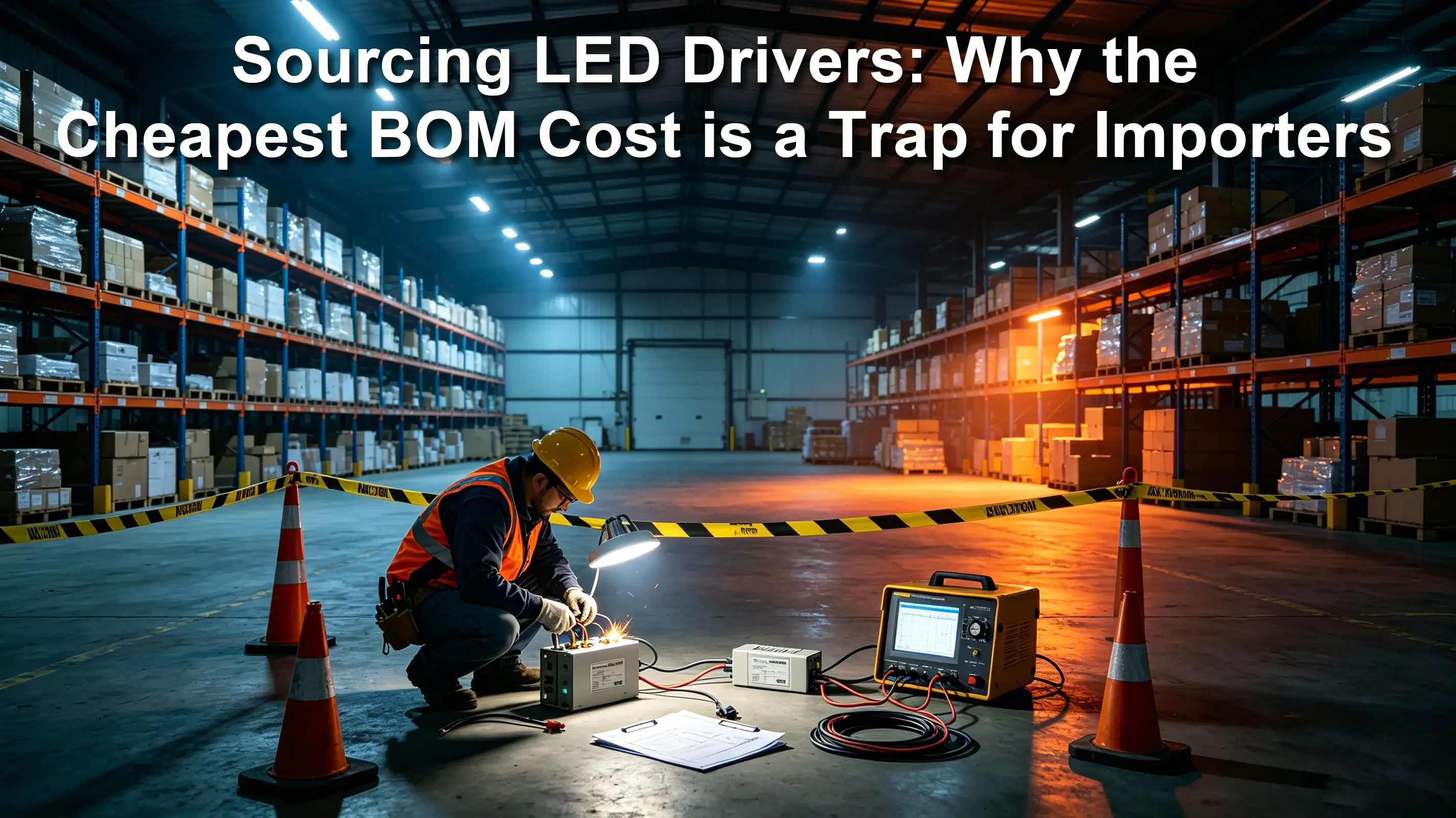
If you've been in the lighting procurement business for more than a year, you’ve almost certainly experienced this scenario:
You're sourcing LED drivers for a major upcoming commercial lighting project. You receive two quotes from different overseas manufacturers. The spec sheets look virtually identical—same wattage, same output voltage, same IP rating. Yet, Supplier B's quote is a tempting 15% to 20% lower.
The immediate temptation is to lock in Supplier B, report the BOM (Bill of Materials) savings to your boss, and pad your profit margins.
But here is the harsh reality that veteran lighting importers know all too well: The cheapest LED driver on paper is often the most expensive one in the field. When you base your overseas sourcing strategy purely on initial BOM cost, you aren’t saving money—you are simply deferring the cost, with interest, to your future self. Let's break down why focusing solely on the FOB price is a dangerous trap, and what hidden "monsters" lurk behind those suspiciously low quotes.
1. The $10 Part That Costs $150 to Replace
This is the number one blind spot for many buyers. In the manufacturing hubs of Asia, a replacement driver might only cost a few dollars. But where are your fixtures actually being installed?
If you are supplying high-bay lights for a warehouse in Texas, or streetlights for a municipality in Germany, a driver failure is a logistical nightmare.
The Labor Reality: You aren't just paying for a new driver. You are paying a local licensed electrician $100 to $150 an hour.
The Equipment: You might need to rent a bucket truck or a scissor lift to reach the fixture.
The Disruption: You are halting your client's operations.
When a cheap driver fails prematurely, a component that saved you $3 at the sourcing stage will easily cost you $200+ in local field replacement costs, not to mention the international shipping fees for RMA (Return Merchandise Authorization) parts. You wipe out the BOM savings of 100 fixtures with just one field failure.
2. The Spec-Sheet Mirage: What's Inside the Black Box?
How do lower-priced manufacturers achieve those rock-bottom prices? They don't have a magical manufacturing process; they simply compromise on the internal components. Since the driver is potted or sealed, you can't see what's inside.
Here is where the corners are typically cut:
Electrolytic Capacitors: This is the lifeblood of the driver. A premium manufacturer uses top-tier capacitors (like Rubycon or Nippon Chemi-Con) rated for 10,000 hours at 105°C. A budget supplier will use generic capacitors rated for maybe 2,000 hours at 85°C. The moment these dry out, the light dies.
Stripped EMI/EMC Filters: To save pennies, some suppliers will remove essential filtering components like X/Y capacitors or common-mode chokes. Your driver might turn the LEDs on, but it will also blast electromagnetic interference back into the grid, failing CE or FCC compliance checks at local customs or on-site inspections.
Weak Surge Protection: If the spec sheet says "4KV Surge Protection," but the internal MOV (Metal Oxide Varistor) is undersized, the first summer thunderstorm will wipe out an entire parking lot of your lights.
3. The Hidden "Energy Tax" (Efficiency Matters)
When sourcing, buyers often focus on watts and amps but overlook conversion efficiency.
Let’s say you are supplying 1,000 pieces of 150W LED high bays for an industrial client.
Premium Driver: 93% efficiency.
Budget Driver: 88% efficiency.
That 5% difference means the budget driver is drawing more AC power from the wall to deliver the same DC power to the LEDs. Over a year of running 12 hours a day, those 1,000 "cheap" drivers will consume tens of thousands of extra kilowatt-hours.
With energy prices skyrocketing across Europe and North America, facility managers are watching their utility bills like hawks. If your fixtures don't deliver the promised energy savings because of an inefficient driver, your brand's reputation takes the hit.
4. Flicker and the "Sick Building" Syndrome
To cut costs, budget drivers often use a single-stage circuit topology with minimal output filtering. The result? A light that looks fine to the naked eye but possesses severe invisible flicker.
In the EU and the US, regulations regarding flicker (like IEEE 1789 or Ecodesign directives) are becoming strictly enforced. If your client installs these lights in an office or a retail space, employees will start complaining of eye strain and headaches, and smartphone cameras will capture terrible banding effects when customers try to take photos.
You aren't just buying a power supply; you are buying the quality of light. A cheap driver destroys the end-user's optical experience.
The Shift: From BOM Cost to TCO (Total Cost of Ownership)
Smart importers and procurement directors don't buy LED drivers; they buy reliability insurance. They evaluate suppliers based on TCO (Total Cost of Ownership), which includes:
1. Initial FOB Cost (The BOM)
2. RMA & Freight Costs (Shipping replacements cross-border)
3. Local Maintenance Liability (Electrician labor & equipment)
4. Brand Equity (Customer trust and repeat business)
The next time a supplier hands you a quote that seems too good to be true, ask them for their internal component list. Ask them about their capacitor brands. Ask them for real, verifiable UL/ENEC certification reports.
In the global lighting business, the cheapest driver on day one is almost guaranteed to be the most expensive driver by year three. Source wisely.


