
Why Must the Ripple Coefficient of Stadium Lighting Drivers Be Lower Than 1%?
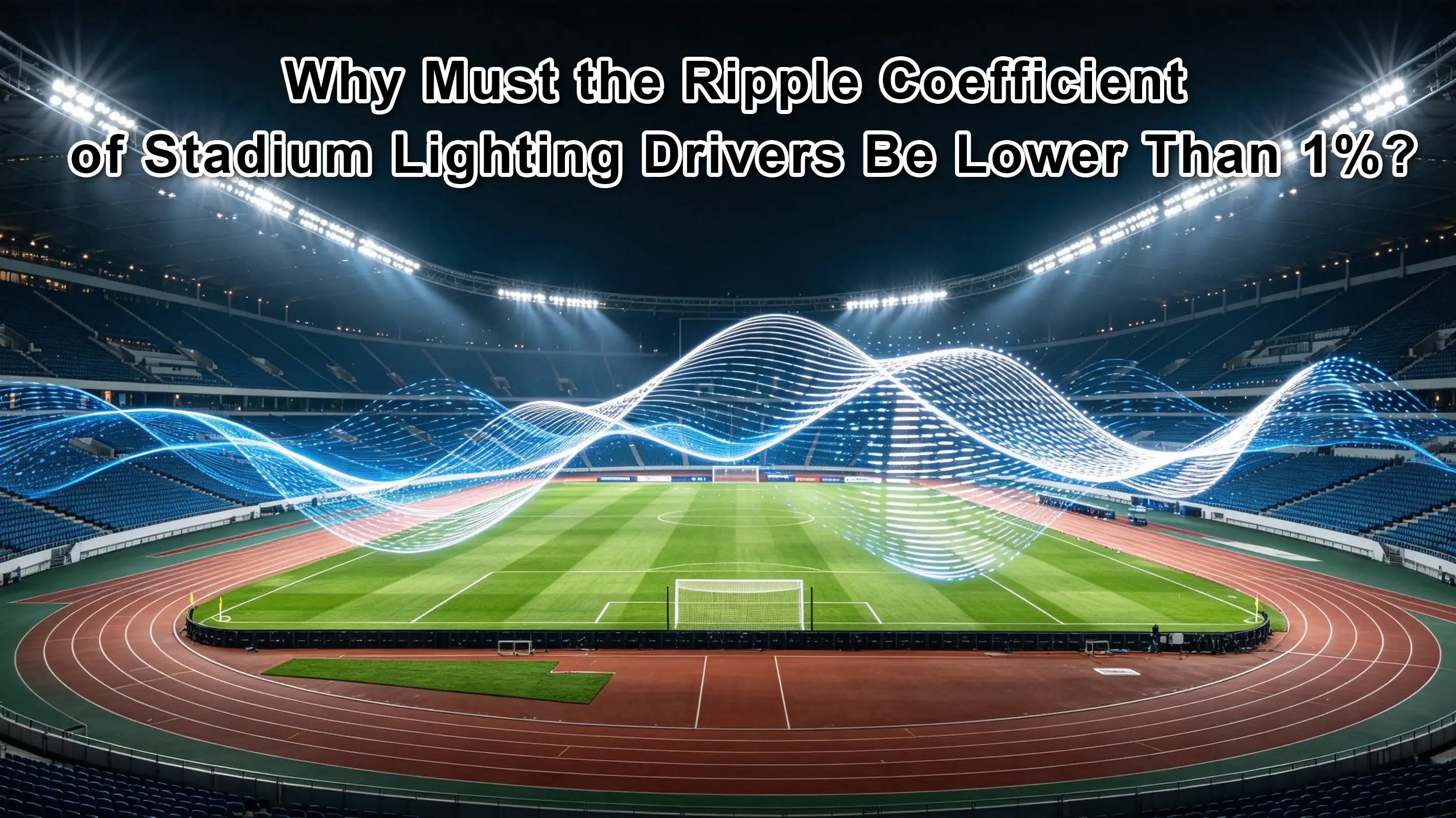
Born for 4K Super Slow Motion: Why Must the Ripple Coefficient of Stadium Lighting Drivers Be Lower Than 1%?
In the extra time of the World Cup final, a stunning volley hits the back of the net.
Hundreds of millions of viewers worldwide hold their breath, waiting for the Super Slow Motion Replay. However, as the broadcast switches to the 1,000fps slow-motion feed, the screen begins to show dizzying strobing bars or color shifting, turning a magnificent moment into a visual disaster.
This is not just a broadcasting accident; it is a nightmare for stadium owners—it means the venue may be disqualified from hosting top-tier events.
The culprit is not the camera, nor the efficacy of the LED fixture, but a parameter hidden deep within the driver: Output Ripple Current Ratio.
This article provides a deep dive, from a broadcast-grade perspective, into why "Ripple < 1%" is a non-negotiable red line for top-tier sports lighting, and how TLCI determines broadcast image quality.
I. Why Do Cameras "Go Blind" When Human Eyes Don't?
The human eye has a strong persistence of vision; as long as light fluctuates faster than 100Hz, we perceive it as constant.
But modern sports broadcasting uses High-Speed Cameras with frame rates of 500fps or even 1,000fps (taking 1,000 photos per second).
1. The Physics of the "Stroboscopic Effect"
If the LED driver output carries a 100Hz (or 120Hz) ripple from the AC mains:
Human Eye: Cannot detect it.
1,000fps Camera: Has an extremely fast shutter speed (e.g., 1/2000s). Within one second, it takes 1,000 shots. Some shots capture the "peak" of the light wave (bright), and some capture the "valley" (dim).
Result: When played back, the footage shows periodic flickering or the infamous "Rolling Shutter Artifact"—black bars scrolling across the screen.
2. The Life-or-Death Line of Ripple Current
To eliminate this, the driver's output current must be extremely smooth, approaching Pure DC.
Standard Commercial Driver: Ripple ≈ 5% - 10%. Fine for offices, unusable for TV.
Standard Sports Driver: Ripple < 3%. Meets HD broadcasting, but risky for super slow motion.
Broadcast-Grade Driver: Ripple < 1%. This is a mandatory requirement by UEFA and FIFA for Elite Level A stadiums. Only at this level is the light constant on a microsecond scale.
II. TLCI: The "Color Rendering Index" for Cameras
Many contractors focus only on CRI (Ra), but in TV broadcasting, CRI is obsolete. Camera sensors (CMOS/CCD) have completely different spectral sensitivities than the human eye.
TLCI (Television Lighting Consistency Index) is a standard by the European Broadcasting Union (EBU) specifically to evaluate color rendering on television screens.
Driver Impact: While the spectrum is mainly determined by the LED phosphor, the driver's dimming method affects TLCI.
PWM Defects: Low-frequency PWM dimming causes spectral discontinuity for cameras, leading to color shifts (e.g., grass looking yellow, team jerseys looking off-color).
Solution: Stadium lighting must use CCR (Constant Current Reduction) or High-Frequency PWM (>30kHz) to ensure TLCI scores remain stable at 90+ across all brightness levels.
III. Tech Decode: How to Achieve "< 1% Ripple"?
To suppress ripple below 1% for 1,000W+ drivers, low-cost Single-Stage circuits cannot compete.
1. Two-Stage Topology
Drivers must use an independent PFC Stage + DC/DC Stage architecture.
Stage 1 (PFC): Corrects power factor and converts AC to high-voltage DC (ripple is still high here).
Stage 2 (DC/DC): An independent voltage/current regulation circuit that "shaves off" the ripple from the first stage through high-frequency switching and deep filtering.
2. Massive Output Capacitor Matrix
To fill the "valleys" of the wave, the output stage requires a large bank of capacitors. This increases cost and challenges the physical size design of the driver.
B2B Value: While expensive, this design ensures your fixtures perform perfectly under 4K/8K cameras, serving as your entry ticket to orders for the Olympics, World Cup, or NBA arenas.
IV. Selection Guide: Don't Be Fooled by "Flicker-Free"
Many drivers on the market claim to be "No Flicker," but for stadium lighting, you must demand deeper data:
1. Demand the "Ripple Current Test Report": Don't just read the text; look at the oscilloscope waveform. Confirm that the Ripple Current Ratio is consistently below 1% at both full load and dimmed states.
2. Confirm "Flicker Exemption" Level: According to IEEE 1789, the product must fall into the "No Effect Area" (No Risk Zone) of the chart.
3. Check TLCI Data: Ensure that when paired with your LED chips, the TLCI score is ≥ 90 (0-100 scale, higher is better).
V. Conclusion: Every Frame Equals Value
In the sports industry, broadcasting rights are the core asset. Poor lighting directly devalues the commercial worth of the event.
As a venue owner or contractor, spending 20% more budget on Broadcast-Grade Drivers with <1% Ripple is actually protecting the venue's operational qualification and broadcasting revenue for the next 10 years.


