
Deep Dive into the 2025 New ErP Directive's Mandatory Requirements for LED Driver Standby Power & Efficiency
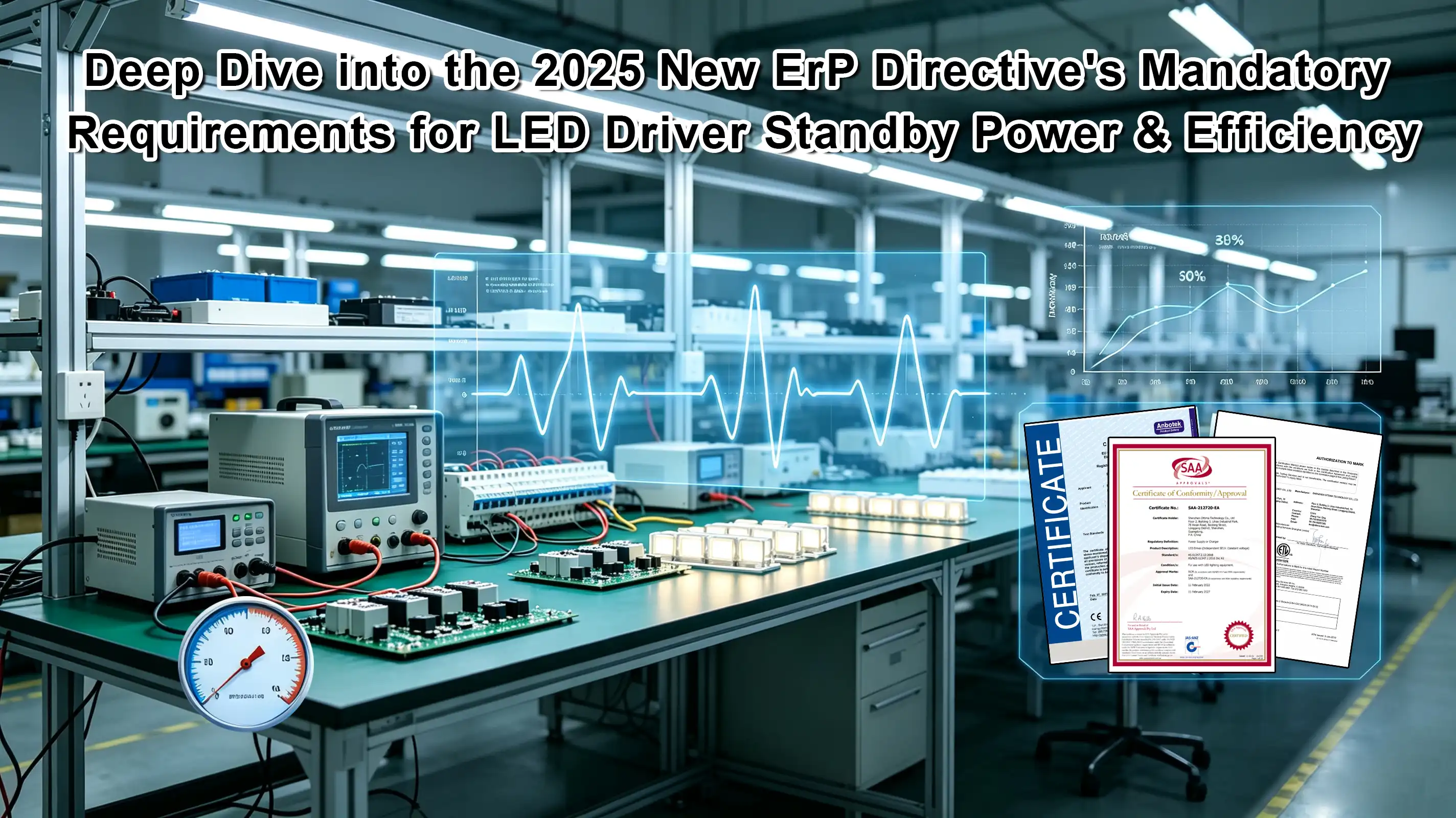
For global luminaire exporters, the EU market is a massive cake, but it is also a "high-voltage line" with the world's highest entry barriers.
Among them, the most daunting is the ErP (Energy-related Products) Eco-design Directive. Unlike CE-LVD (Safety) or CE-EMC (Electromagnetic Compatibility), ErP draws a red line directly on the "Performance Baseline" of the product.
With the full implementation of the Single Lighting Regulation (SLR) - (EU) 2019/2020 and its amendments, market surveillance in 2025 is entering "deep waters." Many manufacturers are finding that luminaires that could be exported smoothly a few years ago now face the risk of failing customs inspections or even forced recalls.
The core "roadblock" often lies in the LED driver: Excessive No-Load Power and Non-Compliant Flicker.
This article strips away the complex legal text and hits the three hard requirements of the new ErP regulations for LED drivers, helping you avoid pitfalls with precision.
Hard Requirement 1: No-Load & Standby Power — Must be < 0.5W
In the past, everyone focused on the efficiency of the driver "when working." But the new ErP rules say: You cannot steal electricity even when "resting."
The regulation imposes strict limits on the "idle state" of the driver:
1. No-load Power (Pno): When the driver is connected to power but not connected to an LED load, power consumption must be Pno ≤ 0.5W.
2. Standby Power (Psb): When the driver is connected to a load but the output is turned off via a control signal, consumption must be Psb ≤ 0.5W.
3. Networked Standby Power (Pnet): For smart drivers (e.g., DALI, Zigbee, Wi-Fi), a slight allowance is made, but it must still be Pnet ≤ 0.5W.
B2B Pain Point: Many cheap smart drivers consume up to 1.5W or even 2W in standby just to keep the Wi-Fi module online. This might have passed before, but under the new rules, it is absolutely non-compliant.
Solution: Procurement must verify that the driver uses a low-power standby chip design to ensure the Pnet measured value is compliant.
Hard Requirement 2: Flicker — The Life-or-Death Line of SVM ≤ 0.4
This used to be a "gray area" in the industry; now it is a stark red line. ErP no longer uses vague descriptions like "Flicker-Free," but introduces two quantified metrics:
1. Pst LM (Short-term Flicker): For visible low-frequency flicker (up to 80Hz). Limit: Pst LM ≤ 1.0.
2. SVM (Stroboscopic Visibility Measure): For flicker effects invisible to the eye but perceptible to the brain (80Hz - 2000Hz).
Old Standard: SVM ≤ 1.0.
New Red Line: SVM ≤ 0.4.
B2B Pain Point: Many older PWM dimming drivers typically have SVM values between 0.8 and 1.5. This means old dimmable stock may no longer be exportable to Europe.
Solution: You must upgrade to High-Frequency PWM or CCR (Analog Dimming) drivers and demand the latest integrating sphere flicker test reports.
Hard Requirement 3: Full Load Efficiency — Goodbye to "False Labeling"
The minimum energy efficiency for drivers under ErP is not a fixed value, but a calculation formula based on output power (Pout).
Minimum Efficiency= 0.81, if Pout>120W
Calculated by formula, if Pout≤120W
B2B Pain Point: Previously, many factories habitually inflated efficiency (labeled 90%, actual 85%). Now, EU Market Surveillance Authorities conduct "Audit Testing." If the measured value falls below the standard (considering a 5% tolerance), you face massive fines and recall risks.
Response Strategy: Survival Guide for Exporters
Facing the "Tightening Spell," instead of panicking, upgrade.
1. Build an "ErP Archive"
Don't wait until shipment. During the R&D phase, require driver suppliers to provide specific test reports for (EU) 2019/2020, covering Pno, Pst LM, SVM, and efficiency curves.
2. Monitor the EPREL Database
All light source products exported to the EU must be registered in EPREL (European Product Registry for Energy Labelling). Although the driver itself (Control Gear) does not need an energy label, driver data directly determines whether the whole fixture passes registration. Choosing a sub-par driver will drag down your luminaire's efficacy rating.
3. Choose "Eco-Design Ready" Drivers
We have fully upgraded our product architecture:
Standby King Series: Achieving Pno < 0.3W across the board, far better than regulations.
Zero Flicker Series: SVM < 0.01, not only compliant but meeting medical-grade healthy lighting standards.
Compliance is the Ultimate Competitiveness
The new ErP regulations are not just a challenge but an opportunity. They sweep low-quality, energy-hungry, high-flicker products out of the market, leaving a huge vacuum.
For quality-focused luminaire exporters, equipping a driver that fully complies with 2025 ErP standards is your strongest "passport" in the European market.
Can your drivers pass the EU Customs "Physical Exam"?
We offer a free ErP Pre-Test Service. Send us your driver samples, and we will use professional power meters and flicker meters to issue a detailed "ErP Compliance Diagnostic Report," helping you export worry-free.


