
Why High-End Hotel Renovations Prefer "Dim-to-Warm" Technology Over Standard Tunable White?
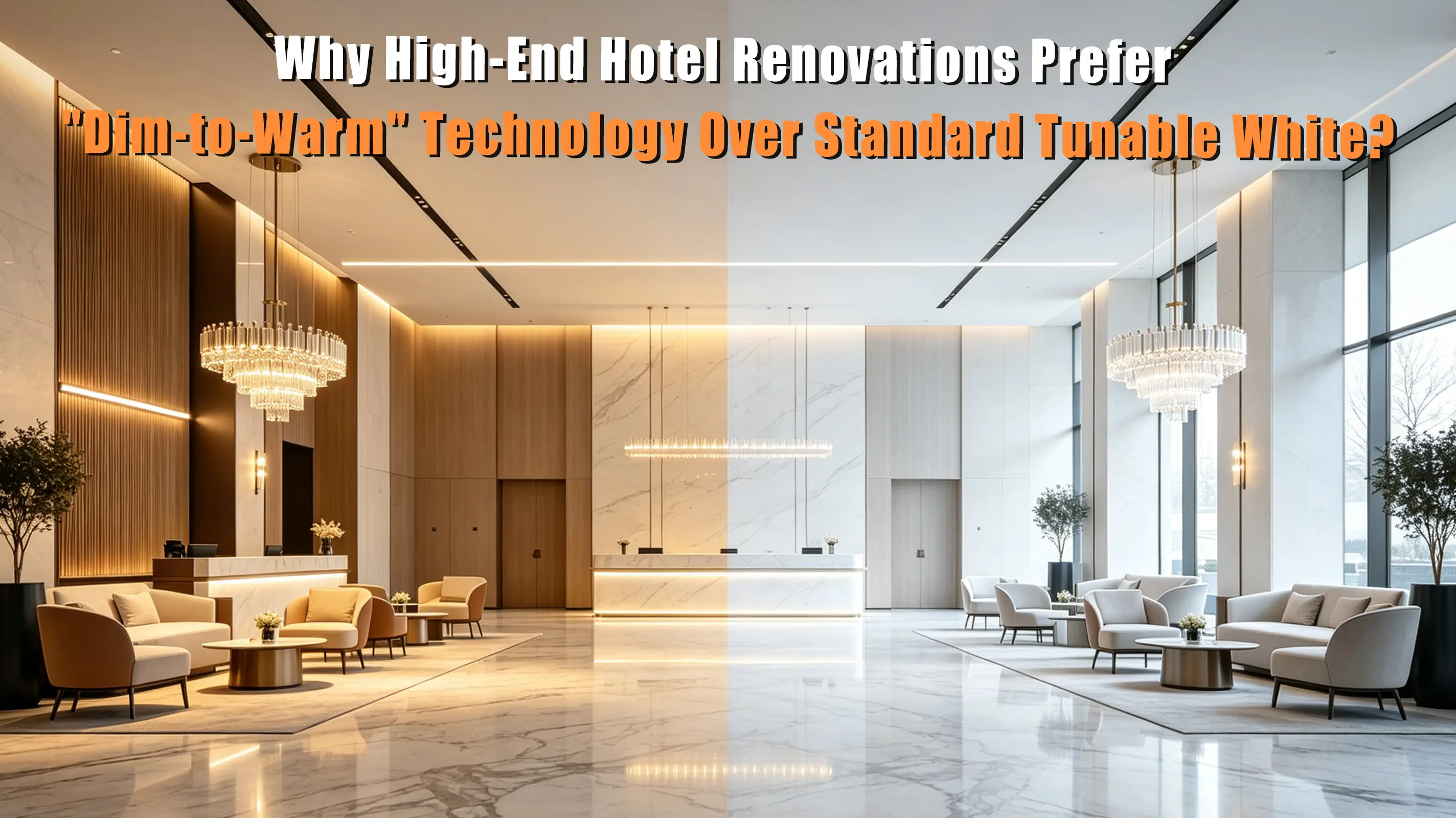
In the lighting design of five-star hotels, there is a golden rule: Light is not just for illumination; it is for mood regulation.
For decades, traditional Halogen and Incandescent bulbs were the darlings of luxury hospitality. The reason is simple: when you turn the dimmer knob to lower the brightness, the physics of the filament automatically warms the color temperature from a bright 2700K down to a candle-like 1800K. This "sunset-like" warmth is a physiological switch that relaxes guests and induces sleep.
However, first-generation LEDs destroyed this experience. Standard LED fixtures maintain a constant color temperature (e.g., always 3000K) when dimmed. At low brightness levels, this white light feels "grey," "cold," and "ghostly"—like a cloudy afternoon, lacking any sense of coziness.
To solve this, two technologies emerged: Tunable White and Dim-to-Warm.
Many engineers assume "Tunable White" is superior because it has more functions. But in actual hotel retrofit projects, Dim-to-Warm is winning by a landslide. This article analyzes the underlying technical logic, control costs, and user experience.
I. The Experience Gap: Rational "Tunable White" vs. Emotional "Dim-to-Warm"
First, we must clarify the fundamental difference between these concepts.
1. Tunable White — The Logic of "Two Sliders"
Principle: The fixture contains separate Cool White (6500K) and Warm White (2700K) LEDs. The user needs two independent control channels: one for brightness, one for color temperature.
Application: Offices, Classrooms, Hospitals. Its core value is "Circadian Rhythm"—cool light for focus in the morning, warm light for rest in the afternoon. It is functional, rational light.
The Hotel Dilemma: Guests don't want to study complex control panels. If a guest just wants to dim the lights to sleep but also has to manually adjust the color temperature, that is poor interaction design.
2. Dim-to-Warm — The Magic of "One Knob"
Principle: Mimics the Black Body Locus curve. Through special algorithms inside the driver, brightness and color temperature are deeply linked. At 100% brightness, it's 3000K; as brightness drops to 10%, the color smoothly transitions to 1800K (Golden Light).
Application: Hotel Guest Rooms, Restaurants, Bars, Spas. Its core value is "Atmosphere"—the dimmer, the warmer; the dimmer, the more relaxing.
Advantage: Single-Channel Control. Whether it's a rotary knob or a wall switch, the user performs one action—"Dim"—and the cozy atmosphere follows naturally. This perfectly replicates the physics of halogen.
II. The Retrofit Nightmare: The Massive Gamble on Wiring Costs
For new builds, wiring might not be an issue. But for Hotel Retrofit projects, "Wires" are Money.
1. The Cost of Tunable White: Rewiring Required
To achieve Tunable White, you typically have two choices:
Option A (0-10V): Pull two sets of signal wires (4 wires total). Existing conduits often cannot accommodate this.
Option B (DALI DT8): Install a DALI bus. While only two wires, it requires replacing all panels, gateways, and paying for expensive DALI system commissioning.
2. The Dimensional Strike of Dim-to-Warm: Use Existing Wires
The killer feature of Dim-to-Warm technology is: It behaves like a "Single-Channel" system at the control end.
For 0-10V Systems: It only needs 1 set of existing dimming wires. The chip inside the driver automatically calculates and distributes current to the cool and warm LEDs based on the single 0-10V voltage signal.
For Triac Systems: You can even use legacy 2-wire phase-cut dimmers. You don't need to tear down walls or re-pull wires. Just replace the old halogen transformer with a Dim-to-Warm LED driver and the bulb with a warm-dim module, and the retrofit is done.
B2B Value: For a hotel with 300 rooms, choosing the Dim-to-Warm solution can save over $50,000 in wiring and labor costs alone compared to Tunable White.
III. The Driver Barrier: How to Make it "Silky Smooth"?
Although Dim-to-Warm looks simple (one control signal), the requirements for the LED Driver are extremely high.
1. Complex Mixing Algorithms
Ordinary dimming drivers just do simple PWM chopping. But a Dim-to-Warm driver must integrate an MCU to calculate in real-time:
"Current input is 5V (50% brightness). I need to output 300mA to the 3000K LEDs and 100mA to the 1800K LEDs to mix a 2400K color temperature." If the algorithm isn't precise, color jumping or brightness jitter will occur during dimming.
2. Low-Brightness Stability
Halogens are stable at very low brightness. But LEDs at 1% brightness (1800K state) run on tiny currents, prone to Flicker.
High-end Dim-to-Warm drivers use Hybrid Dimming Technology: switching to high-frequency PWM in the low-brightness zone ensures the 1800K light remains as stable and pure as a candle.
IV. Selection Advice: The Final Solution for Hotel Owners
If you are undertaking a five-star hotel or Michelin-starred restaurant lighting project, refer to this strategy:
1. Guest Rooms & Lounge Areas: Definitely use Dim-to-Warm Drivers.
Reason: Zero learning curve for guests, ultimate coziness, and lowest retrofit cost.
2. All-Day Dining / Conference Rooms: Consider Tunable White (DALI DT8).
Reason: These spaces truly need brightness in the morning (Breakfast/Meeting mode) and warmth at night (Dinner mode). Complex scene definition is required here.
Technology is About Returning to Nature
The emergence of Dim-to-Warm technology is a "Renaissance" in LED lighting. It uses the most complex underlying algorithms to restore humanity's most primitive and comfortable lighting habit—Rest at sunset, dream in amber light.
As a driver manufacturer, we provide not just power supplies, but the "invisible hand" behind this atmospheric magic.
Does your hotel project need light with "Warmth"?
We offer a full range of Dedicated Dim-to-Warm Smart Drivers (supporting Triac, 0-10V, DALI-2 interfaces), featuring built-in precise "Halogen Curve Fitting." Contact us to get a Sample Demo Kit and witness the magic of light flowing with brightness.


