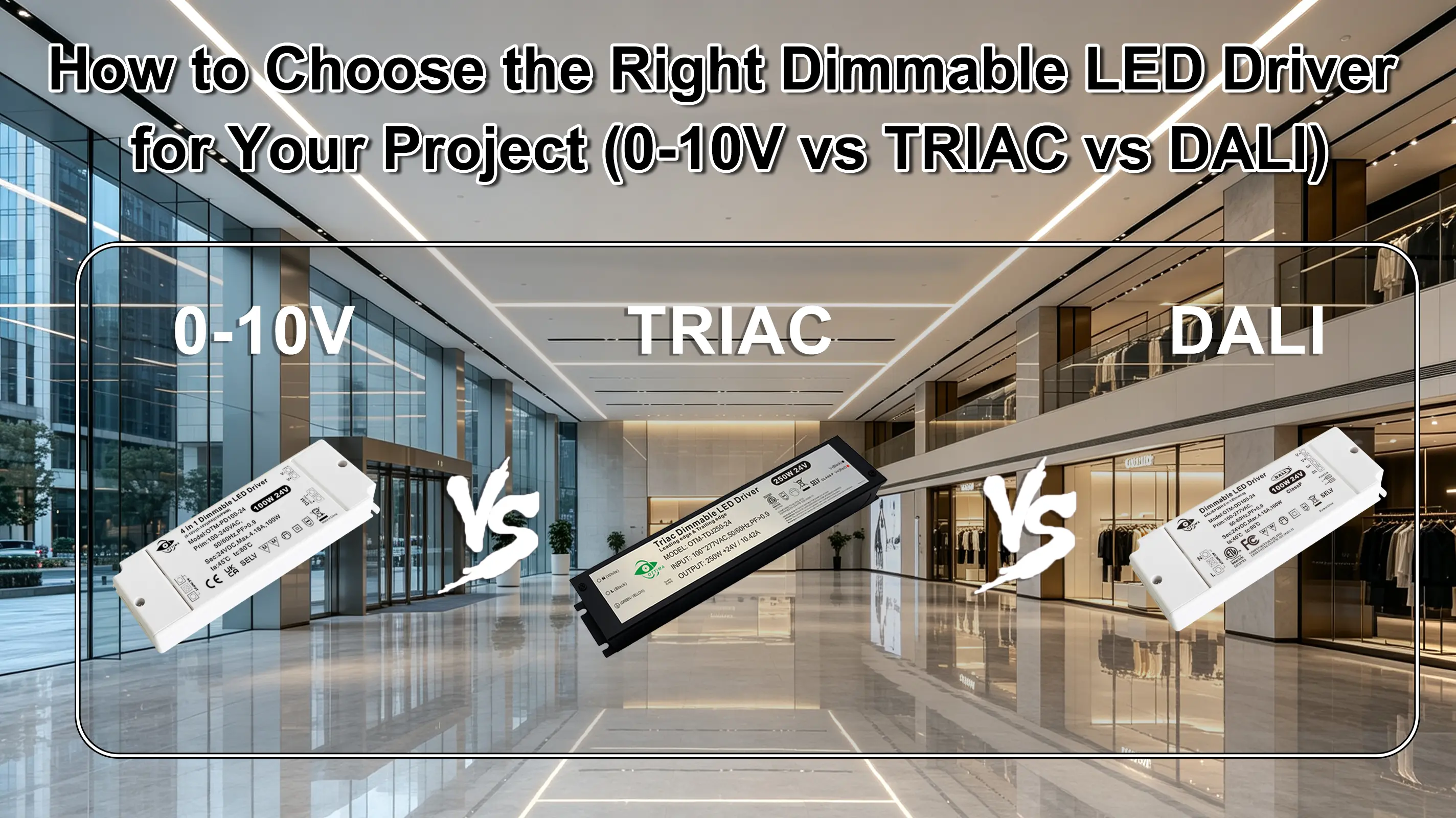
What Is a Dimmable LED Driver?
A dimmable LED driver is more than just a power supply—it is the control center of your lighting system. It regulates voltage and current while enabling smooth brightness adjustment based on user input.
In real-world applications, the driver determines:
Whether your lights dim smoothly or flicker
Whether your system is compatible with existing controls
How stable your lighting performs over time
For example, in a commercial lighting project, a poorly matched driver may result in inconsistent brightness across fixtures, leading to visible performance issues and costly rework.
This is why professional buyers and contractors treat the LED driver as a critical component—not a commodity.
Why Choosing the Right Dimming Method Matters
Many buyers assume that all dimmable LED drivers perform similarly—but in reality, the dimming method directly affects system performance, installation complexity, and long-term reliability.
Choosing the wrong dimming type can lead to:
Flickering or unstable light output, especially at low brightness levels
Incompatibility with existing dimmers or control systems
Limited dimming range, reducing lighting flexibility
Increased installation costs due to rewiring or system adjustments
From a business perspective, these issues often translate into:
For wholesalers and contractors, this is not just a technical issue—it is a cost and reputation risk.
0-10V vs TRIAC vs DALI: A Deeper Comparison
Instead of just understanding definitions, it's more important to evaluate these dimming methods based on real project requirements.
0-10V Dimming: Reliable for Commercial Use
0-10V dimming is one of the most widely adopted solutions in commercial lighting due to its stability and simplicity.
It uses a low-voltage control signal to adjust brightness, making it highly reliable for large-scale installations such as offices, warehouses, and retail spaces.
However, it requires additional control wiring, which can increase installation complexity in retrofit projects.
If your project involves new construction or structured wiring, 0-10V is a highly dependable choice.
TRIAC Dimming: Best for Retrofit Projects
TRIAC dimming works with traditional phase-cut wall dimmers, making it a popular choice in residential and renovation projects.
Its biggest advantage is ease of installation—no extra control wires are needed.
However, performance depends heavily on compatibility between the dimmer and the driver. Poor matching can result in flickering or buzzing.
This makes TRIAC ideal for:
But less suitable for precision-controlled environments.
DALI Dimming: Advanced and Scalable
DALI (Digital Addressable Lighting Interface) is designed for intelligent lighting systems.
It allows individual fixture control, scene setting, and automation, making it ideal for:
However, DALI systems require controllers and programming, resulting in higher upfront costs and system complexity.
Choose DALI when your project demands advanced control and scalability, not just basic dimming.
How to Choose the Right Dimming Type for Your Project
To make the right decision, professionals typically evaluate four key factors:
1. Project Type
2. Installation Condition
3. Control Requirements
Simple dimming → TRIAC
Group control → 0-10V
Smart automation → DALI
4. Budget vs Flexibility
Lower cost → TRIAC
Balanced → 0-10V
High-end → DALI
Professional Insight:
If you frequently deal with different project types, using a multi-compatible driver can significantly reduce decision complexity.
Why More Buyers Are Switching to 5-in-1 Dimmable LED Drivers
In today’s market, flexibility is becoming a key purchasing factor.
Instead of stocking multiple driver types, many distributors and contractors are shifting to 5-in-1 dimmable LED drivers because they:
Support multiple dimming systems in one unit
Reduce SKU complexity
Minimize compatibility risks
Improve project efficiency
For B2B buyers, this approach is not just convenient—it is strategically smarter.
It allows you to respond faster to different customer requirements without increasing inventory pressure.


