
10kV vs. 20kV Surge Protection: Is the Difference Really Just a Few Dollars in Components?
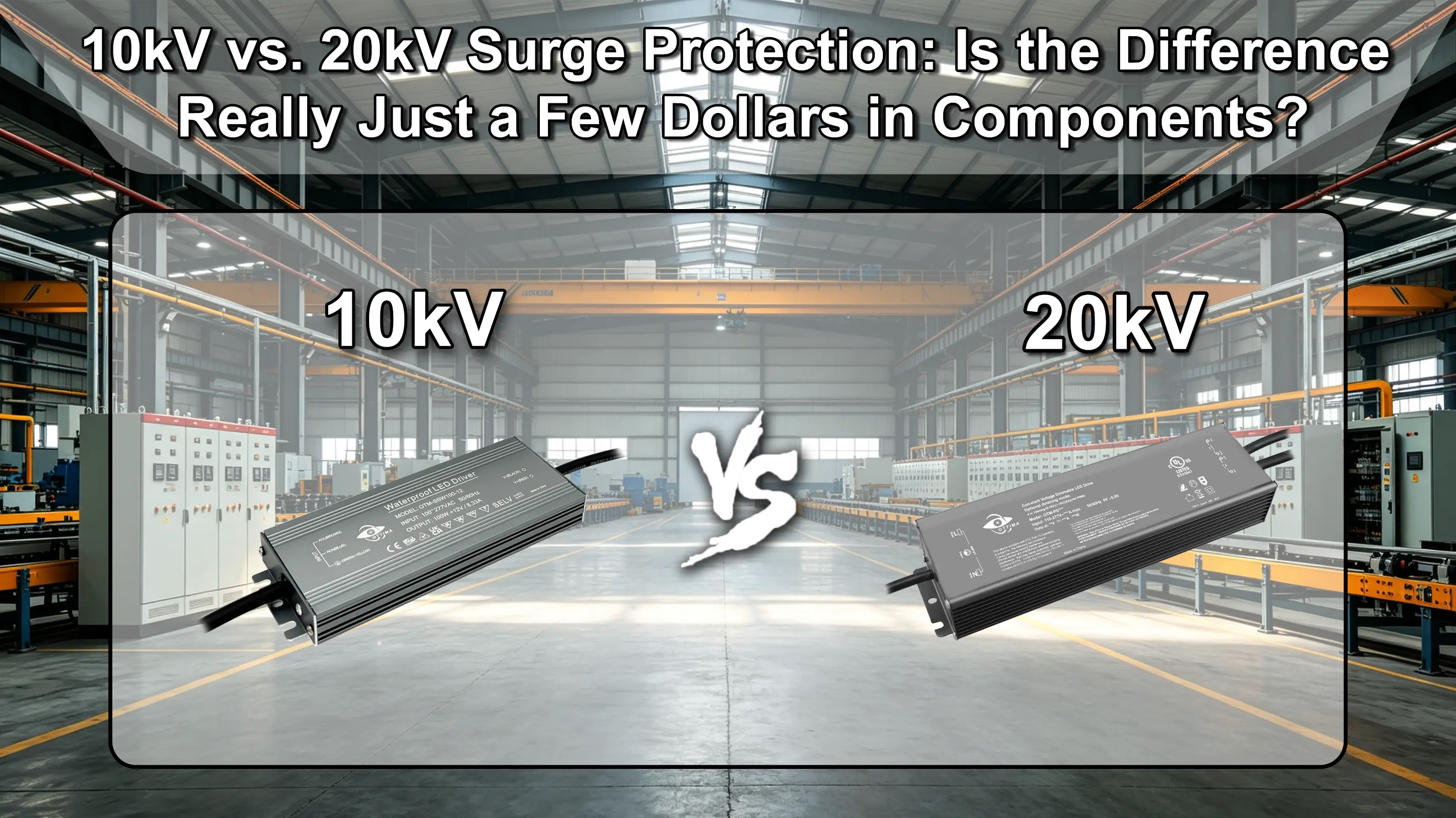
In the world of municipal street lighting, "Surge Protection" is often treated as a checkbox on a procurement sheet. You see two quotes: one for a 10kV driver and another for 20kV. The price gap? Maybe $5 or $10.
The temptation is to think: "It's just a bigger Varistor (MOV). If I'm on a budget, 10kV is 'good enough'."
Printing "20kV" on a driver label is cheap. Engineering a circuit to actually survive a 20kV strike is expensive.
Low-end manufacturers often just slap a larger MOV (Metal Oxide Varistor) across the input. While this might pass a single laboratory pulse, it fails in the field. Why? Because true 20kV protection requires Multi-Stage Coordination.
Professional-grade 20kV protection uses a combination of MOVs and GDTs (Gas Discharge Tubes). The GDT acts as a high-speed switch that diverts the massive energy to the ground before it even reaches the sensitive semiconductor components. If your driver doesn't have this coordinated "handshake" between components, that 20kV surge will simply jump over the MOV and incinerate the IC chip.
But ask any maintenance manager in a lightning-prone region or a heavy industrial zone, and they will tell you a different story. When a summer storm hits, the "10kV" lights aren't just failing—they are literally frying. The truth is, the gap between 10kV and 20kV isn't about the cost of a component; it's about the integrity of the entire electrical architecture.
1. The Physics of 20kV Protection: Beyond the Voltage Number
High voltage doesn't play by the same rules as standard electricity. At 20kV, electricity can "arc" or jump across physical gaps on a PCB (Printed Circuit Board).
The Cheap Way: Using a standard PCB layout but adding a bigger surge component. Result: The surge arcs across the board traces, bypassing the protection entirely.
The Engineering Way: Designing the PCB with increased Creepage and Clearance distances. This often requires a larger physical footprint and specialized slotting in the PCB to prevent high-voltage arcing. This is why a real 20kV driver is often physically bulkier—it’s built to contain the "lightning" inside a safe path.
Creepage and Clearance Distances
A 20kV surge potential can cause an electrical arc to jump across standard PCB layouts. To handle this, our 20kV drivers implement:
Active PCB Slotting: Physical air gaps are cut into the circuit board to interrupt potential arc paths between high-voltage surge entry points and sensitive low-voltage control circuits.
Enhanced Encapsulation: Higher-grade potting compounds with superior dielectric constants are used to prevent internal tracking and carbonization during extreme weather events.
Dielectric Strength (Hi-Pot Testing)
While a 10kV driver is tested for basic safety, a 20kV unit undergoes rigorous Reinforced Isolation testing. This ensures that even during a direct strike on a nearby pole, the high-voltage energy is safely shunted to the ground without breaching the insulation barrier and reaching the LED chips or the DALI/0-10V control interface.
2. Component Synergy: The Hybrid Protection Model
Standard 10kV drivers typically utilize a single-stage Metal Oxide Varistor (MOV). Each time a surge occurs, the MOV absorbs energy and physically degrades. After a series of minor spikes, the MOV fails, leaving the driver defenseless.
Our 20kV architecture employs a Multi-Stage Hybrid Topology:
Primary Stage (GDT): A Gas Discharge Tube acts as the "Heavy Lifter." It can handle massive currents (up to 20,000 Amps) without physical degradation.
Secondary Stage (High-Cap MOV): Working in tandem with the GDT, the MOV handles the residual voltage "let-through," ensuring a clean power signal reaches the internal power conversion stage.
Thermal Protection: Integrated thermal fuses prevent the MOV from overheating in the event of sustained overvoltage (e.g., a neutral wire disconnection).
Because streetlights are mounted on metal poles, they are essentially giant lightning rods. A 20kV rating is meaningless if it only protects L-N. True infrastructure-grade drivers provide balanced protection across all paths (L-G, N-G, L-N). This requires a sophisticated internal Earthing strategy that cheap drivers simply skip to save on BOM and assembly time.
3. Economic Impact: TCO (Total Cost of Ownership) Analysis
The Maintenance Trap
The initial cost difference between a 10kV and a 20kV driver is typically less than 5%. However, the cost of a single field failure includes:
Bucket Truck Rental: $300 - $600 per deployment.
Labor: Two certified electricians for 1-2 hours of site work.
Indirect Costs: Dark streets leading to increased traffic accidents and public safety liabilities.
Failure Rate Comparison
Data from municipal deployments in lightning-prone regions (e.g., Florida, SE Asia, Brazil) shows:
10kV Failure Rate: 3.5% annually.
20kV Failure Rate: <0.15% annually.
The 20kV driver pays for itself within the first 18 months of operation by eliminating just one mid-life maintenance cycle.
5. Technical Specifications Comparison
Feature | 10kV Standard | 20kV Professional |
Max Surge Current (Imax) | 10kA | 20kA |
Protection Stages | Single (MOV) | Hybrid (GDT + MOV) |
Common Mode Protection | Basic | Reinforced |
PCB Isolation | 4mm Clearance | 8mm + Slotting |
Service Life | ~20 Surges | ~100+ Surges |


