
How UL Class 2 vs. Non-Class 2 Drivers Determine Your Luminaire Structural Design and Certification Costs
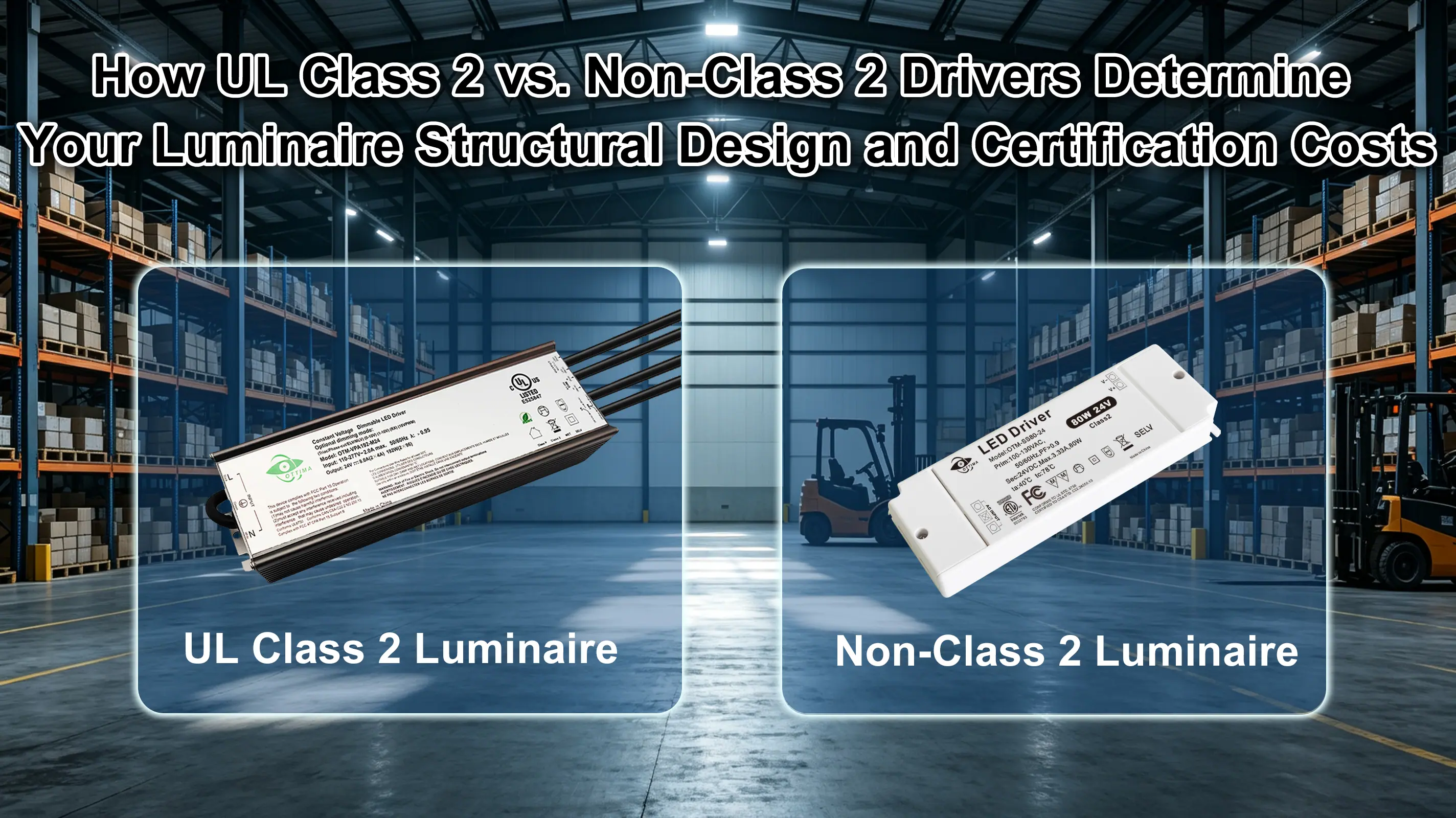
For luminaire manufacturers (OEMs) aiming to conquer the North American market, UL Listing is a mountain that must be climbed.
When planning products, many product managers focus solely on driver wattage and price, ignoring a core safety attribute: Output Type.
UL Class 2: Energy Limited (<100W, <60V).
Non-Class 2 (often referred to as Class 1): High power mode with unlimited energy output.
This isn't just an electrical engineering detail; it directly dictates what enclosure materials your structural engineers can use and how much certification testing fees your boss needs to pay.
Choosing the wrong driver type could force your luminaire to use expensive 5VA fire-rated plastics or require complex insulation structures, causing product costs to skyrocket and killing market competitiveness.
This article, based on the UL 8750 standard, deeply analyzes the "Butterfly Effect" these two driver types have on luminaire design.
I. Core Definitions: What is "Intrinsically Safe"?
To understand the structural impact, you first need to understand how UL defines "danger."
1. UL Class 2 (Energy Limited)
Definition: Per UL 1310 or UL 8750 standards, output voltage is under 60V DC, power is limited to under 100VA (approx. 100W), and it features overcurrent protection.
The Logic: UL considers Class 2 circuits to have insufficient energy to start a fire or cause lethal electric shock. Therefore, the LED modules and lenses connected after a Class 2 driver are considered a "Safe Zone."
2. Non-Class 2 (Energy Unlimited)
Definition: Output voltage or power exceeds Class 2 limits (e.g., a 150W, 200V output driver).
The Logic: These circuits pose a high risk of fire and shock. Therefore, UL requires the luminaire to be built like a "fortress" to contain these dangers.
II. The Butterfly Effect on Design: Enclosures & Materials
This is where the difference is most shocking. Choosing a Class 2 driver liberates structural design.
1. Fire Enclosure
Non-Class 2 Luminaire: Must have a Fire Enclosure.
If plastic, it must pass the rigorous 5VA flame test (extremely hard to burn through).
The bottom of the enclosure cannot have open holes to prevent molten metal from dripping and igniting the floor.
UL Class 2 Luminaire: No Fire Enclosure required (only an Electrical Enclosure).
Since the source energy is limited, UL believes even a short circuit on the LED board won't cause a fire. You can design lighter, more breathable heat sink structures.
2. Plastic Material Rating
Non-Class 2 Luminaire: Plastics directly contacting live parts (like lenses, reflectors) typically require V-0 or even 5VA ratings. These engineering plastics are expensive and harder to mold.
UL Class 2 Luminaire: Plastic parts within the Class 2 circuit often only need HB or V-2 ratings (the lowest flame retardant level).
Cost Drop: For large plastic parts like diffusers and lenses, material costs can drop by 30%-50%.
3. Insulation & Spacing
Non-Class 2: Strict creepage distances are required between the LED PCB and metal housing, or insulating sheets must be used.
UL Class 2: Since the output is safe low voltage, insulation requirements are drastically reduced, allowing for simpler assembly processes.
III. The "Subtraction" in Certification Fees
When you send samples to a UL lab (or ETL/CSA), your driver choice directly impacts the quote.
1. Reduction in Test Items
If your luminaire is powered by a Class 2 Driver, UL engineers will exempt a massive amount of destructive testing on the LED load side:
Exempt: Component Breakdown Test on LED modules.
Exempt: Certain Temperature Test points.
Simplified: Dielectric Strength Test (Hi-Pot).
2. Shorter Certification Cycle
With fewer tests and lower risk of non-compliance (requiring redesigns), Class 2 luminaires typically get certified 2-3 weeks faster than Non-Class 2 fixtures. This is critical for hitting peak sales seasons.
IV. The High-Power Dilemma: What about a 200W High Bay?
Clients ask: "I want to make a 200W UFO High Bay. Can I use Class 2 to save structural costs? But it exceeds the 100W limit."
The Solution: Multi-Channel Class 2
This is a "cheat code" solution provided by top-tier driver manufacturers (like us).
Mechanism: A 200W driver is designed internally with 4 independent 50W output channels.
Compliance: Each channel individually meets Class 2 standards.
Result: Although the total power is 200W, structurally, the luminaire is treated as a Class 2 Luminaire. You can continue to use cheaper lens materials and avoid complex fire enclosure designs.
V. Summary & Decision Matrix
Refer to this table when planning your next luminaire for North America:
Consideration | Option A: Use Class 2 Driver | Option B: Use Non-Class 2 Driver |
Applicable Power | < 100W (or Multi-channel High Power) | > 100W (Single Channel) |
Enclosure Material | Cheap (HB/V-2 Plastic) | Expensive (5VA Plastic / Metal) |
Structural Design | Free (No Fire Enclosure needed) | Restricted (Sealed Fire Enclosure) |
Certification Fee | Low (Fewer tests) | High (Full safety suite) |
Installation | Conduit-Free Allowed (Article 725) | Metal Conduit Mandatory (Class 1) |
Conclusion: Unless your application (like ultra-bright stadium lights) absolutely requires a single high-current output, prioritizing UL Class 2 drivers is the best strategy to reduce Total Product Cost (BOM + Certification + Installation) in almost every scenario.
Is your luminaire structure optimized to the limit?
We provide a full range of UL Class 2 (Single & Multi-Channel) LED drivers. Contact our safety experts for a free evaluation of your new product's insulation structure and material selection, helping you secure that UL Listing effortlessly.


