
Driver Passed, Luminaire Failed? Deep Dive into LED System EMC Interactions & Rectification Strategies
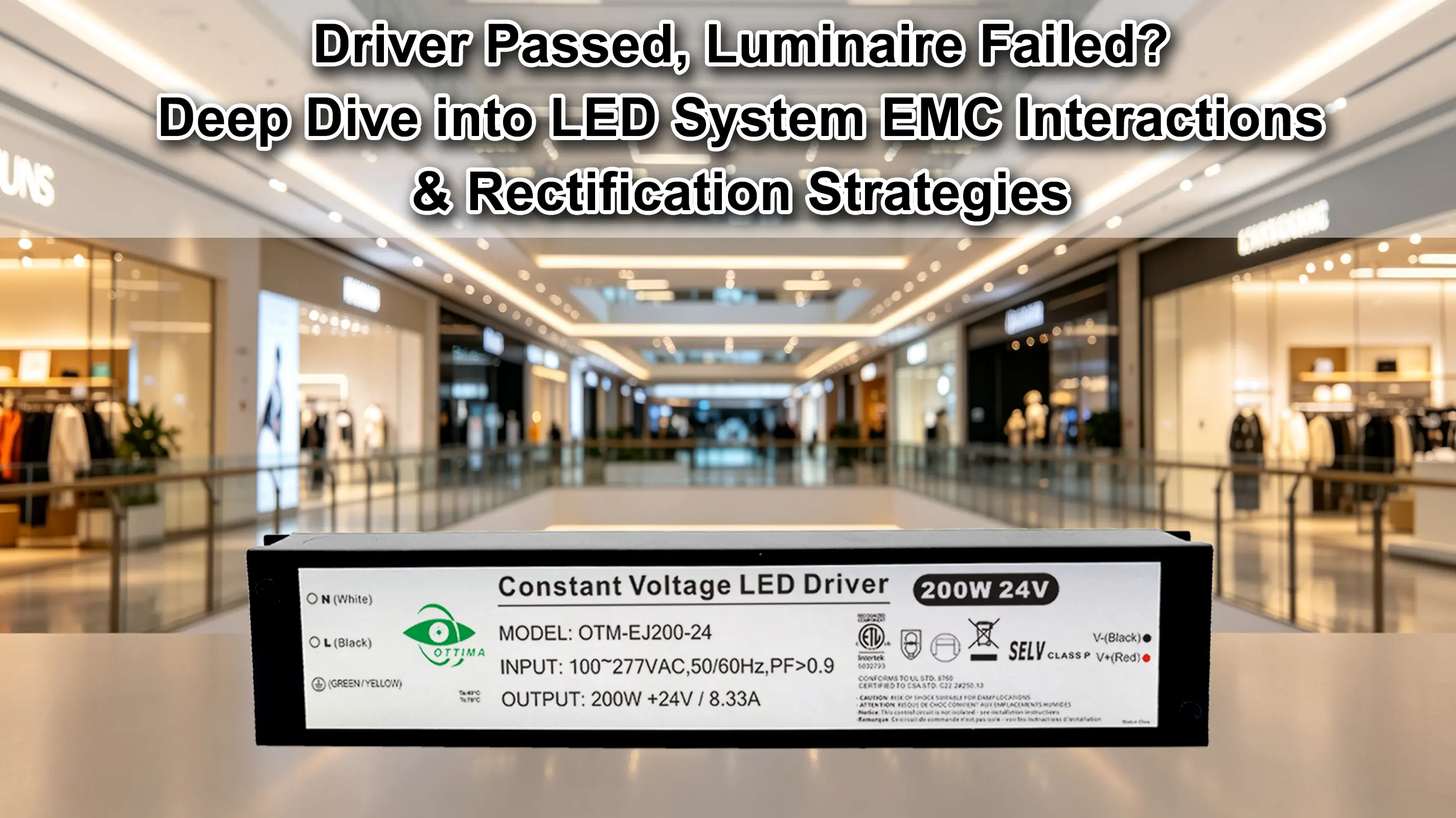
In the export certification process of LED luminaires, the most frustrating scenario for an R&D Director is this:
You procured a well-known brand LED driver with complete certificates (perfect CE/EMC reports). However, when you installed it into your carefully designed luminaire housing and sent it to a third-party lab, the report came back: "Radiated Emissions (RE) exceeded by 3dB. FAIL."
Engineers look at each other: "The power supply is fine, the LEDs are fine, so why is the combination a disaster?"
This is not black magic; this is the "System-Level Effect" of Electromagnetic Compatibility (EMC).
In the world of EMC, 1+1 rarely equals 2. This article, written from the perspective of a professional LED driver manufacturer, reveals the physical truth behind "System EMC Failure" and provides a set of practical engineering rectification strategies.
I. Why Do "Good Drivers" Cause "Bad Results"?
To solve the problem, you must first understand the massive environmental difference between component testing and full luminaire testing.
1. Load Characteristics: Pure Resistance vs. Complex Impedance
Driver Certification: Labs typically use cement resistors or electronic loads. These are purely resistive and electrically "clean."
Luminaire Operation: The load becomes an LED PCB. LEDs are non-linear, and crucially, there is massive Parasitic Capacitance between the aluminum PCB and the heatsink. High-frequency switching noise couples through this capacitance to the metal housing, creating a common-mode noise loop.
2. The "Antenna Effect": Wiring is Broadcasting
The transformer and MOSFETs inside the driver generate high-frequency noise during high-speed switching.
Component Test: Input/output wires are short and laid out according to standards.
Luminaire Assembly: For aesthetics or structural reasons, AC input and DC output wires might be bundled together or routed tightly against the metal housing. These long wires become efficient transmitting antennas, amplifying internal driver noise and radiating it into space.
II. The Three "Invisible Killers": Sources of EMC Failure
When you hold a failed spectrum graph, first identify the frequency band.
1. 30MHz - 300MHz Radiated Excess (Most Common)
The Suspect: DC Output Cable.
The Physics: The wavelength in this band matches the internal wiring length of many luminaires. High-frequency Common Mode Noise from the driver output radiates outwards using the output wire as an antenna and the luminaire housing as ground.
Aggravator: If your luminaire is Class II (Metal case, no ground), the entire floating metal housing acts as a radiator.
2. Low Frequency Conducted Emissions (CE) Failure
The Suspect: Differential Mode Choke saturation.
The Physics: Often caused by high internal temperatures in the luminaire, causing the X-capacitor or Common Mode Choke inside the driver to degrade (core saturation), drastically reducing filtering performance.
3. Spatial Coupling Interference
The Suspect: Parallel Bundling of Input/Output Wires.
The Physics: "Dirty" current from the driver output directly induces noise onto the "clean" AC input lines via Near-Field Coupling (Mutual Inductance). This is "self-contamination."
III. The Engineer's First Aid Kit: 4 Practical Rectification Strategies
When the prototype fails in the lab, don't panic. Perform surgery using these steps:
Strategy A: Destroy the "Antenna" — Twisted Pair
The cheapest and most immediate fix.
Action: Tightly twist the driver's positive (V+) and negative (V-) output wires together.
Physics: Twisting cancels out the magnetic fields generated by high-frequency currents on the two wires. This directly destroys the condition for differential mode radiation.
Effect: Can reduce radiation by 3-5dB.
Strategy B: Cut the Loop — Ferrite Core (Magnetic Ring)
If Common Mode noise is high (many spikes), use a ferrite core.
Action: Add a snap-on ferrite core to the Input (AC) or Output (DC) wires, preferably looping twice.
Selection: For 30M-300MHz radiation, use Nickel-Zinc (Ni-Zn); for low-frequency conduction, use Manganese-Zinc (Mn-Zn).
Note: Place the core as close to the driver port as possible to prevent noise from leaking out and recoupling.
Strategy C: Drain the Noise — Y-Capacitor Grounding
For Class I (Grounded) luminaires, this is the ultimate weapon.
Action: Bridge a high-voltage Y-capacitor (e.g., 1000pF/2000V) between the LED PCB positive/negative and the metal heatsink (Earth).
Physics: Provides a low-impedance path for high-frequency common-mode noise to flow directly back to earth, rather than radiating into the air.
Cost: Increases leakage current slightly; ensure it stays within safety limits.
Strategy D: Optimize Layout
Separate Routing: Never bundle AC input and DC output wires together. Keep them at least 2-3cm apart.
Good Grounding: Ensure the contact resistance between the driver case (if metal) and the luminaire heatsink is less than 0.1Ω, not just for safety, but for shielding.
IV. Prevention is Better than Cure: Procurement Guidelines
Rectification is painful. The best EMC is "Designed In" and "Purchased In."
As a luminaire manufacturer, demand more than the standard when buying drivers:
1. Demand a 6dB Margin: If the limit is 60dBuV, don't buy a driver that sits at 58dBuV. Demand suppliers achieve below 54dBuV. This 6dB margin is the "error space" reserved for your wiring and parasitic capacitance.
2. Ask for "Loaded" EMC Reports: Don't settle for resistive load reports. Ask the driver factory for test data connected to real LED loads (preferably with long wire connections).
3. Check EMI Filter Components: Open the driver. If the input stage has only simple single-stage filtering or lacks a common mode choke, this driver is almost guaranteed to fail in a system test.
V. Conclusion: EMC is Systems Engineering
"The driver is fine, the fixture failed" is not an excuse; it's an engineering reality.
Passing EMC certification relies on a high-quality driver source + rational luminaire structural design. As a professional driver manufacturer, we possess a top-tier EMC lab and an experienced FAE team.
Don't fumble in the dark lab alone.
Send us your whole luminaire sample. We provide not only drivers with 6dB margins but also free full-fixture EMC diagnostic and rectification services, helping your product pass global certification in one go.


