
DALI-2 or 0-10V? Global Dimming Technology Roadmap Comparison and R&D Decision Guide for Luminaire Manufacturers
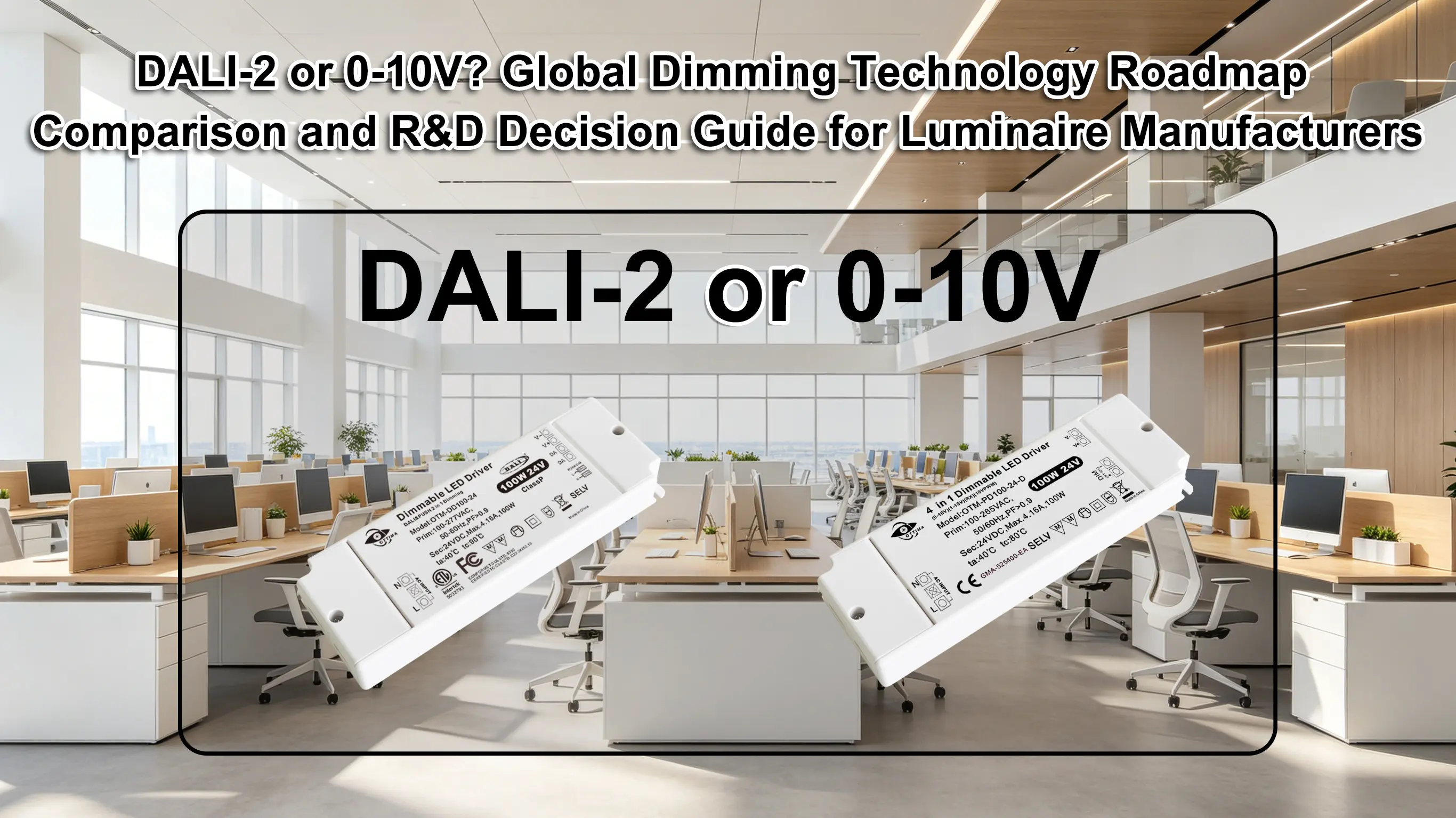
In the R&D meetings of LED luminaire manufacturers (OEMs), the fiercest debates often revolve around "Control Protocols."
The sales team reports: "North American clients want cheap 0-10V, whether it's for High Bays or Panels."
The marketing team counters: "European clients mandate DALI-2 in their tenders and demand D4i data capabilities."
The R&D Director has a headache: "Do we need to maintain two completely different PCB product lines? This will drastically increase SKU counts and inventory pressure."
Choosing between 0-10V and DALI-2 is no longer just a technical question; it has evolved into a business strategy issue. Choosing the wrong path leads to either a lack of competitiveness in the high-end market or a loss of market share in price-sensitive segments.
This article provides a deep R&D decision guide from three dimensions: Underlying Technical Logic, Hidden Cost Structures, and the Global Market Landscape.
I. Underlying Logic: Analog Signals vs. Digital Communication
To make the right decision, one must first understand the fundamental genetic differences.
1. 0-10V: The "Lingua Franca" of the Analog Era (with an Accent)
0-10V is an analog voltage control method.
Pros: Simple principle, extremely low driver cost, no computer software needed for commissioning—an electrician with a screwdriver can do it.
Fatal Flaws:
Inconsistency: For "50% brightness," Manufacturer A's driver might respond to 5V, while Manufacturer B's responds to 4.5V. This leads to poor dimming uniformity.
Voltage Drop: Analog signals suffer from voltage drop over long distances. Fixtures far from the controller may appear dimmer than those nearby.
One-Way Communication: It is a "mute" system. The controller issues orders, but if the light fails, the controller knows nothing about it.
2. DALI-2: The "Internet" of the Digital Era (Precise & Bidirectional)
DALI (Digital Addressable Lighting Interface) is a digital protocol based on the IEC 62386 standard.
Pros:
Precise Addressing: Every light has a unique address. You can regroup lighting zones via software without changing a single wire.
Bidirectional Communication: The fixture not only listens but "talks." It can report failures and feedback power data (with D4i drivers).
Standardization: DALI-2 certification mandates interoperability, solving the issue of different brands "fighting" each other.
Cons: Higher driver cost (requires internal MCU and communication circuits), and commissioning requires specialized equipment and engineers.
II. Hidden Costs: The Ledger Beyond the BOM
Many R&D managers focus only on the driver's unit purchase price, thinking 0-10V drivers are 30%-50% cheaper than DALI drivers and thus superior. This is one-sided.
1. Installation & Wiring Cost (System Cost)
0-10V: To achieve zonal control, independent signal wires must be run from every group of lights back to the distribution panel. For a large open-plan office, this means a "spider web" of cables in the ceiling and expensive labor.
DALI-2: All lights are paralleled on a two-wire bus. Grouping is entirely software logic. Although the driver is more expensive, the savings in cabling and labor often cover the price difference.
2. Dim-to-Off Cost
0-10V: Many entry-level 0-10V drivers cannot turn off completely (leaving a glow at 0V), requiring an additional relay to cut AC power. This adds external hardware cost.
DALI-2: Natively supports standby mode. Sending an "OFF" command puts the fixture into ultra-low power standby immediately without extra relays.
III. Global Landscape: Where Are Your Luminaires Going?
Technology isn't "good" or "bad," only "suitable" or "unsuitable."
Target Market | Dominant Protocol | R&D Suggestion |
North America (USA/Canada) | 0-10V is King | Electricians here are used to 0-10V. For Indoor Commercial Lighting (Troffers, Panels), 0-10V is mandatory. For High-End Buildings, Lutron ecosystems (proprietary or DALI-based) have a niche. |
Europe (EU) | DALI-2 is Standard | Europe is stringent on light quality and energy management. In office, education, and industrial projects, you can barely bid without a DALI interface. 0-10V is considered obsolete technology here. |
Asia/Middle East | Hybrid Market | Price-sensitive projects use 0-10V or Phase-cut; 5-star hotels and landmarks use DALI. |
Industrial/Outdoor | 0-10V (Legacy) / D4i (Future) | Traditional High Bays are fine with 0-10V. However, modern Smart Street Lighting is trending strongly toward D4i (DALI-based) for sensor integration. |
IV. R&D Decision Matrix: How to Define Your Product Line?
As a luminaire manufacturer, you can't just make one type. We recommend a "Platform Strategy":
Strategy A: For "Distribution" Products (SKU Sensitive)
Products: Downlights, Strips, Generic Panels.
Decision: Choose drivers supporting Dip-Switch Dimming.
Solution: Procure a "3-in-1" Driver (supporting 0-10V / PWM / Resistor dimming simultaneously). One SKU covers all analog dimming needs with the fastest inventory turnover.
Strategy B: For "Project" Products (Performance Sensitive)
Products: Linear Lights, Wall Washers, High-End Floor Lamps.
Decision: Must embrace DALI-2 / Tunable White (DT8).
Solution: Reserve DALI interfaces in the luminaire design. If doing Human Centric Lighting (CCT Tuning), ensure you use DT8 (Single Address, Dual Channel) drivers instead of patching together two 0-10V drivers (which leads to severe color drift).
Strategy C: The "Wireless" Future
Trend: Matter, Zigbee, Bluetooth Mesh.
Decision: Don't develop the wireless module yourself.
Solution: Choose 0-10V or DALI drivers with 12V AUX Power Output. This allows clients to plug in any third-party wireless sensor like a Lego brick, making the fixture "Smart-Ready" without being locked into one ecosystem.
V. Conclusion
In the 2025 lighting market:
0-10V is the baseline for survival—cheap, robust, universal, perfect for retrofit markets.
DALI-2 is the source of premium value—representing data, precision, and connectivity, it is the ticket to high-end projects and system integrator lists.
Smart luminaire manufacturers don't see this as an "either/or" choice, but an optimization game: Maximize cost-performance with 0-10V for basic models, and fully exploit DALI-2 data value for flagship models.
What kind of "Heart" does your next bestseller need?
Whether you are sticking to the cost-efficiency of 0-10V or aiming for the intelligence of DALI-2, we have a full range of driver solutions (covering 10W-240W). Contact our FAE team to get the "In-Depth Cost/Performance Comparison Table for Dimming Solutions."


