
Why a 1% Driver Failure Rate Can Destroy 100% of Your Brand Reputation?
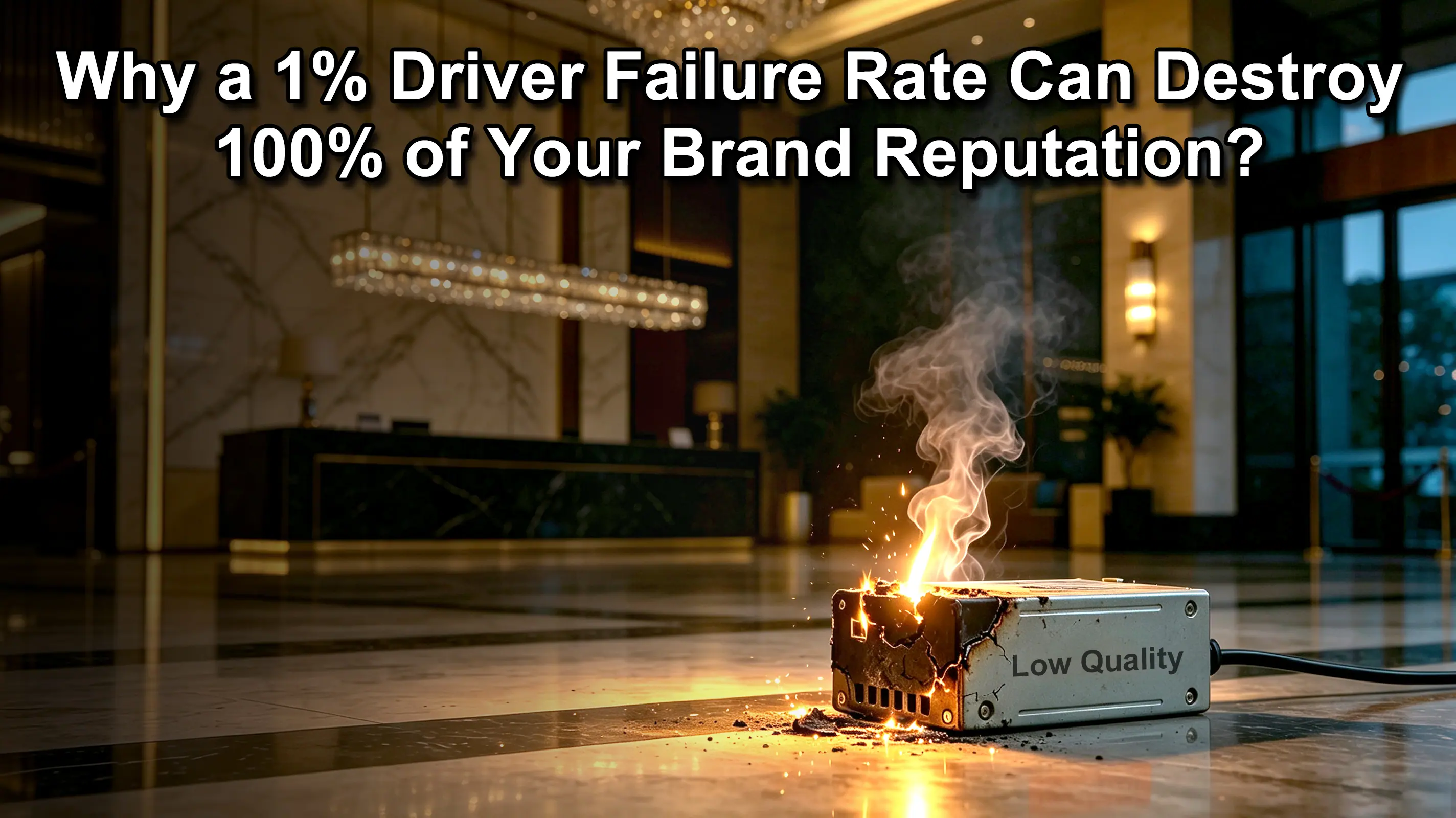
At the B2B negotiation table in the LED lighting industry, purchasing managers often care most about "Price," while engineering directors care most about "Lifetime."
Many luminaire manufacturers believe that shaving $1 off a driver can save the company millions. However, they ignore a brutal "After-Sales Multiplier Effect":
Replacing a defective driver on the factory line costs $0.50.
Replacing it in a local warehouse costs $20.
Once installed on a 10-meter street light pole or in a five-star hotel ceiling, the replacement cost (aerial lift + downtime + labor) skyrockets to over $200.
If you have a project with 10,000 lights, a 1% annual failure rate means 100 lights go dark every year. This means not only tens of thousands of dollars in compensation but also that your brand gets stamped with the "Low Quality" label.
This article unveils the physical truth behind LED driver lifetime and teaches you how to see through the numbers game on datasheets.
I. The "Short Board" Theory: What Kills the LED Driver?
The LED chip itself has a theoretical life of 100,000 hours, but the luminaire's life is determined by the driver, which is in turn determined by its "weakest link."
In 90% of cases, this weak link is the Aluminum Electrolytic Capacitor.
1. Electrolyte Evaporation
Electrolytic capacitors contain liquid electrolytes. Over time and with rising temperatures, this electrolyte slowly evaporates through the rubber seal.
As the electrolyte dries up, capacitance drops, and ESR (Equivalent Series Resistance) spikes.
This leads to increased ripple, flickering lights, or complete failure to start.
2. The Arrhenius Law — The 10°C Rule
This is the golden rule of electronics engineering: For every 10°C decrease in ambient temperature, the lifetime of an electrolytic capacitor typically doubles.
Conversely, if a driver runs hot (e.g., inside a sealed fixture with poor heat dissipation), every 10°C rise cuts the life in half.
II. Clearing Confusion: The Huge Gap Between MTBF and Lifetime
Many datasheets list both MTBF and Lifetime. These are two completely different concepts often intentionally confused.
1. MTBF (Mean Time Between Failures)
Meaning: A statistical probability concept (often based on MIL-HDBK-217F). It refers to the probability of random failures during the normal useful life (excluding wear-out).
The Numbers Game: You often see MTBF = 200,000 hours (approx. 22 years). This does not mean the driver will last 22 years! It only implies the chance of it randomly dying within the warranty period is low.
2. Lifetime
Meaning: A physical calculation based on the wear-out mechanism of core components (capacitors).
The Reality: This is the number you need to watch. Usually stated as: 50,000 hours @ Tc=75°C. It means the driver will survive this long only if its case temperature stays at 75°C.
III. Hardcore Selection: How to Calculate "Real Lifetime"?
Don't just look at the cover of the datasheet. Flip to the "Lifetime vs. Tc Case Temperature" curve.
Case Study:
Assume a driver is rated for 50,000 hours.
Scenario A (Good Thermal Design): Measured driver case temperature Tc = 65℃.
Per the 10°C rule, lifetime doubles → 100,000 hours.
Scenario B (Harsh Environment): Stuffed inside an unventilated inground light, measured Tc = 85℃.
Lifetime halves → 25,000 hours. Running 12 hours a day, it will fail in less than 6 years.
B2B Advice: As a buyer, you must demand the Electrolytic Capacitor Brand (Japanese brands like Rubycon, Nichicon, Chemi-Con are guarantees of longevity) and the Tc Point Temperature Test Report from your supplier.
IV. Our Commitment: Designing for "Zero After-Sales"
To protect your brand reputation, we build three layers of insurance into our driver designs:
1. Japanese Capacitor Matrix: We use 105°C long-life electrolytic capacitors for 100% of the output stage, with a design life redundancy of 120%.
2. Thermal Potting Process: The entire PCB is submerged in thermal silicone. This not only waterproofs the unit but also conducts internal heat rapidly to the metal case, lowering internal temperature rise by 5-8°C on average.
3. High-Efficiency Design: A 1% efficiency boost (e.g., from 93% to 94%) means 15% less waste heat, directly extending component life.
Reliability is Designed, Not Tested
In the LED supply chain, the driver accounts for only 10%-15% of the luminaire cost but bears 100% of the failure risk.
Don't let saving 5% on procurement costs expose your brand to a massive after-sales black hole five years from now. Choosing a driver that stands the test of the "Arrhenius Law" is the most cost-effective insurance policy for your brand.
Want to know how long your fixture will really last?
We offer a free Tc Temperature & Lifetime Assessment Service. Send us your luminaire sample, and we will perform thermal imaging and provide a detailed "Driver Lifetime Prediction Report."


