
Deep Dive into LED Driver Class I vs Class II Selection Logic & Safety Traps
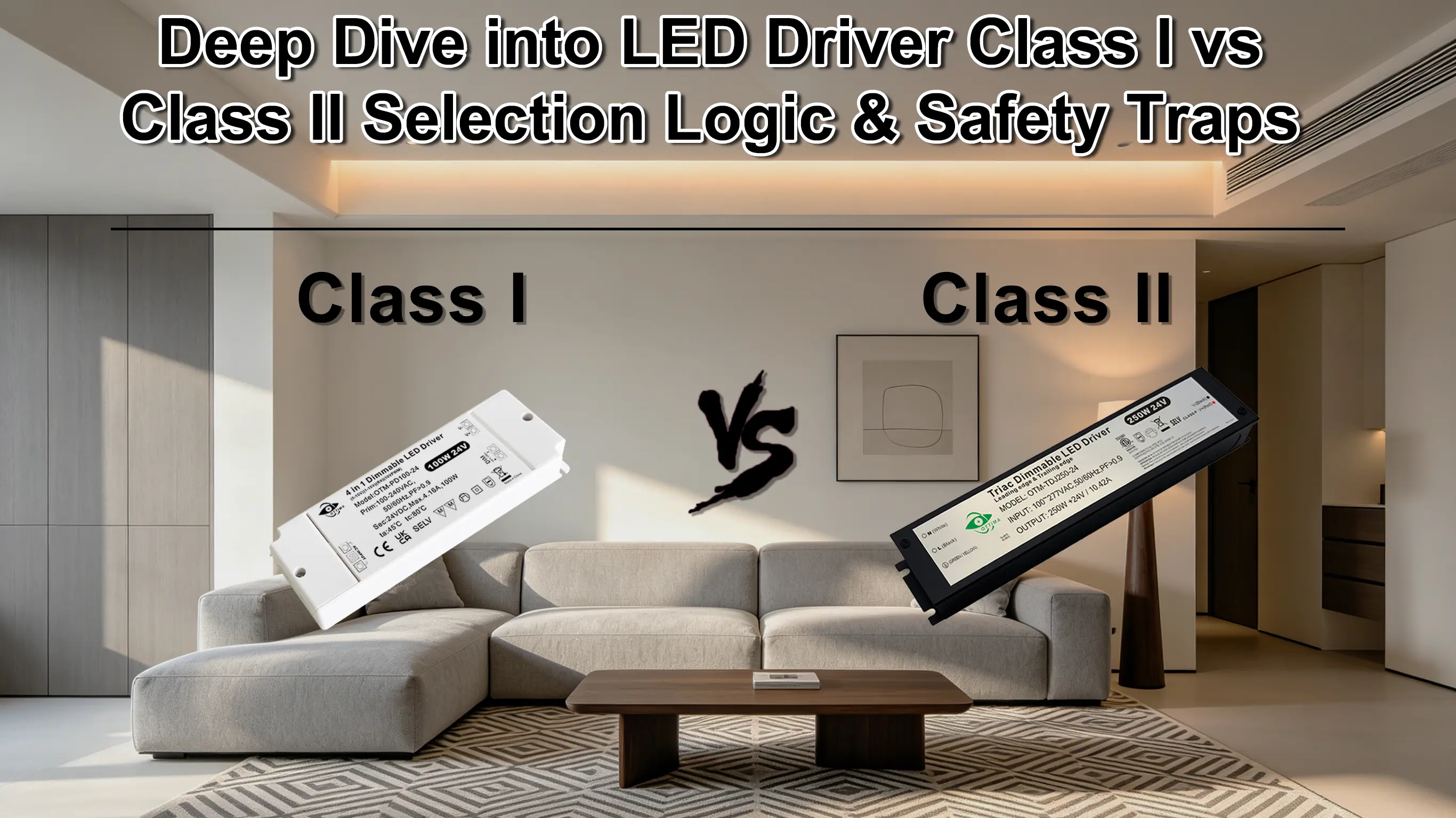
In the R&D and export certification process of LED luminaires, structural engineers and procurement managers often face a seemingly contradictory question:
"Our street light has a full metal housing. For safety, must we use a Class I (Grounded) driver?"
"Why can our competitor's plastic-clad aluminum bulb pass certification without a ground wire (Class II)?"
"Are 'UL Class 2' and 'IEC Class II' on the datasheet the same thing?"
Confusing these concepts can lead to not only failed UL/CE safety tests but also mass EMI interference or surge failures during thunderstorms.
As a professional LED driver manufacturer, we provide more than just power supplies; we provide compliance advice. This article analyzes the ultimate choice between Class I and Class II from three dimensions: Electrical Safety Principles, EMI Design Challenges, and Application Scenarios.
I. Concept Clarity: The Word Game of Class I, Class II, and Class 2
This is the biggest misconception in the industry and must be clarified first.
1. Class I (Appliance) — "Grounding is the Lifeline"
Symbol: ㊉ (Protective Earth)
Definition: Relies on Basic Insulation plus Protective Earth (PE) to prevent electric shock.
Feature: The driver usually has a metal case and must have 3 input wires (L, N, G).
Logic: If internal insulation fails, leakage current flows through the ground wire and trips the breaker/GFCI, protecting the human body.
2. Class II (Appliance) — "Double Armor"
Symbol: ☐ (Square within a square - Double Insulation)
Definition: Does not rely on grounding but on Double Insulation or Reinforced Insulation.
Feature: The driver can be plastic or specially treated metal, typically with only 2 input wires (L, N).
Logic: Even if the first layer of insulation fails, a second layer ensures the casing never becomes live.
3. NEC Class 2 (Arabic Numeral 2) — "Energy Limited"
Difference: This is a North American UL standard (NEC Article 725), referring to limited Output Voltage (<60V) and Power (<100W) to prevent fire and shock.
Conclusion: A driver can be both IEC Class II (Double Insulated) and UL Class 2 (Energy Limited). Never confuse Roman Numeral II with Arabic Numeral 2.
II. Engineering Choice: Why Do Engineers Like Class I, But Installers Like Class II?
The choice depends on your fixture structure and target market.
1. Advantages of Class I: EMI & Heat Dissipation
Easier EMI: High-frequency switching noise inside the LED driver can be "drained" to the ground (PE) via Y-capacitors. Class I drivers with ground wires are easier to pass EMC tests.
Better Thermal: Class I allows internal components to touch the metal case via thermal pads, transferring heat quickly to the fixture heatsink.
Surge Protection: Common mode surges (L-G) can be discharged through the ground wire.
2. Advantages of Class II: Installation Ease & Retrofits
No Ground Wire Needed: In many old building retrofit projects, the original wiring may lack a ground wire or have an unreliable one. Here, Class II is the only choice.
Lower Leakage Current: With no path to ground, Class II drivers have extremely low leakage current, suitable for sensitive areas like hospitals.
III. The Deep End: Metal Case Class II Drivers
This is the technical high ground of the premium market. Many outdoor clients ask: "I want the durability and heat dissipation of a metal case, but I have no ground wire on site. I need Class II."
This brings massive challenges to driver design:
1. Insulation Distances (Creepage & Clearance)
In a Class I driver, live parts to the metal case only need Basic Insulation (e.g., 2.5mm creepage). But in a Class II metal driver, they must meet Reinforced Insulation (e.g., >5mm or more). This forces a sparse PCB layout and larger transformer size.
2. The EMI Nightmare
Without a ground wire, high-frequency noise has nowhere to go. Engineers must design complex differential/common mode filtering circuits internally or use shielding technologies. This makes Class II metal drivers typically 10%-15% more expensive than Class I.
3. Selection Trap
If you buy a metal driver labeled Class II, check for the "Double Square" symbol. If missing, installing it in an ungrounded fixture is a violation. A single fault could make the entire pole live.
IV. Scenario Recommendation: Which One Fits Your Fixture?
Fixture Type | Recommended | Reason |
High Power Street/High Bay | Class I | Metal housing is easily grounded; better for heat & 10kV surge protection. |
Indoor Panel/Downlight | Class II | Often ceiling-mounted, easier wiring, usually independent drivers. |
Plastic Bulb/Tube | Class II | Inherently insulated housing; no ground needed. |
EU/US Old Street Retrofit | Class II (Metal) | No ground wire on site, but requires metal case durability. |
Track Light | Class I or II | Depends on the track system. US tracks are often Class I; EU often Class II. |
V. Conclusion: Safety is a Baseline, Not an Option
In B2B procurement, choosing Class I vs. Class II is essentially a system-level math problem. You need to balance the fixture's thermal structure, EMC costs, and the end-user's installation environment.
Remember:
1. If your fixture housing is metal and ungrounded, you MUST use a Class II driver.
2. If your fixture passed UL Class I certification, you can use a Class II driver (if specs match), but the reverse is absolutely prohibited.
Struggling with Safety Certification for Exports?
We offer a full range of UL/ENEC Dual Certified drivers, covering both Class I Standard and Class II Reinforced Insulation models. Contact our safety engineers for a free review of your fixture's insulation coordination.


