
Why Outdoor LED Drivers Must Have 10kV Surge Protection? A Deep Guide to Differential and Common Mode
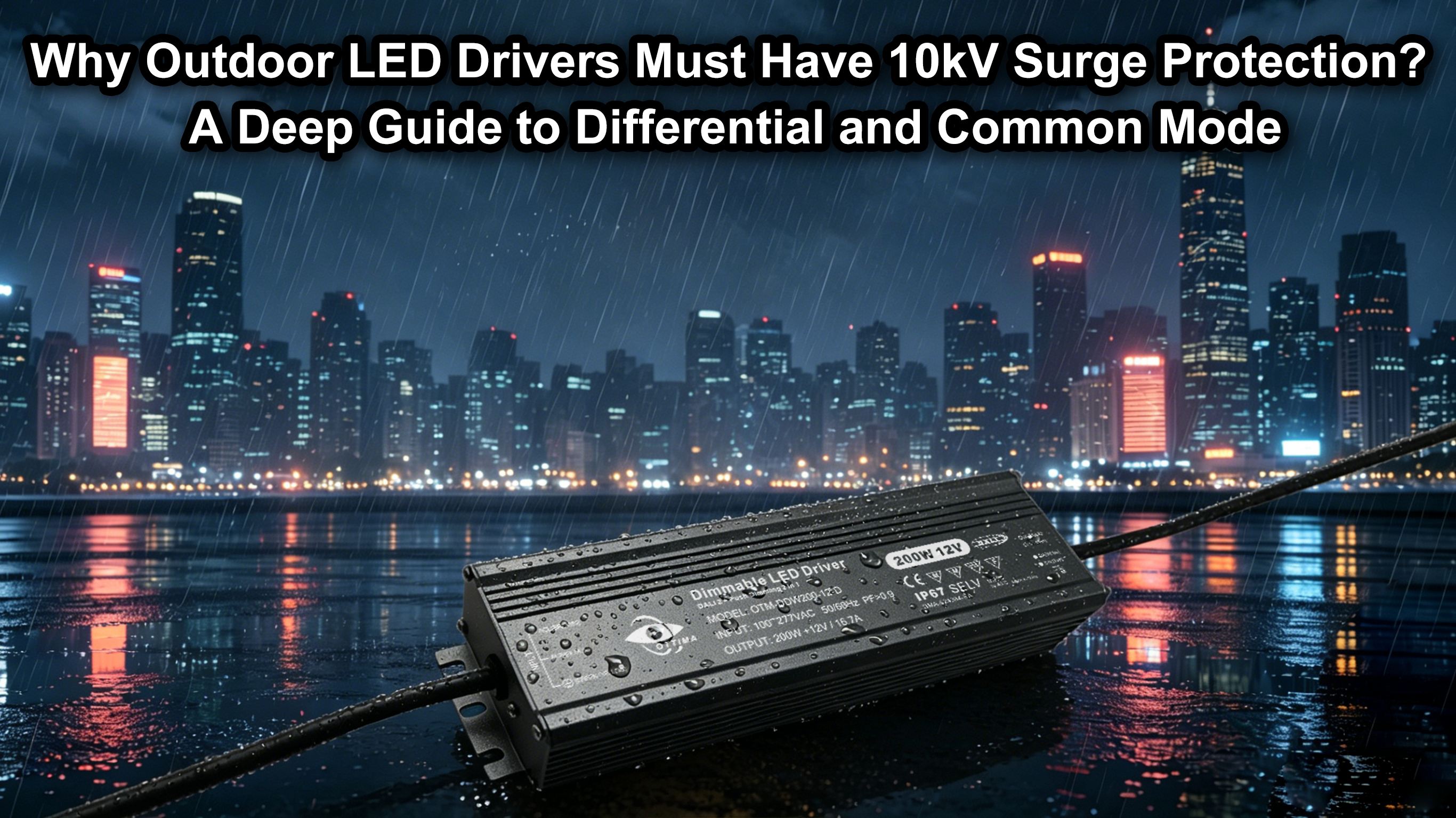
Every thunderstorm season is a time of high anxiety for municipal street lighting departments and outdoor lighting contractors.
After a single storm, an entire street of lights might go dark, or start flickering en masse. When maintenance crews open the pole inspection door, they often find tripped breakers or, worse, scorched driver units.
"We installed lightning rods, why did the lights still fail?"
This is a classic misconception. Lightning rods protect against "Direct Strikes," but the real culprit destroying LED drivers is "Induced Surge."
For outdoor applications, standard 2kV or 4kV protection is insufficient. This article analyzes, from a circuit perspective, why 10kV Surge Protection is the non-negotiable "Line of Defense" for outdoor LED drivers.
I. The Invisible Killer: Differential Mode vs. Common Mode Surge
To choose the right driver, you first need to understand where the surge enters. According to IEC 61000-4-5 standards, surges are categorized into two paths:
1. Differential Mode Surge
Path: Occurs between Line (L) and Neutral (N).
Cause: Typically caused by the switching of high-power grid equipment (like heavy motors, elevators nearby) or grid voltage fluctuations from lightning.
Damage: Directly impacts the driver's bridge rectifier and input capacitors. Insufficient protection leads to instant short circuits and tripping.
2. Common Mode Surge — The #1 Killer of Outdoor Fixtures
Path: Occurs between Line/Neutral (L/N) and Ground (PE).
Cause: When lightning strikes the ground or a rod nearby, the ground potential rises instantly by tens of thousands of volts. Since the fixture housing is grounded (metal pole), but the power lines are at a relatively lower potential, this massive voltage difference tries to "punch through" the driver's insulation to reach the power lines.
Damage: This causes insulation breakdown in the transformer, PCB creepage distances, or even the LED MCPCB insulation, destroying the LED chips along with the driver.
II. Why 4kV/6kV Is Not Enough: The Case for 10kV
In indoor or protected commercial environments, 4kV is usually sufficient. But in exposed outdoor areas (highways, plazas, golf courses), the environment is brutal.
1. The Magnitude of Induced Voltage
A moderate lightning strike (approx. 30kA) can induce instantaneous high voltages of over 6kV to 8kV on overhead cables within a 100-meter radius.
If your driver is only rated for 6kV, it is living on the "edge of failure" and is highly likely to fail after repeated hits.
10kV Drivers: Provide a Safety Margin of roughly 40%. This isn't just for surviving one big hit; it's about resisting component degradation from years of minor surges.
2. Residual Voltage Issues
The core component of surge protection is the MOV (Metal Oxide Varistor). It acts like a floodgate to shunt high voltage.
Drivers designed for 10kV typically use larger MOVs combined with GDTs (Gas Discharge Tubes). Under the same 6kV strike, a 10kV driver shunts energy faster and more thoroughly, resulting in lower residual voltage passing through to the sensitive downstream circuits.
III. Built-in vs. External SPD: The Contractor's Dilemma
Many contractors ask: "If the driver already has 10kV protection, do I need an external SPD (Surge Protection Device)?"
1. Built-in Protection
Pros: Low cost, high integration, no extra wiring.
Cons: MOVs are sacrificial components. Every time they absorb a surge, they degrade slightly. If a massive strike burns out the built-in MOV, the entire driver is toast and must be replaced.
2. External SPD
Pros: Acts like a "bulletproof vest" for the driver. In a catastrophic event, the external SPD sacrifices itself to save the expensive driver. Replacing an SPD (approx. $10) is far cheaper than replacing a driver + aerial lift labor (hundreds of dollars).
Recommendation:
Standard Roads: High-quality 10kV Built-in Protection Drivers are usually sufficient.
High-Risk Areas (Hilltops, Lightning-prone zones, High Masts): Strongly recommend a dual combo of 10kV Driver + 10kV/20kV External SPD.
IV. Selection Guide: How to Read the Datasheet?
When procuring outdoor drivers, verify these three parameters—no exceptions:
1. Separate L-N (Diff) / L-G (Common) Ratings: Some cheap drivers just label "6kV," which often refers only to Common Mode, while Differential Mode might be a weak 2kV.
Pass: Diff ≥ 4kV, Common ≥ 6kV.
Excellent: Diff ≥ 6kV, Common ≥ 10kV.
2. MOV Brand and Size: Ask the supplier about the MOV diameter. For 10kV protection, 14mm (14D) or even 20mm (20D) varistors are typically required. Small MOVs cannot handle repetitive strikes.
3. "Protection Failure Indication"? Premium outdoor drivers or SPDs feature an LED indicator or signal wire. When the surge element fails, it signals maintenance crews to replace it, preventing the fixture from running "naked" without protection.
Reliability is Designed, Not Just Tested
For outdoor lighting projects, Operational Expenditure (OpEx) often far exceeds initial Capital Expenditure (CapEx). One mass repair event after a storm can wipe out all project profits.
Choosing a professional outdoor driver with 10kV Common Mode / 6kV Differential Mode capability is not wasting budget; it is buying a 5-year "All-Weather Insurance Policy" for your project.
Is your outdoor project in a lightning-prone area?
We offer a full range of 10kV Enhanced Surge Protection LED Drivers (covering 50W-300W), featuring integrated GDT+MOV hybrid protection circuits. Contact us for a specialized "Lightning Risk Assessment & Protection Proposal" for your site.


