
How to Remote-Audit an LED Driver Factory's QA/QC System Without a Site Visit?
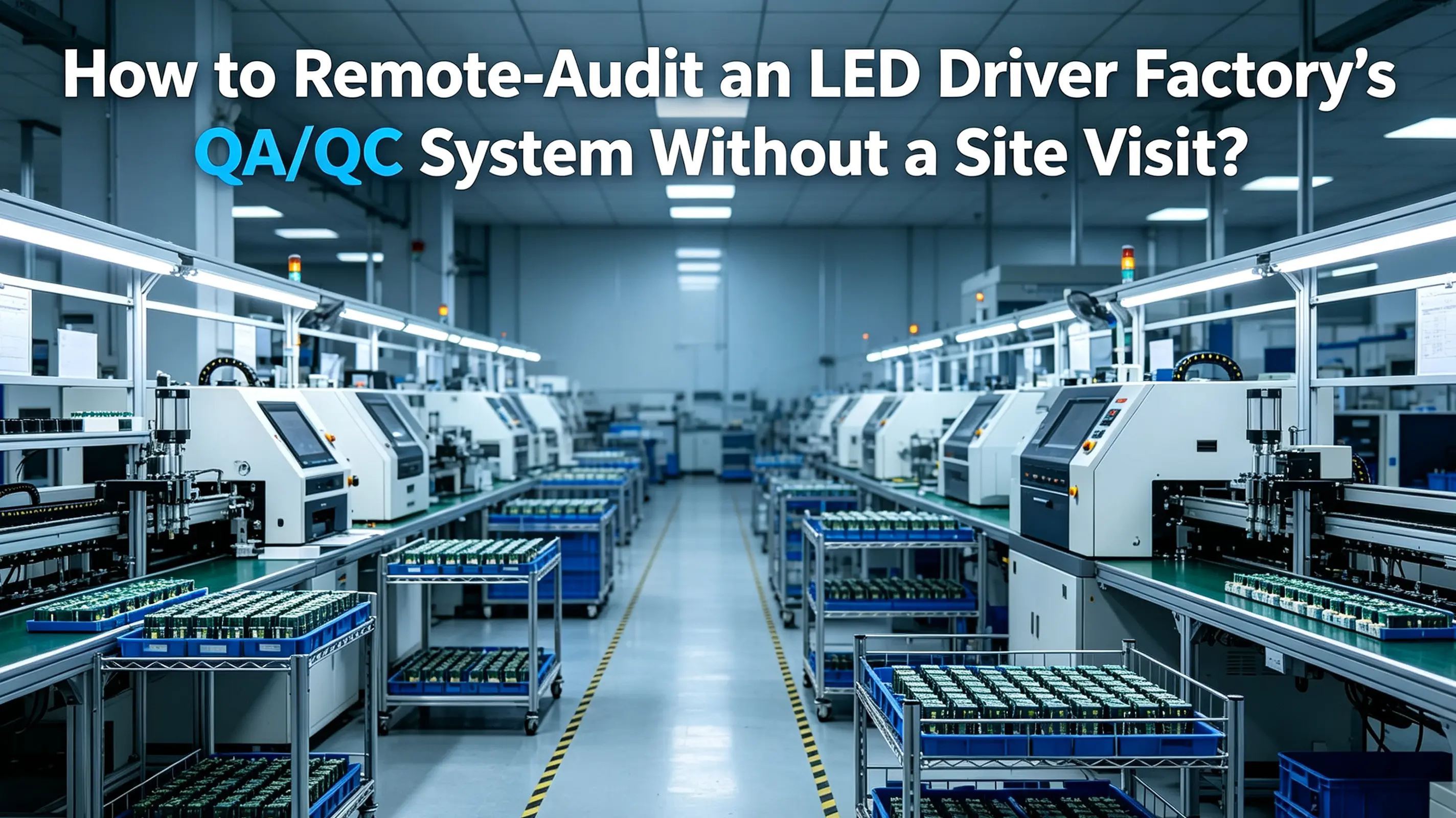
In the global LED lighting supply chain, finding a reliable OEM/ODM driver partner often starts with an email but ends in a crisis of trust.
For Procurement Directors in Europe or North America, the biggest challenge is: When you cannot fly to Shenzhen or Ningbo for a site visit, how do you see through the polished PPTs and websites to reveal the supplier's "true face"?
Many so-called "manufacturers" are actually "Screwdriver Workshops" that just assemble purchased components, or worse, pure trading companies. They might provide a perfect "Golden Sample," but once mass production begins, quality fluctuations become your nightmare.
As a driver manufacturer committed to quality, we are willing to disclose our internal audit logic. This article provides a "Remote Detective Guide," teaching you how to strip away the marketing packaging and hit the core of the factory's QA/QC by demanding critical Process Data.
Layer 1: "Verifying" Lab Capabilities — The Cornerstone of R&D
Many factories claim to have R&D capabilities, but real R&D requires expensive laboratory support.
Remote Check Strategy: Do not just look at PDF files of certificates (which can be Photoshopped). Ask the supplier for:
1. UL/TUV Authorized Lab Qualification: Ask if they participate in the WTDP (Witness Test Data Program) or CTDP.
Logic: Having WTDP qualification means UL engineers recognize the factory lab's test data. This is an endorsement of top-tier manufacturing capability.
2. CNAS Accreditation: If in China, are they accredited by CNAS (China National Accreditation Service for Conformity Assessment)?
3. Live Photo of EMC Testing: Ask for a photo taken right now in their lab showing an ongoing EMI radiation test, with the current date visible on the screen. Factories without expensive Anechoic Chambers cannot provide this.
Layer 2: Traceability System — The "Black Box" of Quality
This is the core indicator distinguishing a "Professional Army" from "Guerrillas."
Remote Check Strategy: Send the supplier a photo of the label from a sample you bought 6 months ago, including the Date Code or SN (Serial Number), and issue this challenge:
"Please provide the original production records for this specific driver within 4 hours."
A rigorous factory should be able to provide:
1. PCBA Batch: Which SMT line produced this? What was the reflow oven temperature profile record?
2. Key Component Traceability: Which vendor supplied the electrolytic capacitors inside? What is the incoming Lot Number?
3. Burn-in Record: How long did this unit stay in the aging room? What were the voltage and load settings?
B2B Insight: If the supplier hesitates or needs days to "fabricate" an Excel sheet, their production process is a Data Black Hole. If a batch failure occurs, they will have no way to investigate the root cause.
Layer 3: ORT (Ongoing Reliability Test) — Consistency is Key
Many factories only do reliability testing during the R&D stage (EVT/DVT). But after mass production, quality may slide due to material batch fluctuations.
Remote Check Strategy:
Ask for last month's ORT Monitoring Report.
A real QA system will randomly select samples from weekly mass production for "Destructive Testing":
85/85 Test: 85°C / 85% Humidity for 1000 hours.
Thermal Shock: Rapid cycling between -40°C and +80°C.
Surge Re-test: Verifying lightning protection capability.
Recommended Script: "Please show me your Q3 2024 ORT Schedule and the actual test logs."
Layer 4: The "Water" in Burn-in Tests
All factories claim to do aging tests (burn-in), but 90% are "cheating."
Remote Check Strategy: Request a Live Video Call and go straight to the Burn-in Room.
Checkpoints:
1. Load Type: Is the driver connected to a real load (Cement Resistor / LED Module) or running empty? (Running without load saves electricity but is "Fake Aging").
2. Temperature Monitoring: Is the aging rack monitored? Is it done in a high-temperature environment (e.g., 45°C-50°C)? Aging at room temperature is meaningless for screening Infant Mortality.
3. Impact Aging: Are the lights Flickering (ON/OFF Cycling)? Pure continuous-on aging cannot screen out startup circuit defects; high-frequency switching impact is mandatory.
Layer 5: Incoming Quality Control (IQC) & AVL Management
The lifespan of a driver depends on its "weakest link"—usually capacitors or MOSFETs.
Remote Check Strategy: Ask to see the AVL (Approved Vendor List) for critical components.
Electrolytic Capacitors: Does the list explicitly lock in top-tier brands like Rubycon, Nichicon, or Chemi-Con? Or does it say "Equivalent," leaving a backdoor for purchasing cheap substitutes?
MOSFETs/ICs: Are they from major players like Infineon, ST, or On-Semi?
The Killer Move: Ask for the IQC Report for the most recent batch of capacitors. Check if they actually tested leakage current and ESR, or if they just "counted the quantity."
Trust Comes from Transparency
In B2B partnerships, "Daring to be Transparent" is proof of strength.
A factory trying to hide process defects will refuse the above requests citing "Trade Secrets." A manufacturer confident in their QA/QC system will view these data points as an opportunity to flex their muscles.
You don't need a passport or a plane ticket. With just a few professional questions, you can screen out the partner across the ocean who can truly walk with you for the next 5 years.
Want to see a real "Transparent Factory"?
We welcome any form of Remote Video Audit. Contact our sales team to book a 30-minute "Cloud Tour." We will take you into our SMT workshop, ORT lab, and automated burn-in room, answering every doubt with real-time data.


