
UL Class 2 Driver Depth Guide: How to Cut Installation Costs by 40% and Win Bids Using NEC Codes?
In the fiercely competitive North American commercial lighting market, Electrical Contractors often face a brutal reality: Even if your luminaire pricing matches your competitors, you can still lose the project due to a high "total installation bid."
Where is the pain point? It lies in Labor and Materials.
While competitors are still calculating the cost of EMT conduit per foot, junction boxes, THHN wire, and expensive electrician hours based on traditional Class 1 standards, top-tier contractors have already rewritten the rules with the "UL Class 2 Strategy."
This article won't just tell you "what Class 2 is"; we will dive deep into NEC Article 725, dissecting how to use this code to achieve "legally compliant cost-cutting" and solve the accompanying technical challenges (like voltage drop), helping you become a "cost killer" in project bidding.
Code Origins — The "Privilege" of NEC Article 725
Many buyers know UL Class 2 represents "safety," but few know it represents "privilege" in engineering.
According to National Electrical Code (NEC) Article 725, Class 2 circuits are defined as "Energy Limited Circuits." The core logic is: The power supply itself limits the output energy so that under any fault condition (including short circuits), it will not generate enough heat to ignite surrounding materials, nor will it produce a lethal electric shock.
Three Hard Specs for Class 2 Drivers:
Voltage Limit: Below 60V DC (Dry locations).
Power Limit: Any single output channel must not exceed 100 VA (approx. 100W).
Overcurrent Protection: Must have the characteristic of quickly cutting off power during a fault.
The "Installation Privilege" Granted by NEC:
Precisely because of this intrinsic safety, the NEC allows Class 2 circuits to be:
Conduit-Free: This is the biggest cost-saving point.
Junction Box Free: Simple connectors are allowed.
Low-Voltage Wiring Methods: You can route cables freely inside walls or above ceilings, much like pulling ethernet or phone lines (provided you choose the right cable rating).
Class 1 vs. Class 2 — A "Dimensional Strike" on the Job Site
To visualize the difference, let's recreate a real job site. Suppose we need to install 50 units of 40W LED panel lights for an open-plan office.
Scenario A: Traditional Class 1 Installation (High Voltage / High Power)
Cabling: Must use 12 AWG or 14 AWG THHN/THWN line-voltage wire.
Protection: Cables must be run entirely inside EMT metal conduit or flexible metal conduit (MC Cable).
Construction: Requires licensed electricians for pipe bending, cutting, deburring, and strap installation. Every added corner burns labor costs.
Flexibility: Once installed, want to move a fixture? That’s another nightmare.
Scenario B: UL Class 2 Installation (Low Voltage Driver)
Cabling: Can use thinner, cheaper 16 AWG or 18 AWG multi-conductor jacketed cable (similar to speaker wire).
Protection: Direct free-air cabling. Cables can be zip-tied to building structures or laid directly on ceiling grids.
Construction: No bending tools needed; a general technician can pull wire rapidly by hand.
Flexibility: Leave a few meters of service loop, and the owner wants to adjust the fixture position? Move it anytime, no pipe modification needed.
Doing the Math — Where Does the 30% Profit Come From?
Beyond the obvious conduit costs, Class 2 saves you many hidden costs.
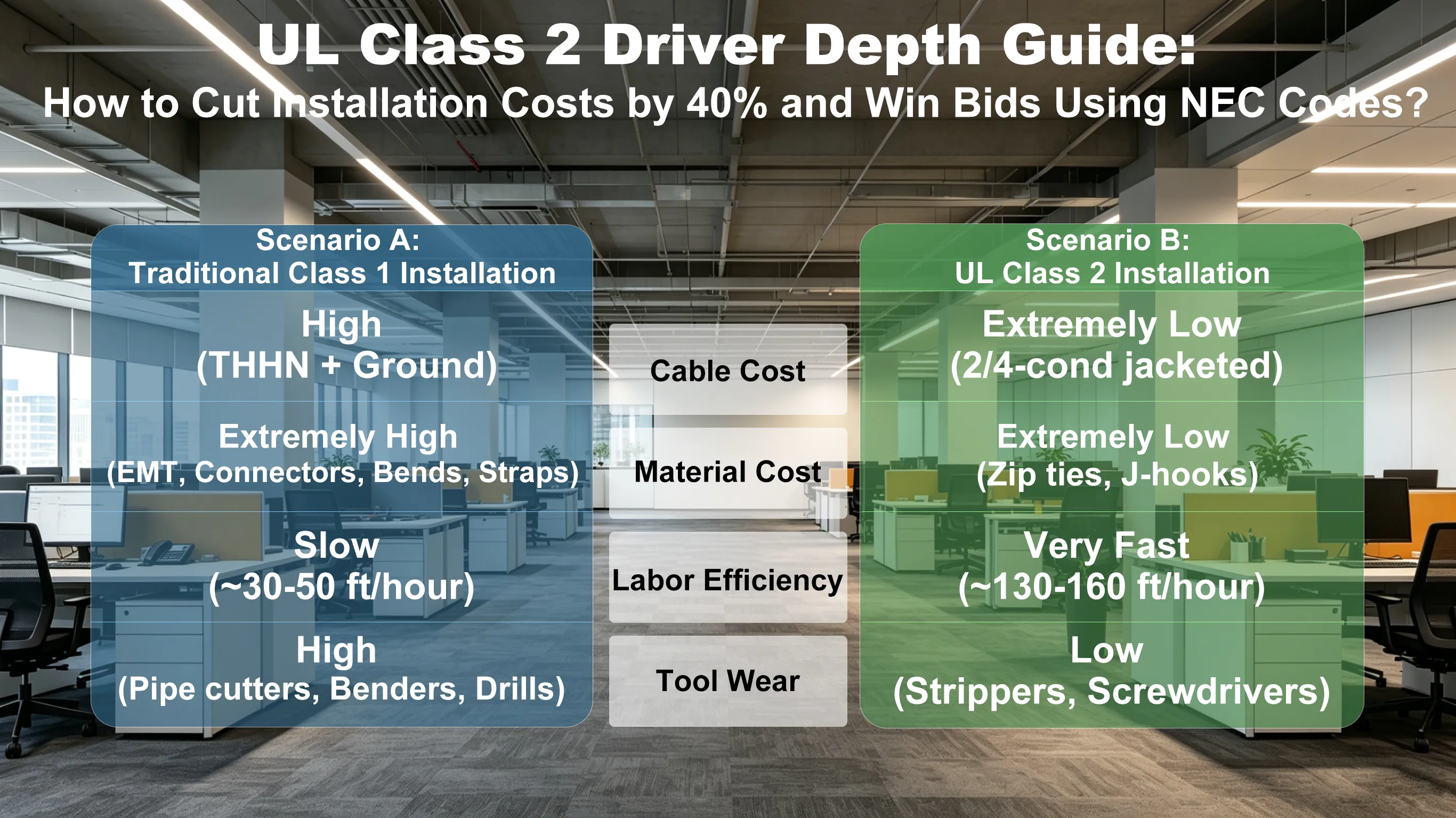
Cost Dimension | Class 1 (Traditional Conduit) | Class 2 (Conduit-Free) | Deep Analysis |
Cable Cost | High (THHN + Ground) | Extremely Low (2/4-cond jacketed) | Class 2 low voltage side usually needs no ground wire; thinner gauge means half the copper usage. |
Material Cost | Extremely High (EMT, Connectors, Bends, Straps) | Extremely Low (Zip ties, J-hooks) | Auxiliary materials often make up 40% of material costs; Class 2 drives this to near zero. |
Labor Efficiency | Slow (~30-50 ft/hour) | Very Fast (~130-160 ft/hour) | Not just fast, but critically reduces reliance on high-wage licensed electricians. |
Tool Wear | High (Pipe cutters, Benders, Drills) | Low (Strippers, Screwdrivers) | Reduces on-site noise and heavy tool transport. |
Conclusion: In a typical project, a Class 2 solution can generally reduce total installation costs (Labor + Materials) by 30% - 40%. This is enough to crush competitors on price while maintaining a higher profit margin.
Deep Tech Zone — Avoiding Pitfalls: Voltage Drop & Cable Selection
While Class 2 offers huge advantages, as a professional, you must be wary of its Achilles' Heel — Voltage Drop.
Since Class 2 allows thinner cables (like 18 AWG) and transmits higher current at low voltage (e.g., 24V), line loss is much more severe than in high-voltage circuits. Improper handling leads to dimming, flickering, or color inconsistency at the end of the run.
Expert-Level Solutions:
1. Strict Distance Calculation:
In a 24V system using 18 AWG wire at full load, it is recommended that the transmission distance does not exceed 30 feet (approx. 9 meters).
For longer distances, you must upgrade the wire gauge to 16 AWG or 14 AWG. Do not sacrifice engineering quality to save pennies on wire.
2. Choose the Right Cable Fire Rating (NEC Mandatory):
Although conduit-free, the cable "jacket" matters and must meet fire codes:
CL2 (General Purpose): For use inside walls.
CL2R (Riser): Vertical runs between floors; higher fire rating.
CL2P (Plenum): Highest Rating. If your cable runs through Plenum Spaces (air-handling drop ceilings), you MUST use CL2P cable. This is a mandatory requirement for most commercial office projects.
Commercial Bidding Strategy — How to Persuade Owners?
When bidding, don't just say "I'm cheaper." Use Class 2 features to sell "Future Value" to the owner:
1. "Future-Proofing":
Pitch: "Mr. Smith, if you choose this Class 2 solution, when you reconfigure the office layout in the future, we can adjust fixture positions as easily as moving ethernet cables—no tearing down walls or changing pipes, saving you future renovation costs."
2. "Safer Maintenance":
Pitch: "This is a 24V safe low-voltage system. Your facility staff can replace fixtures without even cutting the main power—zero shock risk, extremely safe and convenient maintenance."
Common Myths (FAQ)
Q: My fixture is a 200W High Bay. Can I not use a Class 2 driver? (Due to the 100W limit)
A: You can! Choose a "Multi-Channel Class 2 Driver." For example, a 200W driver designed with 4 independent 50W channels inside. Each channel complies with Class 2 standards, allowing you to legally connect these 4 sets of wires to the fixture's 4 modules conduit-free.
Q: Is Class 2 the same as Class II?
A: Absolutely not!
Class 2 (Arabic Numeral): Refers to the NEC defined circuit installation class (Low Voltage, Low Energy, Shock Safe).
Class II (Roman Numeral): Refers to electrical insulation class (Double Insulated, No Ground Wire needed).
Procurement Tip: For installation savings, look for NEC Class 2; for grounding needs, look for Class II.
Conclusion
In LED driver selection, UL Class 2 is not just a certification mark; it is a complete "Cost Reduction & Efficiency Improvement" engineering methodology.
As a wholesaler, when you can clearly articulate the above logic to your contractor clients and provide matching Class 2 drivers and CL2P cable recommendations, you are providing not just a product, but a weapon to win bids.
Ready to Upgrade Your Inventory Strategy?
We provide a full range of NEC-compliant UL Class 2 LED drivers (covering Constant Current & Voltage, Single & Multi-Channel). Contact our engineering team to get Voltage Drop Calculation Tables and Cable Selection Proposals tailored for your project.


