
Why Grow Lights Need "Ultra-High Power" & "Spectrum Tunable" Dedicated Drivers?
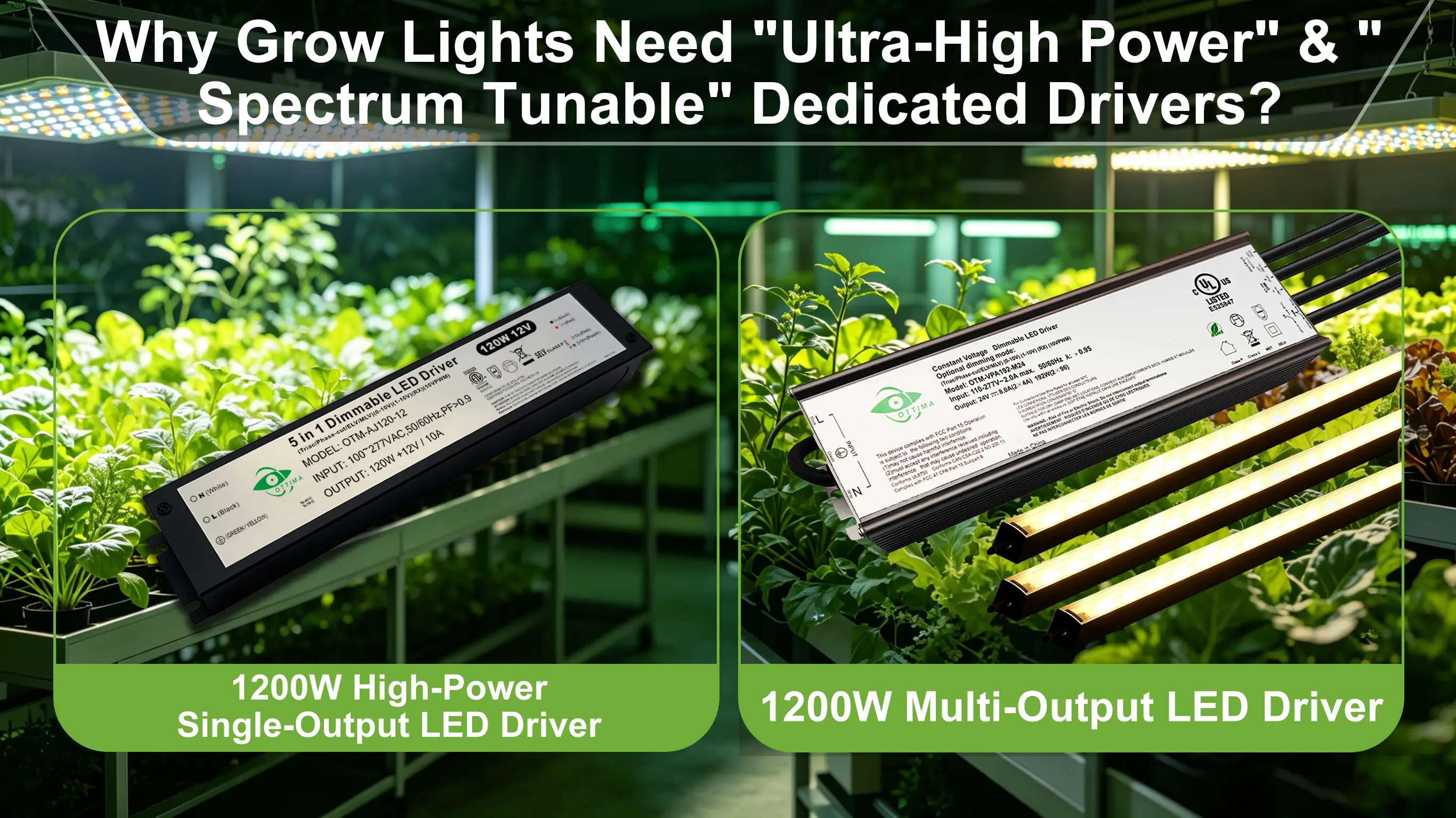
In modern controlled environment agriculture, light is fertilizer.
For commercial greenhouse growers and vertical farming operators, shifting from traditional High-Pressure Sodium (HPS) to LED lighting represents a massive Capital Expenditure (CapEx). The return they expect is not just energy savings, but shorter growth cycles, higher biomass, and more precise control over time-to-market.
However, many luminaire manufacturers and engineering contractors often overlook a core fact: Without a professional "engine" to drive them, even the most expensive LED chips and perfect light recipes cannot perform effectively.
The requirements for LED drivers in horticultural lighting are the most stringent of all LED applications. This article will reveal why, in the field of horticultural lighting, you must focus on "Ultra-High Efficiency Thermal Balance," "Dynamic Spectrum Control," and "Extreme Environment Endurance."
I. The Challenge of the 1000W+ Era: Efficiency is Money (and HVAC Costs)
To achieve Photon Flux Densities (PPFD > 1000 µmol/s) comparable to or even higher than traditional 1000W HPS lamps, the power of modern LED grow lights is skyrocketing, with 600W, 800W, and even 1200W becoming mainstream configurations.
1. The "Double Leverage" Effect of Efficiency
In a closed greenhouse or plant factory where hundreds of kilowatt-class fixtures are operating simultaneously, the difference in driver efficiency can have a staggering economic impact. This concerns not only the electricity bill but also HVAC (Heating, Ventilation, and Air Conditioning) costs.
Standard Driver (92% Efficiency): Inputting 1000W means 80W of energy turns into waste heat.
Top-Tier Horticultural Driver (97% Efficiency): Inputting 1000W generates only 30W of waste heat.
B2B Deep Math: Reducing heat emission by 50W per fixture in a plant factory with 1,000 lights means reducing the thermal load by 50kW. In a fully enclosed environment, this means you can:
1. Pay less for electricity: Directly save on lighting power bills.
2. Buy less HVAC: Lower the capacity requirement for air conditioning systems (CapEx).
3. Pay less for HVAC electricity: Reduce the power consumed by AC to remove heat (OpEx).
Conclusion: In horticultural lighting, pursuing 97% ultra-high efficiency is not a "spec race," but tangible profit protection.
2. Detachable Design
For high-power applications, professional driver designs often support remote installation (detachable from the LED board). This allows growers to mount drivers centrally in cool areas of the greenhouse or along walkways, rather than directly above the fixtures. This not only lowers the operating temperature of the LED chips (extending lifespan) but also facilitates centralized maintenance and replacement.
II. The Secret Weapon of Light Recipes: Multi-Channel "Dynamic Spectrum" Control
Early LED grow lights had fixed spectrums (like full-spectrum pink light), using one light from seeding to harvest. But plant science (Photobiology) tells us that crops need different "light recipes" at different growth stages.
Vegetative Stage (Seedling/Leafy Greens): Needs more Blue Light to promote strong roots and stems, preventing leggy growth.
Reproductive Stage (Flowering/Fruiting): Needs abundant Deep Red (660nm) and appropriate Far Red (730nm) to induce flowering cycles (photoperiodism) and increase fruit weight (Emerson Effect).
Driver Solution: Multi-Channel Independent Dimming
Ordinary single-channel drivers cannot achieve this. You need a smart driver with Multi-Channel (2-4 channels) output.
Channel 1 (Main Light): Drives full-spectrum white light, providing base PPFD.
Channel 2 (Red Boost): Independently drives 660nm deep red, turned on at full power during the flowering stage.
Channel 3 (UV/IR): Independently drives UV (increases secondary metabolites, improving flavor/medicinal potency) or IR (triggers shade avoidance response, regulating plant shape).
Through 0-10V or digital communication (DALI-2/D4i), growers can independently adjust the ratio of red or blue light just like adjusting "volume."
Value Proposition: This empowers the luminaire with "One Light, Multiple Uses," allowing growers to customize the optimal spectrum for tomatoes, cucumbers, or medicinal plants, maximizing economic value.
III. Surviving in "Toxic Gas": Combating Sulfur and High Humidity
The greenhouse environment is a torture test for electronics. If you use ordinary outdoor street light drivers for grow lights, the failure rate will teach you a hard lesson.
1. The Invisible Killer: Sulfuration
Growers often spray pesticides or fumigate with Sulfur in greenhouses to control powdery mildew and spider mites.
The Hazard: Sulfur has extremely strong permeability. It can penetrate ordinary silicone potting, reacting chemically with the silver plating on LED brackets or resistors/connectors inside the driver to form black silver sulfide.
The Consequence: Leads to reduced conductivity, resistance drift, and ultimately dead lights or driver failure.
Procurement Standard: You must select Anti-Sulfur Drivers specifically designed for this. This includes thickened Conformal Coating on the PCB and the use of potting compounds with better airtightness and chemical resistance.
2. Humidity and Condensation
Greenhouse relative humidity remains at 85%-95% year-round, with large day-night temperature differences, easily causing condensation inside equipment.
Procurement Standard: IP67 is the baseline. It is even recommended to look for IP68-rated drivers to ensure they remain "watertight" under long-term high humidity or even dripping conditions.
IV. Intelligent Trend: D4i and Data-Driven Agriculture
Future agriculture is data-driven. The driver is no longer just a power supply; it is a node in the greenhouse IoT.
Choosing drivers that support the D4i (DALI for IoT) standard provides growers with critical data:
1. Precise Energy Reporting: Monitor power consumption of each row of lights in real-time to calculate energy cost ratios.
2. Failure Prediction: Monitor LED operating voltage and temperature. If voltage rises abnormally, it alerts to potential chip aging or damage, enabling predictive maintenance.
3. Asset Management: Read luminaire factory information and operating hours, facilitating full lifecycle management.
V. Grid Friendliness: Solving the Impact of "Thousands of Lights Starting"
When a large plant factory has 5,000 units of 1,000W grow lights, the pressure on the grid at the moment of "turning on" in the morning is immense.
Pain Point: Huge Inrush Current can cause circuit breakers to trip or even damage power distribution equipment.
Solution: Select drivers with "Ultra-Low Inrush Current" design or "Soft Start" functions.
Professional horticultural drivers can control inrush current to extremely low levels, allowing a single circuit breaker to load more fixtures, reducing the investment cost of distribution cabinets.
The Driver is the "Insurance Policy" for Yield
In the field of horticultural lighting, fixtures are often expensive (a 1000W fixture can cost hundreds of dollars). As the core component, the LED driver determines the energy efficiency ratio (electricity bill), spectrum flexibility (yield), and lifespan in harsh environments (maintenance cost) of this expensive equipment.
For luminaire manufacturers, choosing a dedicated driver with 97% high efficiency, multi-channel dimmability, and anti-sulfur protection is not just about improving product specs; it is a promise to your customers:
"We understand growing, and we protect every one of your harvests."
Want to match the strongest "engine" for your plant grow lights?
We provide professional horticultural lighting driver solutions covering 600W to 1200W, supporting multi-channel spectrum control. Contact our professional team to get spectral driver recipe recommendations tailored to your crop type.


