
Sub-Zero Power Physics: Mitigating Electrolyte Freezing, ESR Spikes, and Cold-Start Failures in Cold Storage LED Drivers
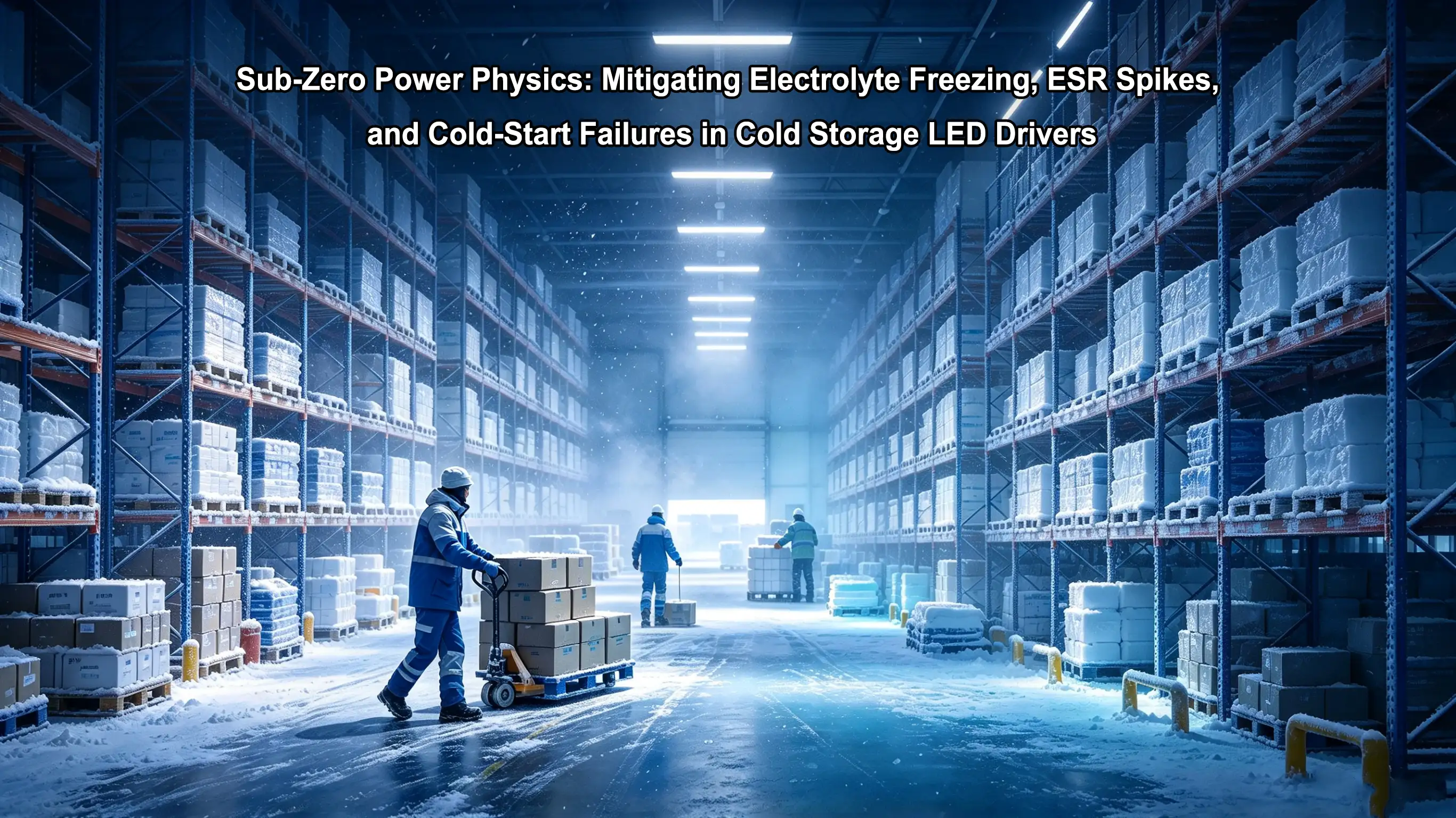
In the demanding domain of industrial cold chain infrastructure—encompassing deep-freeze warehouses operating at -40℃, cryogenic food processing plants, and northern North American outdoor logistics hubs—standard commercial LED lighting systems face an unforgiving operational environment. Facility operators frequently encounter a frustrating and costly phenomenon: luminaires that suffer from catastrophic startup delays exceeding three seconds, or fail to ignite altogether upon power restoration after a maintenance cycle or brownout.
This is not a simple matter of low-temperature component rating; it is a fundamental crisis of power electronics physics. As ambient temperatures plummet to -40℃, traditional electrolytic capacitor chemistry undergoes severe phase degradation, triggering an exponential explosion in Equivalent Series Resistance (ESR) and paralyzing the power supply's startup oscillator.
This technical paper investigates the sub-zero physics governing ionic mobility in liquid electrolytes, models the mathematical collapse of capacitor performance during thermal shock, and demonstrates how Ottima’s engineering architecture—combining solid polymer electrolytic capacitors with an intelligent self-heating auxiliary circuit—guarantees sub-200ms cold-starts without endangering downstream LED arrays.
The Cold Storage Thermal Reality: Beyond Standard Operating Limits
Standard industrial lighting is typically rated down to -25℃ or -30℃. However, modern automated cold-storage facilities, blast freezers, and ice cream hardening tunnels routinely operate between -35℃ and -45℃. When an LED driver designed for moderate environments is installed in these spaces, the internal ambient temperature within the sealed driver housing drops to match the ambient environment once the fixture is powered off for a period.
Upon re-energization, the power supply must transition from absolute thermal equilibrium at -40℃ to full operational load instantaneously. During this critical window, standard power conversion topologies experience massive failure rates due to microelectronic property shifts.
The Hardcore Physics of Liquid Electrolyte Freezing & ESR Spikes
At the heart of almost every standard LED driver power factor correction (PFC) stage and bulk filtering network lies the aluminum electrolytic capacitor. While valued for high capacitance density and low cost at room temperature, the liquid electrolyte within these components is their Achilles' heel under extreme cold.
1. The Breakdown of Ionic Conductivity
A standard electrolytic capacitor relies on a liquid chemical solution (typically a gamma-butyrolactone or ethylene glycol solvent mixed with ionic salts) to act as the working cathode, forming a conductive bridge between the aluminum foil cathode and the dielectric oxide layer.
As temperature decreases from +25℃ to -40℃, the kinetic energy of the solvent molecules decreases drastically. The viscosity (η) of the liquid electrolyte increases exponentially according to the Arrhenius-type temperature dependence:
η(T) = η0 · exp ({Ea}/{kB · T})
Where:
η0 is a pre-exponential constant.
Ea is the activation energy for viscous flow.
kB is the Boltzmann constant.
T is the absolute temperature in Kelvin.
At -40℃ (233.15 K), the solvent viscosity surges by several orders of magnitude. In many standard formulations, the solvent reaches its glass transition temperature or crystallizes entirely. The free ions responsible for ionic conduction become immobilized within the frozen matrix. Consequently, the bulk electrical conductivity (σ) of the electrolyte crashes.
2. The Exponential Explosion of Equivalent Series Resistance (ESR)
Because the ionic mobility is severely restricted, the internal resistance of the capacitor—quantified as Equivalent Series Resistance (ESR)—multiplies dramatically.
While a standard bulk capacitor may exhibit an ESR of 50 mΩ at +25℃, its ESR at -40℃ can skyrocket by a factor of 100× to 500×, exceeding several ohms:
ESR(-40℃) >> 100 × ESR(+25℃)
The Cold-Start Failure Cascade: From Oscillator Choke to Voltage Overshoot
This massive spike in ESR triggers a cascading failure sequence across the LED driver's internal power architecture during a cold start:
1. The RC Time Constant and Under-Voltage Lockout (UVLO) Trap
The bulk storage capacitor functions in conjunction with start-up resistors and auxiliary bias supplies to charge the controller IC's VCC pin. The charging time constant ($tau$) is defined by:
τ = (Rstart + ESR) · Cbulk
When ESR spikes into multi-ohm territory, the time constant τ expands exponentially. The control IC fails to reach its Under-Voltage Lockout (UVLO) turn-on threshold within the expected timing window. The startup sequence stalls, resulting in the characteristic 3-to-5-second delay or infinite reboot loop.
2. The Voltage Overshoot and Die Breakdown Hazard
If the power supply does manage to force-start despite high ESR, a secondary peril emerges: Transient Voltage Overshoot.
Because the high ESR severely degrades the capacitor's ability to smooth out high-frequency ripple currents during the initial switching cycles, severe voltage spikes propagate across the DC bus. When the driver outputs power to the LED array before the internal control loop stabilizes, these unmitigated voltage overshoots can exceed the reverse-bias breakdown voltage of the LED chips, causing immediate degradation or catastrophic open-circuit failure in the luminaire.
The Ottima Engineering Solution: Solid Polymer Capacitors & Self-Heating
To conquer the -40℃ cold storage dilemma, Ottima engineers abandoned traditional liquid electrolytic topologies in critical high-stress nodes, replacing them with an advanced hybrid architecture.
1. Solid Polymer Electrolytic Capacitors
Ottima drivers replace vulnerable liquid-electrolyte bulk capacitors with Solid Polymer Aluminum Electrolytic Capacitors.
Instead of a liquid chemical solution, solid polymer capacitors utilize a conductive organic polymer (such as poly3,4-ethylenedioxythiophene, or PEDOT) as the electrolyte. Because solid polymers feature metallic conduction mechanisms rather than ionic liquid conduction:
No Freezing Point: There is no liquid solvent to crystallize or increase in viscosity.
Minimal ESR Fluctuation: The $ESR$ remains remarkably stable across extreme temperature swings, maintaining near-nominal values even at -55℃.
Extended Lifespan: The failure modes associated with liquid dry-up and electrolyte evaporation are entirely eliminated.
2. Intelligent Self-Heating Auxiliary Circuit
While solid polymer capacitors solve bulk filtering and ESR stability, startup control ICs and reference regulators still require optimal thermal operating ranges. Ottima implements a proprietary Self-Heating Auxiliary Circuit (SHAC).
When ambient sensors detect a deep sub-zero state (e.g., < -25℃) upon initial connection to AC mains, the SHAC temporarily routes a controlled, high-efficiency micro-current through integrated non-inductive resistive thermal elements strategically positioned adjacent to critical control components and auxiliary power stages.
This localized, rapid thermal generation elevates the core component operating temperature above -10℃ within milliseconds (≤ 150ms), restoring full fluid dynamics and switching efficiency before the primary power conversion stage initiates.
[AC Mains Applied at -40°C]
│
├──> [Self-Heating Auxiliary Circuit (SHAC)] ──> Localized Micro-Heating (≤150ms to >-10°C)
│
└──> [Solid Polymer Capacitors (Stable ESR)] ──> Zero Ionic Freezing / Constant Impedance
│
└──> [Instant Cold-Start: <200ms & Zero Voltage Overshoot]
Performance Benchmark: Achieving <200ms Cold-Starts at -40°C
When subjected to rigorous environmental chamber testing in accordance with industrial refrigeration standards (such as UL 8750 cold-start protocols and IEC 60068-2-1 low-temperature tests), Ottima drivers demonstrate exceptional resilience.
By uniting solid polymer capacitor technology with the intelligent Self-Heating Auxiliary Circuit, Ottima achieves a guaranteed cold-start time of less than 200 milliseconds at -40℃, completely suppressing DC bus voltage overshoots and protecting sensitive mid-power and high-power LED arrays from electrical stress.
Securing the Cold Chain Infrastructure
In modern industrial cold storage and food logistics, lighting reliability is directly tied to operational safety, product integrity, and regulatory compliance. Specifying standard LED drivers in a -40℃ freezer environment invites premature failures, maintenance headaches, and catastrophic downtime.
By integrating Ottima LED drivers featuring solid polymer capacitors and self-heating sub-zero architecture, facility engineers and specifiers deploy a robust, industrial-grade power solution. With lightning-fast cold-starts, zero voltage overshoot, and verified long-term durability in extreme sub-zero environments, Ottima ensures uninterrupted performance where standard power electronics fail.


