
Mitigating Sulfur and High Humidity Degradation: Hermetic Sealing and Corrosion-Resistant Engineering in Horticultural LED Drivers
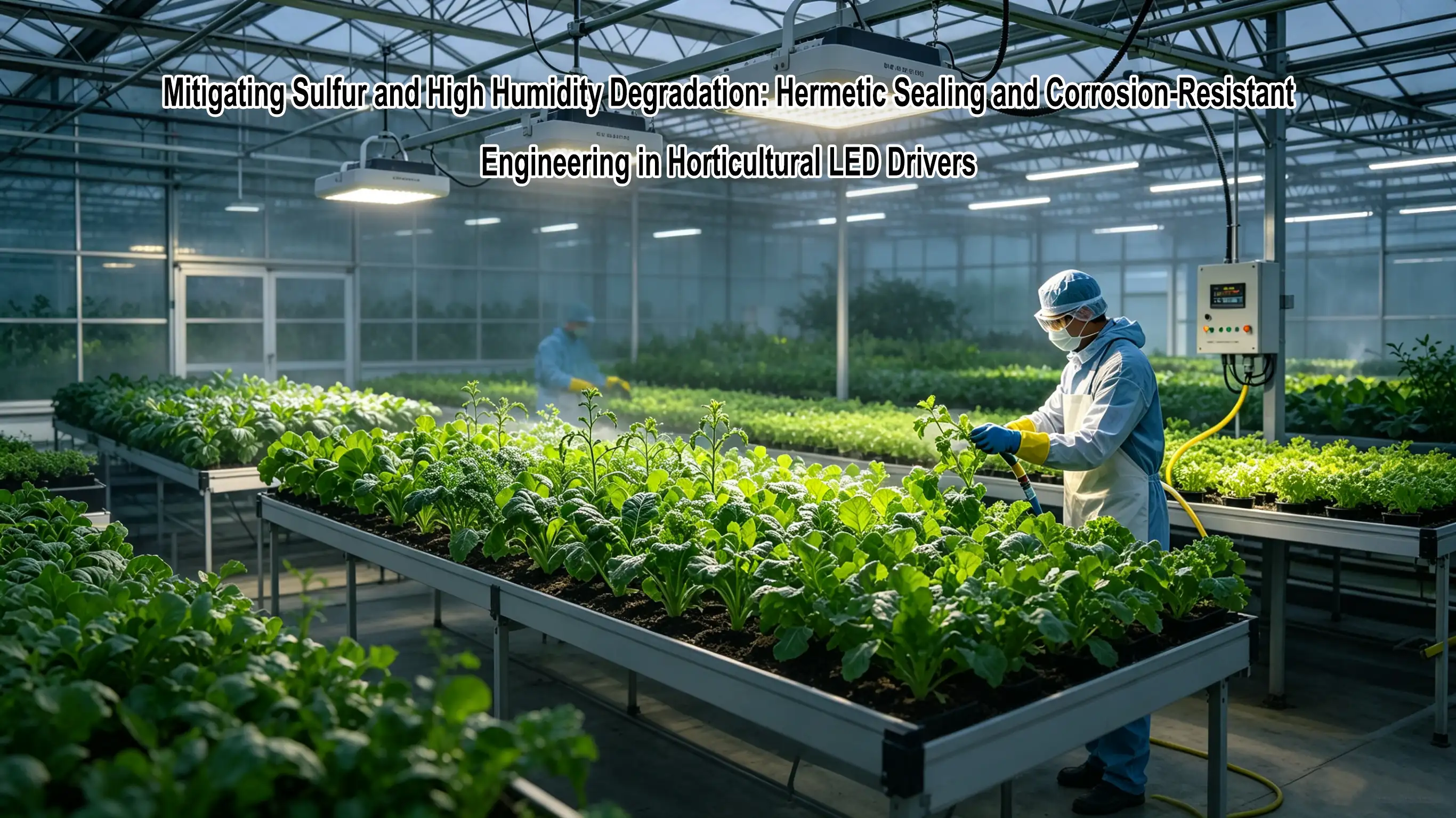
Introduction: The Silent Threat inside Controlled Environment Agriculture (CEA)
Modern Controlled Environment Agriculture (CEA) — encompassing high-tech glasshouses, multi-layer indoor vertical farms, and commercial greenhouses — demands elite electrical infrastructure capable of operating under punishing environmental conditions. While luminaire manufacturers obsess over photosynthetic photon efficacy (PPE) and spectrum optimization, the hidden Achilles' heel of greenhouse lighting installations often lies within the power supply unit: the LED driver.
Greenhouse environments are chemically and climatically aggressive. To manage fungal pathogens like powdery mildew and botrytis, greenhouse operators frequently perform routine sulfur vaporization and fumigation cycles. Simultaneously, transpiration from dense canopy foliage maintains a continuous environment of 95% relative humidity (RH) paired with elevated ambient temperatures ranging from 35℃ to 40℃.
When standard commercial or industrial-grade LED drivers are deployed into these enclosed, sulfur-rich, humid atmospheres, catastrophic failures occur within months. Sulfur gas molecules permeate standard plastic housings and low-grade silicone seals, reacting chemically with internal copper traces and solder joints. The result is rapid corrosion, open-circuit failures, and massive field return rates. This whitepaper examines the electro-chemical failure mechanisms of non-hermetic drivers and details the advanced engineering paradigm required to guarantee a true 50,000+ hour operational lifespan in agricultural environments.
1. The Environmental Profile of Modern Commercial Greenhouses
To design reliable hardware, engineers must first quantify the severe stressors present in contemporary agricultural facilities. A typical commercial tomato or cannabis greenhouse presents a combination of thermal, humidity, and chemical factors that exceed standard industrial specifications (IEC 60529 IP65/IP67).
Thermal and Moisture Extremes
During peak photoperiods, high-output LED fixtures generate substantial internal heat. Combined with a greenhouse ambient temperature of Tamb = 35℃ - 40℃, driver internal case temperatures frequently exceed 75℃ to 85℃. When irrigation cycles occur or night-time ventilation drops temperatures rapidly, internal pressure differentials pull moisture-laden air through microscopic expansion gaps in non-hermetic enclosures.
Mathematically, the dew point fluctuation drives moisture condensation across internal PCBs:
Pvapour = f (RH, Tamb)
When relative humidity remains sustained at RH ≥ 95%, any micro-breach in sealing integrity leads to direct water droplet formation on high-voltage traces, triggering electrochemical migration and dendrite formation.
The Chemical Menace: Sulfur Vaporization
Sulfur fumigation remains a cornerstone of organic and conventional pest management in greenhouses. Electric sulfur burners heat elemental sulfur (S8) to vaporization points, filling the greenhouse airspace with sulfur dioxide (SO2) and sulfur vapor aerosols.
While elemental sulfur is non-conductive in pure solid form, sulfur vapor is highly penetrating. It acts as an aggressive oxidizing agent when combined with atmospheric moisture.
2. The Physics of Failure: How Sulfur and Humidity Destroy Standard Drivers
Standard outdoor LED drivers utilize stamped aluminum enclosures sealed with standard polyurethane or silicone gaskets, or employ low-cost potting compounds that lack cross-linking density. These materials present critical structural vulnerabilities in agricultural settings.
1. Gas Permeation through Elastomeric Seals
Elastomers (such as standard silicone, EPDM, and neoprene used in cable glands and perimeter gaskets) are porous at the molecular level. Sulfur gas molecules possess a small atomic radius and high vapor pressure, allowing them to diffuse directly through elastomeric matrices via a solution-diffusion mechanism:
J = -D dC/dx
Where J is the diffusion flux, D is the diffusion coefficient of sulfur through the polymer, and dC/dx is the concentration gradient. Over thousands of hours, sulfur molecules accumulate inside the enclosure, creating a corrosive micro-climate around sensitive electronics.
2. Copper Sulfide (Cu2S) Formation
Once inside the driver enclosure, sulfur vapor reacts directly with exposed copper traces, component pads, connector pins, and solder joints. The chemical reaction with bare copper yields copper(I) sulfide:
2Cu + S → Cu2S
Cu2S is a semiconductor with needle-like dendritic growth characteristics (often referred to as "creeping corrosion"). As these crystals grow across printed circuit board traces, they bridge insulating gaps, causing short circuits, erratic PWM dimming behavior, and eventual catastrophic burnout of power MOSFETs or auxiliary power ICs.
3. Solder Joint Degradation and Intermetallic Embrittlement
In the presence of moisture, sulfur compounds react with tin-lead or lead-free (Sn-Ag-Cu) solder joints. This accelerates galvanic corrosion, destroying the intermetallic layer between component leads and the PCB pads. Under thermal cycling (35℃ to 85℃), these corroded joints experience micro-cracking, resulting in intermittent open circuits and total driver failure.
3. The Engineering Solution: Hermetic Sealing and Corrosion-Resistant Architecture
To achieve true resistance against agricultural sulfur and high humidity, driver architecture must be re-engineered from the enclosure level down to component selection.
1. Full Die-Cast Aluminum Enclosures with Fluoropolymer Coatings
Standard extruded aluminum with anodized finishes is insufficient because acidic sulfur condensates can pit anodized layers over time. High-performance horticultural drivers utilize heavy-duty, high-purity die-cast aluminum enclosures treated with a multi-stage conversion coating followed by a high-durability fluoropolymer powder coat (such as PVDF or specialized PTFE-infused epoxies).
Fluoropolymer finishes provide a chemically inert surface barrier that repels both moisture droplets and sulfur aerosols, preventing chemical adhesion and pitting corrosion.
2. Hermetic Potting and Non-Permeable Encapsulation
To completely eliminate internal air cavities where sulfur gas and moisture can accumulate, elite drivers employ vacuum-degassed, two-part thermal potting compounds (specialized polyurethane or epoxy blends).
Zero-Air-Void Integrity: Vacuum potting ensures that every micro-space around transformers, capacitors, and power switches is completely filled.
High Thermal Conductivity (k): Unlike low-grade potting that traps heat, advanced horticultural potting compounds maintain a high thermal conductivity coefficient (k ≥ 1.4 W/m · K), ensuring efficient heat dissipation from internal semiconductor junctions to the outer aluminum housing.
Sulfur-Blocking Molecular Structure: The cross-linked polymer matrix of advanced potting compounds features ultra-tight molecular spacing that physically blocks sulfur gas diffusion, protecting internal copper traces from Cu2S formation.
3. Secondary Conformal Coating and Hermetic Cable Glands
All internal PCBs receive a military-grade secondary conformal coating (acrylic-urethane or parylene coating) to provide a secondary line of defense. Furthermore, cable entry points utilize hermetically sealed, brass-nickel-plated cable glands with compression o-rings, eliminating moisture ingress along flexible wiring harnesses.
4. Summary Matrix: Non-Hermetic vs. Hermetically Sealed Horticultural Drivers
Performance Parameter | Standard Industrial Driver (Non-Hermetic) | Advanced Hermetic Horticultural Driver (Ottima Spec) |
Enclosure Sealing | Gasketed IP65/IP67 with air cavity | Full die-cast aluminum + vacuum potting (Hermetic IP68) |
Sulfur Vapor Resistance | Vulnerable; rapid internal Cu2S corrosion | Impermeable fluoropolymer finish + sulfur-blocking potting |
Humidity Tolerance (RH) | Fails at ≥ 90RH due to condensation paths | Withstands continuous 95% - 100RH condensing environments |
Expected Lifespan in Greenhouse | 15,000 - 25,000 hours (High RMA rate) | >50,000 hours (L70, ultra-low field failure rate) |
5. B2B Value Proposition for Agritech EPCs and Greenhouse Developers
For greenhouse project developers, commercial growers, and agricultural engineering, procurement, and construction (EPC) firms, luminaire and driver failures in large-scale installations incur massive operational costs. Disassembling high-bay horticultural fixtures in a 10-hectare commercial glasshouse to replace corroded drivers requires specialized labor, operational downtime, and expensive warranty claims.
By specifying LED drivers engineered with true hermetic sealing and sulfur-resistant fluoropolymer protection, agritech EPCs deliver guaranteed reliability:
Mitigation of RMA Risks: Eliminates costly warranty callbacks caused by sulfur fumigation damage.
Maximized Crop Yields: Prevents unexpected lighting dropouts during critical vegetative and flowering photoperiods.
Lower Total Cost of Ownership (TCO): Secures a verifiable 50,000+ hour operational lifespan, justifying premium capital expenditure for commercial CEA projects.
6. Conclusion
Controlled Environment Agriculture represents the future of sustainable food and specialty crop production, but it punishes substandard electrical hardware. The combination of high ambient humidity (95 RH), thermal cycling, and aggressive sulfur fumigation makes traditional non-hermetic LED drivers obsolete.
By adopting advanced engineering principles—such as die-cast aluminum enclosures with fluoropolymer finishes, vacuum-degassed hermetic potting, and zero-permeability cable interfaces—horticultural lighting systems can achieve unprecedented durability. Specifying corrosion-resistant, hermetically sealed LED drivers is the ultimate safeguard for modern agritech infrastructure, ensuring uninterrupted growth and long-term profitability.


