
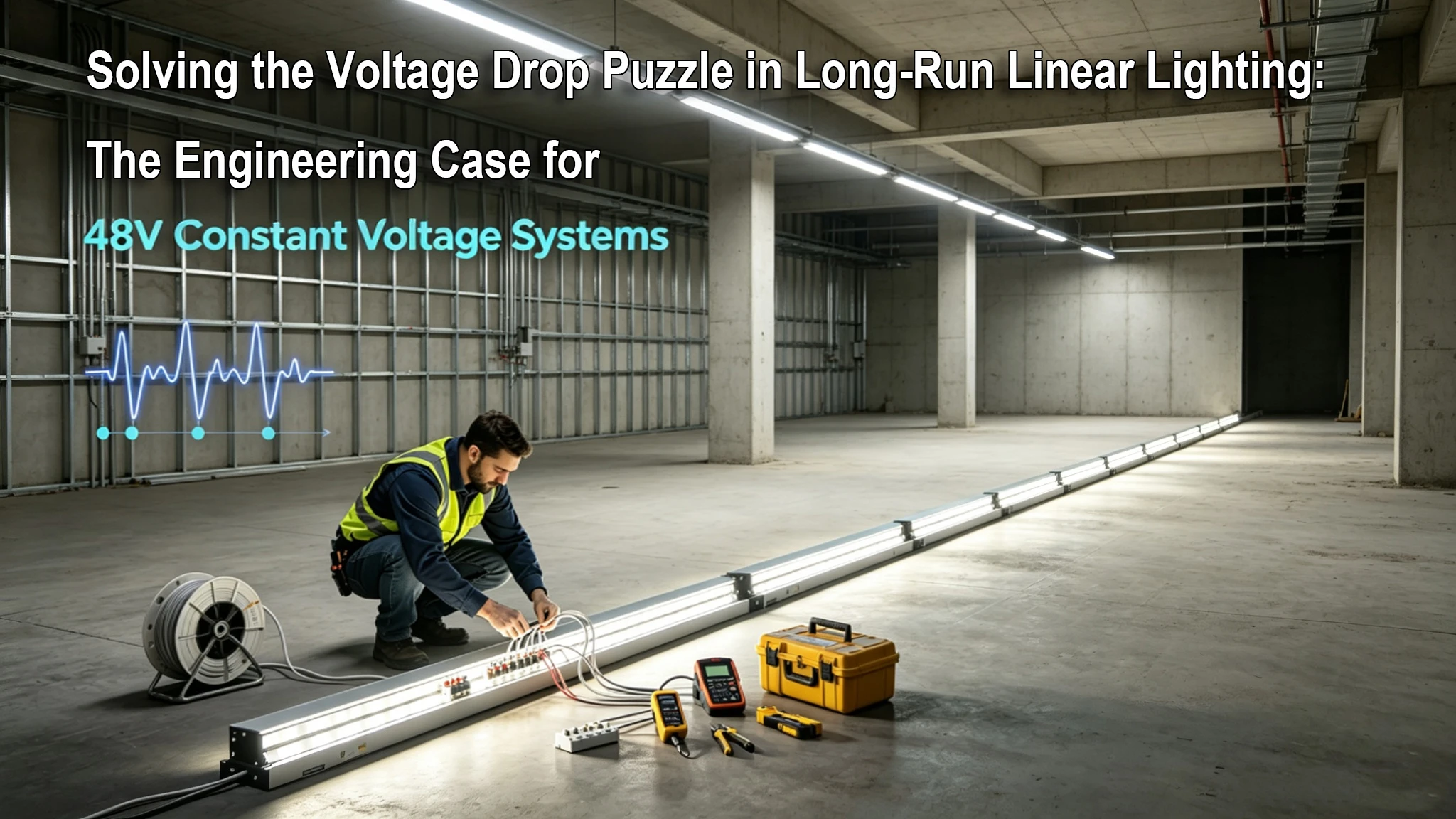
Solving the Voltage Drop Puzzle in Long-Run Linear Lighting: The Engineering Case for 48V Constant Voltage Systems
1. Executive Summary: The Seamless Architectural Vision vs. The Physics of Copper
In contemporary architectural design, the integration of seamless, continuous linear lighting has evolved from a high-end trend into a standard design language. Modern office corridors, airport terminals, hotel facades, and expansive retail spaces frequently demand uninterrupted lines of light stretching 20, 30, or even 50 meters without visible joints or dark spots.
To achieve this minimalist aesthetic, lighting designers specify high-density, flexible constant voltage LED strips installed inside aluminum extrusions. However, when electrical contractors and system integrators attempt to execute these long linear runs using traditional 12V or 24V DC systems, they invariably run headfirst into a fundamental law of physics: Ohm’s Law and the resulting phenomenon of Voltage Drop.
Voltage drop manifests physically as a gradual dimming and noticeable color shift (typically shifting toward an unwanted yellowish or reddish tint) as the distance from the power supply increases. Historically, overcoming this required complex "power injection" topologies, necessitating thick, expensive copper cabling and multiple distributed power supplies hidden behind ceiling hatches—an operational and aesthetic nightmare.
This technical whitepaper presents the comprehensive engineering case for transitioning from legacy 12V/24V systems to 48V DC Constant Voltage LED Driver architectures. We will dissect the mathematics of voltage drop, analyze wire gauge (AWG) constraints, evaluate the safety boundaries of UL Class 2 compliance, and demonstrate the profound CAPEX and OPEX savings that 48V systems deliver to B2B commercial real estate developments.
2. The Physics of Voltage Drop in Constant Voltage Systems
To resolve the voltage drop puzzle, we must first examine the electrical properties of flexible LED tape.
2.1 Anatomy of a Constant Voltage LED Strip
Unlike constant current luminaires, a constant voltage LED strip is a parallel-serial circuit. The strip is divided into distinct, cuttable segments. Each segment contains a series string of LED dies paired with a current-limiting resistor (or an active onboard constant-current regulator IC) connected in parallel across two continuous copper busbars embedded within the Flexible Printed Circuit (FPC).
The FPC's copper tracks act as conductors. While copper is an excellent conductor, it is not perfect; it possesses an inherent resistance ( R ). As current ( I ) flows down the length of the strip to power each successive parallel segment, the cumulative resistance of the copper tracks causes a progressive reduction in voltage ( V ) according to Ohm’s Law:
Vdrop = I × Rcable_and_FPC
2.2 The Mathematical Impact: 24V vs. 48V
The power ( P ) required by an LED load is the product of voltage and current:
P = V × I
If a commercial linear fixture requires 100 Watts of power:
At 24V DC, the system must draw 4.17 Amperes of current:
I =100W÷24V = 4.17A
At 48V DC, the system only draws 2.08 Amperes of current:
I = 100W÷48V= 2.08A
By doubling the system voltage to 48V, we reduce the current draw by exactly 50% for the same power output.
Why is this reduction in current so critical? The power lost as heat within the conductors (the copper FPC tracks and the feed cables)—known as copper loss or Joule heating—is proportional to the square of the current:
Ploss= I2 × R
By halving the current ( I ), the power loss in the copper tracks is reduced by a factor of four (22 = 4). Consequently, the voltage drop along the run is dramatically mitigated. A 48V system can transmit the same amount of power over four times the distance of a 24V system using the exact same wire gauge before experiencing the same percentage of voltage drop.
3. The Color Shift Phenomenon: Why Voltage Drop Ruins High-End Spaces
For lighting designers, the most catastrophic consequence of voltage drop is not merely the loss of brightness, but the degradation of Color Rendering Index (CRI) and Correlated Color Temperature (CCT) consistency.
Most high-quality white LED strips use blue LED dies coated with a yellow phosphor mix. The forward voltage ( Vf ) required to illuminate these blue semiconductor dies typically ranges between 2.8V and 3.2V.
In a 24V system, segments typically place 6 or 7 LEDs in series with a resistor. If the voltage drops from 24V to 21V at the end of a long run, the voltage across each LED segment drops below its minimum Vf.
As the voltage falls, the current flowing through the LEDs drops exponentially. Because white light mixing is highly dependent on precise current density, the blue emission drops faster than the phosphor decay, causing the light at the far end of the strip to shift towards a warm, dingy yellow or red.
This violates the strict MacAdam Ellipse (SDCM) tolerances required in premium spaces like luxury retail or museum galleries, where color consistency must remain within 2 or 3 steps across the entire installation. Operating on a 48V constant voltage LED driver ensures the voltage remains well above the threshold of the linear regulators down the entire length, maintaining absolute CCT and CRI consistency from the first meter to the thirtieth.
4. Cable Gauge (AWG) Calculation and Feed Distance Analysis
Let us look at a practical engineering calculation. Consider a typical commercial cove lighting installation where the constant voltage driver is housed in a remote electrical closet, requiring a 15-meter (50-foot) feed cable to reach the start of a 10-meter LED strip drawing 150W of power.
To maintain visual performance, the maximum allowable voltage drop at the very end of the run should not exceed 3% of the nominal voltage.
Remote LED Driver to LED Strip
+--------------------------+ 15m Feed Cable (AWG) +---------------------------+
| Remote Constant |===============================| Start of 10m Strip |
| Voltage Driver | | (Load: 150W) |
+--------------------------+ +---------------------------+
4.1 The 24V Scenario
Load Current:
I = 150W÷24V = 6.25A
Allowable Voltage Drop (3%):
Vdrop_max = 24V × 0.03 = 0.72V
Required Loop Resistance (Rloop):
Rloop = Vdrop_ma ÷ I = 0.72V ÷ 6.25A = 0.1152Ω
Maximum Copper Wire Resistance per kilometer (for a 15m run, total wire path is 30m):
Rper_km = 0.1152Ω ÷ 0.03km = 3.84Ω/km
To achieve a resistance lower than 3.84Ω/km, the engineer must specify a minimum of 10 AWG (5.26 mm²) copper wire. 10 AWG wire is thick, heavy, extremely rigid, difficult to route through standard architectural conduit, and highly expensive.
4.2 The 48V Scenario
Load Current:
I = 150W ÷ 48V = 3.125A
Allowable Voltage Drop (3%):
Vdrop_max = 48V× 0.03 = 1.44V
Required Loop Resistance (Rloop):
Rloop = Vdrop_max ÷ I = 1.44V÷3.125A = 0.4608Ω
Maximum Copper Wire Resistance per kilometer (30m total path):
Rper_km = 0.4608Ω ÷ 0.03km = 15.36Ω/km
To achieve a resistance lower than 15.36Ω/km, the engineer can specify 16 AWG (1.31 mm²) copper wire.
The Engineering Takeaway
By upgrading to a 48V architecture, the copper cross-sectional area required for the feed cable drops by approximately 75% (from 10 AWG to 16 AWG). This thin, flexible 16 AWG cable is significantly easier for electrical contractors to pull through walls and connect to low-profile luminaire terminations, reducing both material costs and labor time.
5. Navigating the Regulatory Landscape: UL Class 2 Boundaries
In the North American B2B market (and increasingly under international IEC standards), safety regulations dictate strict electrical boundaries for low-voltage lighting systems. The National Electrical Code (NEC Article 725) defines Class 2 circuits to mitigate the risk of both electrical shock and fire.
For a constant voltage power supply to be certified as Class 2, it must comply with the following strict limits under any load condition:
Maximum Voltage: 60V DC (dry locations).
Maximum Power Output: 100W per channel.
+------------------------------------------------------------------+
| UL CLASS 2 BOUNDARIES |
| |
| Voltage Limit: 60V DC <--- [48V Driver fits here] |
| Power Limit: 100W per channel |
+-------------------------------------------------------------------+
How 48V Intersects with Class 2 Compliance
Some MEP engineers incorrectly assume that because 48V is a higher voltage, it is harder to pass Class 2 requirements than 24V. In reality, 48V fits perfectly within the Class 2 envelope:
At 24V, a 100W Class 2 limit restricts the current to 4.17A.
At 48V, a 100W Class 2 limit restricts the current to 2.08A.
Operating at a lower current (2.08A) is inherently safer from a fire hazard perspective, as local resistive heating at loose wire terminals is greatly reduced. Premium 48V constant voltage LED drivers are designed with multiple, isolated 100W outputs. A single physically compact 400W 48V driver can host four independent 100W Class 2 circuits, allowing engineers to drive massive linear runs safely and legally from a single central point.
6. Financial Analysis (CAPEX & OPEX): The Real ROI of 48V Systems
Let us evaluate the economic impact of choosing 48V over 24V for a medium-sized commercial project, such as a 3-floor corporate office requiring 600 meters of high-density linear LED lighting (drawing 15W/meter, total load of 9,000W).
6.1 CAPEX Comparison (Initial Capital Outlay)
Scenario A: The 24V Architecture
Maximum Run Length per feed (to avoid >3% voltage drop): 6 meters.
Number of Power Feeds / Injection Points required: 600m / 6m = 100 feed points.
LED Drivers required (using 200W dual Class 2 drivers): 45 drivers.
Cabling Infrastructure: Requires thick 12 AWG wiring for remote runs to prevent drop. High material cost.
Installation Labor: Electricians must install 100 separate junction boxes and feed cables inside the ceiling.
Scenario B: The 48V Architecture
Maximum Run Length per feed (maintaining CCT consistency): 15 meters.
Number of Power Feeds / Injection Points required: 600m / 15m = 40 feed points.
LED Drivers required (using 400W quad Class 2 drivers): 23 drivers.
Cabling Infrastructure: Slim, highly cost-effective 16 or 18 AWG wiring can be used for remote runs.
Installation Labor: 60% fewer feed points means far fewer junction boxes to install, inspect, and wire.
Cost Component | 24V System | 48V System | Cost Difference (Savings with 48V) |
LED Drivers | $5,400 | $4,100 | $1,300 (24% Savings) |
Copper Cabling | $3,800 | $1,100 | $2,700 (71% Savings) |
Junction Boxes & Accessories | $1,500 | $600 | $900 (60% Savings) |
Electrical Labor (Installation) | $12,000
| $5,500 | $6,500 (54% Savings) |
Total CAPEX | $22,700 | $11,300 | $11,400 (50% Cumulative Savings) |
6.2 OPEX Comparison (Ongoing Operational Costs)
1. The financial benefits of the 48V system continue long after the building is commissioned:
2. Reduced Maintenance Access Points: Halving the number of drivers means halving the statistical probability of a driver failure. Facilities teams have fewer ceiling hatches to access, minimizing disruption to office tenants.
Lower Systemic Energy Loss: Because copper losses ( I2R ) are reduced by 75% in the wiring infrastructure, the overall power supply system runs cooler and draws less raw power from the grid, lowering the building’s monthly utility bill and contributing to LEED energy credits.
7. Technical Specifications for the Perfect Tender Document
To ensure your project receives a true, high-performance 48V linear system without vendor compromise, MEP consultants should use the following explicit specifications in their tender documents:
1. Driver Architecture: "All linear LED luminaires must be powered by remote constant voltage LED drivers operating at a nominal output voltage of 48V DC."
2. Efficiency and Power Factor: "LED drivers must feature active power factor correction (PFC), maintaining a Power Factor (PF) >0.95 and a Total Harmonic Distortion (THD) <10% at full load, with an electrical conversion efficiency of no less than 91%."
3. Regulatory Safety: "The 48V power supply must feature isolated, multi-channel outputs individually compliant with UL Class 2 limits (not exceeding 100W per channel)."
4. Flicker Performance: "Dimming must be executed via high-frequency PWM (>3kHz) or hybrid dimming (CCR to ultra-high PWM) to guarantee absolute flicker-free performance in compliance with IEEE 1789-2015 limits."
8. Conclusion: The Definitive Shift
For commercial developers, lighting integrators, and electrical engineers, the shift to 48V constant voltage LED drivers is an engineering inevitability. Attempting to force legacy 12V or 24V systems to meet the demands of modern, long-run linear lighting is a costly, inefficient compromise.
By adopting a 48V DC architecture, B2B projects eliminate the physical threat of voltage drop, safeguard critical color consistency across massive spaces, drastically reduce copper wire consumption, and slash installation labor costs by half. 48V is not just a higher voltage; it is the fundamental key to unlocking the true aesthetic and economic potential of modern architectural lighting.


