
Lighting as a Data Network: Utilizing DALI-2 Sensors & Driver Diagnostics (DiiA) for Smart City Infrastructure
1. Executive Summary: The Ultimate Smart City Trojan Horse
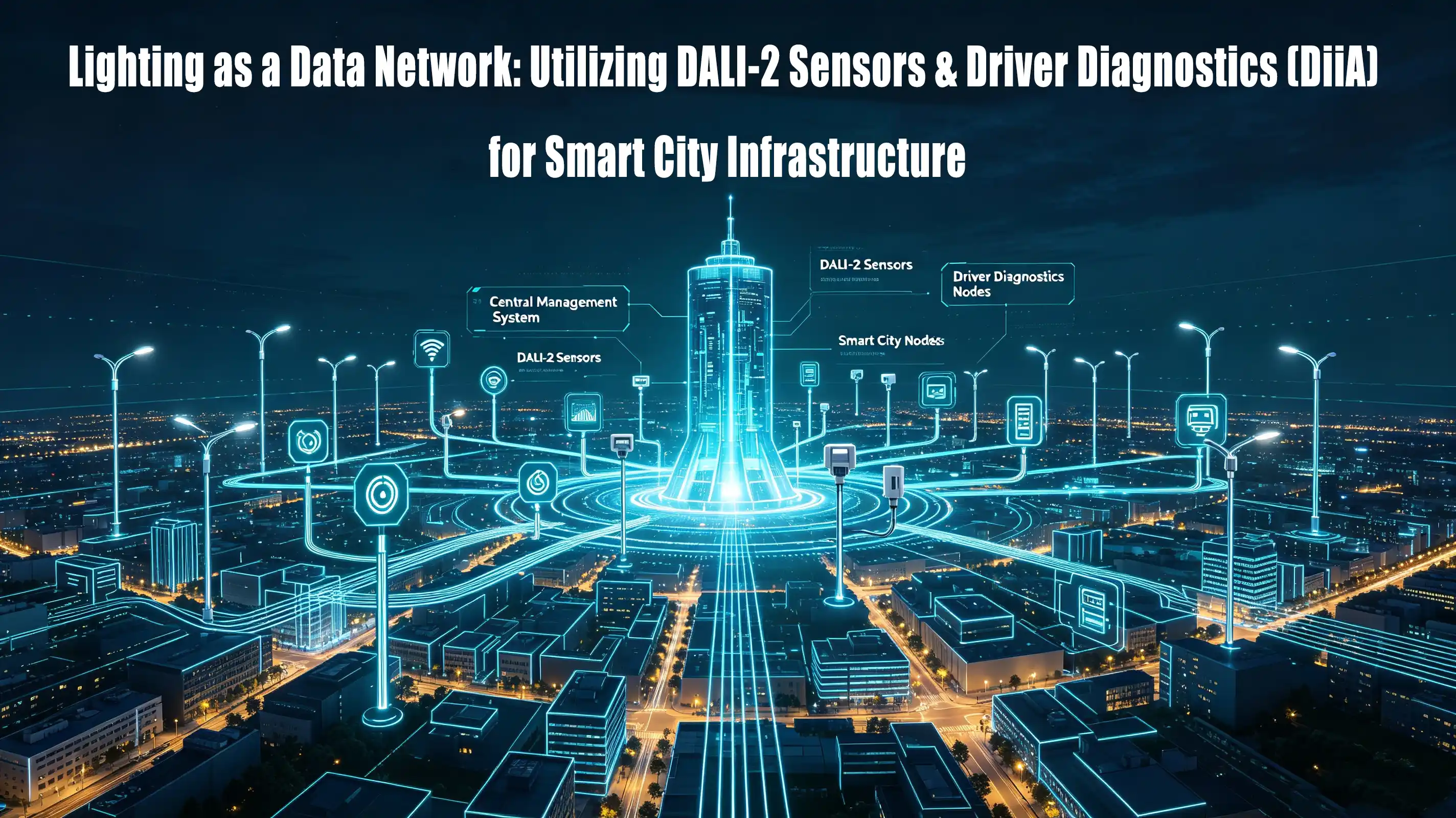
For decades, municipal street lighting has been viewed purely as a civic utility and a major line item on a city's energy budget. However, in the era of the Internet of Things (IoT) and big data, urban planners and Energy Service Companies (ESCOs) are undergoing a paradigm shift. The street lighting grid is no longer just an illumination asset; it is the ultimate "Trojan Horse" for Smart City infrastructure.
Why light poles? They possess three unparalleled advantages: Ubiquity (they exist every 30 to 50 meters), Elevation (they provide optimal vantage points for sensors and antennas), and Constant Power (they are hardwired to the municipal grid).
By transitioning these vertical assets from "dumb" metal poles to intelligent, sensor-equipped nodes, municipalities can harvest unprecedented volumes of urban data. The technological catalyst unlocking this capability is the Digital Addressable Lighting Interface (DALI-2), augmented by the D4i (DALI for IoT) specification. This exhaustive technical whitepaper explores the deep engineering and financial architecture required to utilize DALI-2 sensors and DiiA diagnostic data to construct a robust, future-proof Smart City network.
2. The Protocol Evolution: From DALI-2 to D4i
To engineer a Smart City lighting network, B2B integrators must understand the evolution of the DALI protocol and its specific applications in outdoor environments.
2.1 The Baseline: DALI-2
DALI-2 (IEC 62386) introduced rigorous interoperability and standardization for indoor lighting control. However, outdoor street lighting required a different approach. You don't run a physical two-wire DALI bus for 10 kilometers down a highway. Instead, the outdoor luminaire connects to a wireless network (via cellular NB-IoT, LoRaWAN, or RF mesh), and the DALI communication occurs inside the luminaire housing. This is known as the Intra-Luminaire DALI Bus.
2.2 The IoT Enabler: The D4i Standard
Recognizing the need to mount wireless communication nodes and environmental sensors directly onto streetlights, the DALI Alliance (DiiA) created the D4i certification. D4i is an extension of DALI-2 specifically engineered for IoT integration.
For a driver to achieve D4i certification, it must incorporate specific power supply capabilities to feed external sensors and nodes without requiring secondary power adapters:
Part 250 (Integrated Bus Power Supply): The LED driver provides the mandatory power (typically 24V/3W) to run the DALI bus and power the connected sensor nodes.
Part 150 (AUX Power Supply): For high-power nodes (like cellular modems or advanced edge-computing cameras), the driver provides a separate 24V DC auxiliary power supply.
When a D4i driver is paired with standardized mechanical interfaces like the NEMA 7-pin or the newer, more compact Zhaga Book 18 receptacle, the streetlight becomes a plug-and-play socket for Smart City sensors.
3. Harvesting Urban Data: The Power of DiiA Specifications
The true value of a Smart City network is not the hardware; it is the data. D4i mandates the implementation of specific DiiA specifications that force the LED driver to act as an advanced diagnostic computer, constantly writing critical operational data to its internal memory banks.
3.1 Part 251: Luminaire Data (Asset Management)
In traditional municipal grids, keeping track of which fixture is mounted on which pole is an inventory nightmare involving spreadsheets and bar-code stickers that fade in the sun.
The Solution: Part 251 allows the OEM manufacturer to encode specific luminaire data directly into the driver’s memory bank 1. This includes the GTIN (Global Trade Item Number), nominal light output, CCT (Color Temperature), CRI, and light distribution profile.
Smart City Value: When the luminaire is installed, the wireless node automatically queries this data and uploads it to the Central Management System (CMS). The city’s digital twin is populated automatically, creating a flawless, auto-updating asset inventory.
3.2 Part 252: Energy Reporting (Financial Precision)
Municipalities are routinely billed for street lighting based on estimated tariffs. This flat-rate billing negates the financial incentive to implement deep dimming schedules late at night.
The Solution: Part 252 mandates that the LED driver accurately calculates and stores real-time Active Power (Watts) and Active Energy (kWh). High-end drivers achieve an accuracy of ±2%.
Smart City Value: The wireless node retrieves this precise energy data and transmits it to the CMS. ESCOs and municipalities can now implement "Pay-per-use" billing with utility companies. When the lights are dimmed by 50% at 2:00 AM, the city sees an immediate, mathematically proven reduction in their energy invoice, radically accelerating the ROI of the retrofit project.
3.3 Part 253: Diagnostics & Maintenance (Predictive Analytics)
This is where lighting transitions into an advanced IT network. Part 253 focuses on the health of the driver and the LED array. The driver tracks:
Operating Hours: Total hours the driver has been powered on, and total hours the LED module has been illuminated.
Thermal Diagnostics: The driver records its own internal temperature and the external temperature of the LED module (via an NTC thermistor). It tracks the exact number of hours the fixture operated in specific temperature brackets (e.g., how long it survived at 80°C).
Fault Codes: It logs over-voltage events, short circuits, and open circuits.
Smart City Value: Instead of relying on citizen complaints ("reactive maintenance"), the CMS utilizes AI to analyze this data stream. If a driver on 5th Avenue reports an abnormally high internal temperature for three consecutive nights, the system flags it for "Predictive Maintenance." A technician is dispatched to clean the heat sink or replace the driver before the light fails, eliminating unscheduled truck rolls and improving public safety.
4. Expanding the Ecosystem: DALI-2 Sensors (Parts 303 & 304)
With the power supply and data pipelines established by D4i, the Zhaga/NEMA node on top of the luminaire can host a vast array of DALI-2 certified sensors.
4.1 Traffic and Presence Detection
By integrating Microwave Radar or PIR sensors (standardized under DALI Part 303 for Occupancy), streetlights enable Dynamic Adaptive Lighting. At 3:00 AM, a suburban street dims to 20% to save energy and reduce light pollution. When the sensor detects an approaching vehicle or pedestrian, it instantly commands the luminaire (and the next three luminaires down the street via RF mesh) to ramp up to 100% brightness. This maximizes energy savings without compromising public safety.
4.2 Environmental Monitoring
Smart City nodes are increasingly equipped with air quality sensors (PM2.5, CO2, NOx), noise pollution monitors, and seismic detectors. Because the D4i driver powers the node, the city avoids the astronomical cost of digging up sidewalks to run dedicated power lines for environmental sensors. The lighting network becomes a city-wide, high-density meteorological and environmental grid, providing data that can influence traffic routing and urban planning in real-time.
5. System Architecture: From the Pole to the Cloud
Integrating this technology requires a robust IT topology. B2B systems integrators typically deploy the following architecture:
1. The Edge (The Pole): A luminaire equipped with a D4i LED driver, a Zhaga Book 18 receptacle, and an IoT Communication Node.
2. The Transport Layer: The node communicates via a Low Power Wide Area Network (LPWAN). Options include Cellular NB-IoT / LTE-M (which utilizes existing telecom towers, ideal for decentralized infrastructure) or LoRaWAN / Wi-SUN Mesh (ideal for dense urban deployments where cities want to own their network infrastructure).
3. The Application Layer (CMS): The data is aggregated in a cloud-based Central Management System (CMS) via standardized APIs (like uCIFI or TALQ consortium standards). This dashboard provides facility managers with real-time energy analytics, heat maps of traffic density, and predictive maintenance schedules.
6. Conclusion: The Blueprint for B2B Stakeholders
For lighting manufacturers, systems integrators, and municipal consultants, the message is unequivocal: specifying "dumb" LED drivers for outdoor projects is an architectural dead end.
By mandating DALI-2 and D4i certification in public tenders, municipalities future-proof their infrastructure. The integration of DiiA Parts 251, 252, and 253 transforms the LED driver from a passive power supply into an active edge-computing device. It enables ESCOs to guarantee energy savings, dramatically slashes OPEX through predictive maintenance, and provides the physical foundation for the Smart City of tomorrow. Lighting is no longer just about visibility; it is the nervous system of the urban environment.


