
Why High-End Hotel Lighting Must Focus on the "Audible Noise" of LED Drivers
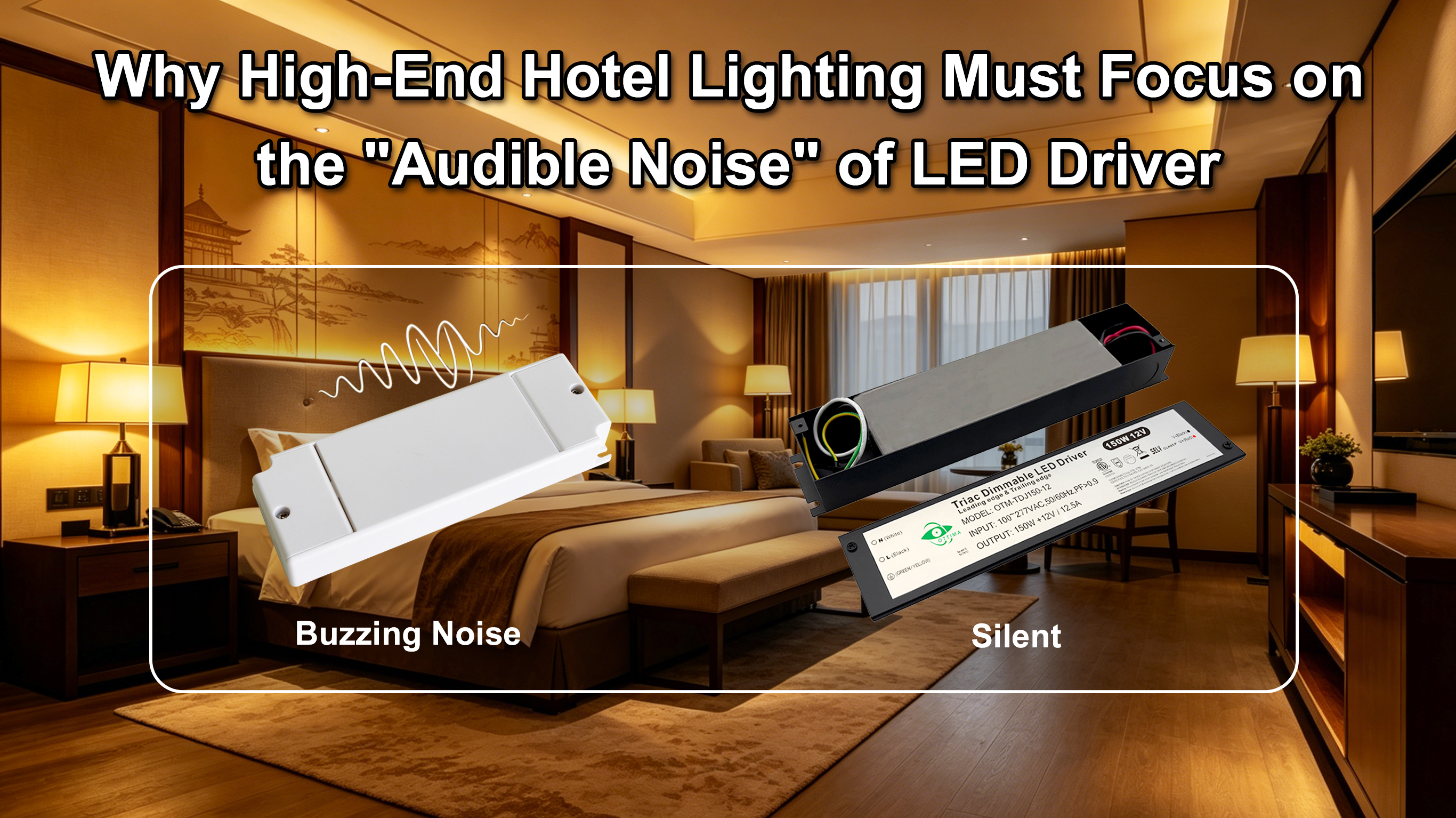
In the executive suite of a five-star hotel, even the slightest flaw is amplified.
Imagine this: Your VIP guest has just finished a day of business meetings and is lying in bed, ready to rest. The room's soundproofing is perfect, the blackout curtains are drawn, and the lights are dimmed to a cozy warm glow.
However, in this extreme silence, a faint but persistent "buzzing" or "humming" sound drifts down from the ceiling.
In that instant, the sense of luxury vanishes.
For hotel engineering directors and lighting designers, "Audible Noise" is a customer experience killer that is harder to detect than glare but just as deadly. This article explores why LED drivers "sing" and how to mitigate this issue through proper selection.
I. The Physics: Why Do Drivers Make Sound?
Electronic components don't have vocal cords; the sound they produce is essentially physical vibration. In LED drivers, this "whining" mainly stems from two physical effects:
1. Magnetostriction — The Transformer's "Breathing"
The core components inside a driver are transformers and inductors, which contain magnetic cores (ferrite).
The Principle: When current passes through the coil creating a magnetic field, the magnetic core material undergoes minute deformation (expansion or contraction) under the influence of the magnetic field.
Resonance: When the current fluctuates at a specific frequency (like 100Hz or PWM dimming frequency), the core mechanically vibrates at that same frequency. If this frequency falls within the human hearing range (20Hz - 20kHz), it becomes a miniature speaker, emitting a "hum."
2. Piezoelectric Effect — The Capacitor's "Tremble"
Certain Multi-Layer Ceramic Capacitors (MLCC) undergo mechanical deformation when voltage fluctuates across their dielectric material. In circuits with significant ripple voltage, these capacitors dance along with the voltage waves, emitting a high-pitched "hiss."
II. The Dimming Trap: Why Does It Get Louder When Dimmed?
Many contractors discover: "It's silent at full brightness, but the noise starts as soon as we dim it."
This is because entry-level drivers often use Low-Frequency PWM (Pulse Width Modulation) for dimming.
The Frequency Trap: If the PWM frequency is set between 200Hz and 2kHz (exactly the range where human ears are most sensitive), every on/off cycle of the current strikes the transformer and capacitors violently, triggering severe mechanical resonance.
No-Load Whine: Even when lights are off (standby mode), if the driver enters an intermittent "Burst Mode" to save power, it can generate periodic noise.
III. The Solution: How to Build an "Ultra-Silent" Driver?
To meet the background noise standards of < 20dB or even < 18dB required by five-star hotels, driver manufacturers must invest heavily in craftsmanship.
1. Vacuum Impregnation & Potting
This is the most effective physical noise reduction method.
Vacuum Impregnation: Dipping the transformer in insulating varnish under vacuum fills the tiny gaps between coils and the core, bonding them into a solid block to suppress vibration at the source.
Full Potting: Encapsulating the entire PCBA circuit board in thermal silicone or epoxy resin. The compound acts not only as a heat sink and water barrier but also as an excellent acoustic sponge, absorbing and blocking the propagation of tiny internal vibrations.
2. Ultrasonic Dimming
Solving the frequency issue at the source. High-end drivers use > 20kHz or even > 30kHz ultra-high-frequency PWM dimming. Although components still vibrate, the frequency is pushed beyond the upper limit of human hearing (ultrasonic), achieving not only true "flicker-free" light but also physically "noise-free" operation.
IV. Procurement Standards: Don't Trust Your Ears, Trust the Data
As a professional buyer sourcing drivers for hotels, libraries, or recording studios, follow these standards:
1. Demand Acoustic Test Reports: Don't just ask "Is it noisy?". Require the supplier to provide sound pressure test data measured at a distance of 10cm - 30cm in an anechoic chamber (background noise < 15dB).
Pass Standard: Noise < 24dB(A) at full load and dimming states.
Premium Standard: Noise < 20dB(A) (equivalent to a whisper) at all states.
2. Specify the Process: Explicitly require in the tender documents (Spec): "Drivers must be Fully Potted" or "Feature Anti-humming construction."
3. On-Site Blind Test: Take samples to the quietest mockup room at the project site late at night. Put your ear close to the ceiling fixture and listen carefully at 10%, 50%, and 90% brightness levels.
Silence is the Foundation of Luxury
In high-end lighting, light is not just seen; it is perceived.
If CRI determines the color of light, Audible Noise determines the "purity" of the environment. An excellent LED driver should be like an excellent butler—serving invisibly, existing silently.
Is your hotel project plagued by "electrical buzzing"?
We offer a full range of Class A Silent Drivers (Fully Potted + >30kHz Ultrasonic Dimming). Contact us today to request silent samples and return ultimate tranquility to your guest rooms.


