
Why Matter LED Drivers are the Next "Universal Language" of Smart Lighting?
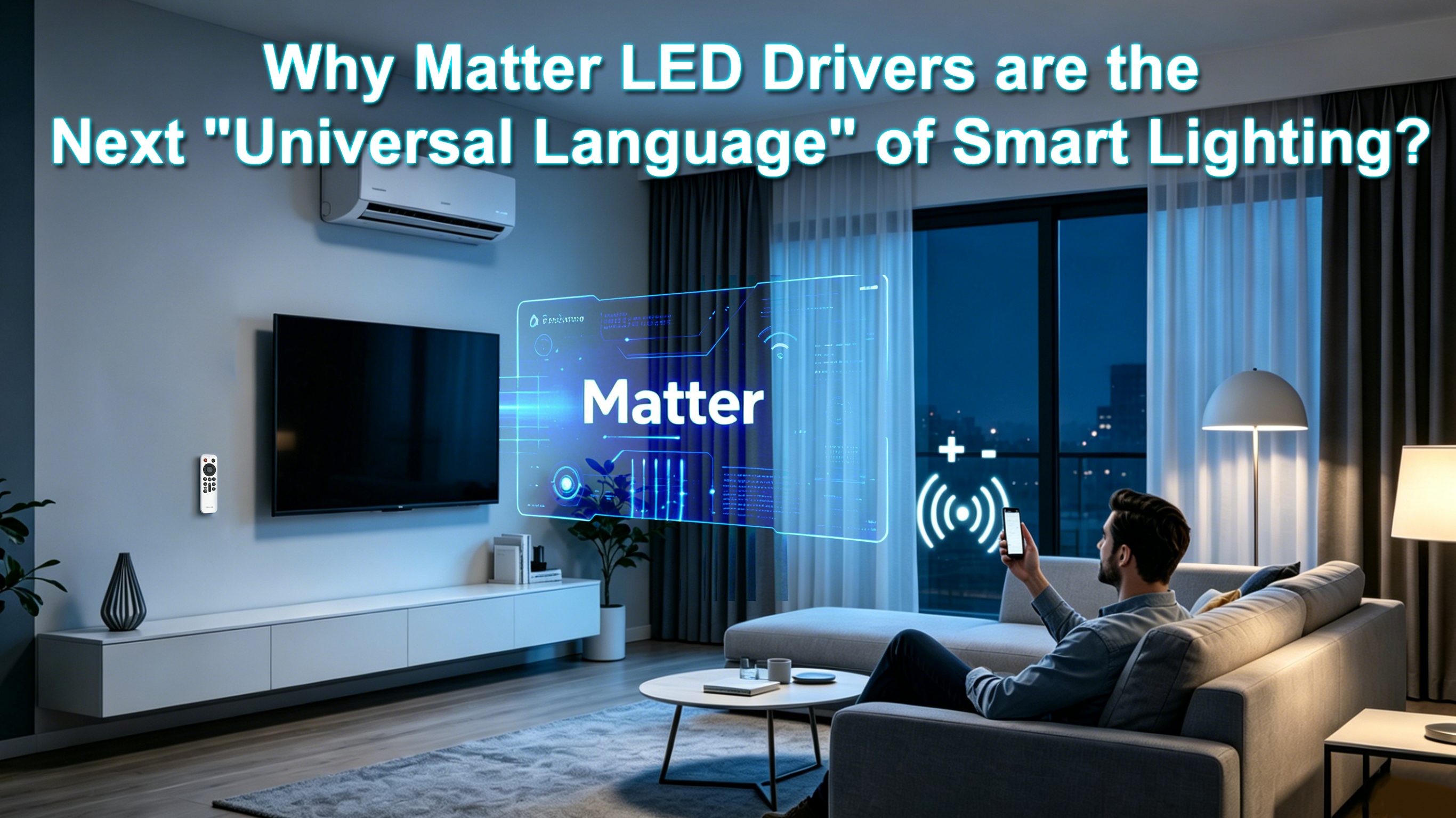
For smart lighting integrators and luminaire manufacturers (OEMs), the past five years have been filled with "decision paralysis."
When planning a smart luminaire or taking on a whole-home smart project, you constantly face endless ecosystem alignment issues:
"This homeowner uses the Apple ecosystem; I need a HomeKit certified driver."
"That project is on the Tuya ecosystem; I need to swap for a Zigbee module."
"Another client uses Amazon Alexa; how do I stock for that?"
This leads to extreme inventory fragmentation. Your warehouse might be piled high with five or six types of drivers that have identical power specs but different communication protocols.
Now, a revolution to end the chaos has arrived. The Matter Protocol, jointly promoted by Apple, Google, Amazon, and the CSA Alliance, is bringing LED drivers into a new era of "Everything Connected, One Standard."
This article provides a deep dive into why Matter-certified LED drivers are not just a new product, but the key to simplifying your supply chain and winning the future.
I. Pain Point Review: The "Tower of Babel" in Smart Lighting
Before Matter, the smart home was like the biblical "Tower of Babel," with various devices speaking different languages and unable to communicate.
1. Protocol Walled Gardens
Zigbee, Z-Wave, Bluetooth Mesh, Wi-Fi... Each protocol has its pros and cons, but they are incompatible. You cannot use a Zigbee gateway to control a Bluetooth bulb.
2. Platform Exclusivity
This is the biggest headache for B2B clients. Typically, Apple HomeKit-supported devices are expensive and hard to develop; Google Home-supported devices won't connect to Siri. As a distributor, you are forced to stock different goods for different end-user groups.
II. The Game Changer: What is a Matter Driver?
Matter is not a new "protocol" in the traditional sense; it is a universal application layer standard built on top of IP (Internet Protocol).
Simply put, Matter is the "Esperanto" (Universal Language) of smart home devices.
1. Certify Once, Run Everywhere
A Matter-certified LED driver can connect simultaneously and locally to:
Apple Home (Siri)
Google Home (Assistant)
Amazon Alexa
Samsung SmartThings
B2B Value: You no longer need to ask the customer, "What phone system do you use?" You only need to stock this one Matter driver to sell to everyone in the market. This not only drastically reduces SKU counts but also eliminates return risks due to ecosystem incompatibility.
2. Local Connection, Works Offline
Unlike traditional Wi-Fi smart lights that rely heavily on the cloud, Matter prioritizes local LAN communication. Even if the internet goes down, your switch panels can still control the lights instantly with extremely low latency and stability comparable to wired systems.
III. The Tech Core: Matter over Thread — The "Nervous System"
Current Matter drivers are mainly based on two underlying technologies: Wi-Fi and Thread. For lighting applications, Thread is the true future.
Why Choose Matter over Thread?
Thread is a low-power, self-healing Mesh networking technology.
Low Power: Thread drivers have extremely low standby power consumption, meeting the strictest energy efficiency standards.
Mesh Network: Every Matter driver acts as a network node. The more lights you install, the stronger and wider the network signal becomes. If one node fails, the network automatically reroutes to heal itself.
Decentralized: No traditional "gateway" or "hub" is needed; only a Border Router (like a HomePod mini or Nest Hub) is required to connect.
Engineering Advantage: In large flats or villa projects, Thread solves the problems of Wi-Fi dead zones and device limits, eliminating the need to deploy multiple wireless APs as in the past.
IV. Hardware Evolution: From "Add-on Module" to "Built-in SoC"
In the Matter era, the hardware architecture of LED drivers is also undergoing a qualitative change.
Past (Era 1.0): Standard 0-10V driver + External Smart Module (Zigbee/Wi-Fi).
Cons: Complex wiring, high cost, requires installation space, prone to offline issues due to loose contacts.
Present (Era 2.0): Driver with Built-in Matter SoC Chip.
Pros: The wireless chip is integrated directly onto the driver PCB. The volume is the same as a standard driver, costs are significantly reduced, and the driver manufacturer handles firmware updates (OTA) and safety certifications centrally.
V. Commercial Decision: Who Should Enter Now?
While Matter is the trend, not everyone needs to switch immediately. We recommend the following B2B clients pay close attention:
1. Cross-border E-commerce & Export-oriented OEMs: The European and American markets have extremely high acceptance of Matter. If your luminaire can bear the "Matter" logo, its competitiveness on Amazon or in offline retail will instantly level up.
2. High-end Whole-Home Integrators: Facing luxury projects with complex devices (locks, curtains, speakers, lights), Matter is the only solution that can "seamlessly blend" these different brands together.
3. Innovative Commercial Lighting Design: Leverage Matter's wireless features to quickly implement zonal dimming and scene control in retrofit projects where trenching and wiring are undesirable.
Universal Language is Productivity
In the history of technology, every "unification of standards" has led to explosive industry growth (think USB ports, think TCP/IP protocol).
Matter-supported LED drivers are transforming smart lighting from a "geek's toy" into "public infrastructure." For driver distributors and luminaire factories, embracing Matter means embracing a future with leaner inventory, broader markets, and simpler maintenance.
Want your luminaires to "understand" all languages?


