
The Silent Killer: Deep Technical Guide to LED Inrush Current & Circuit Breaker Selection
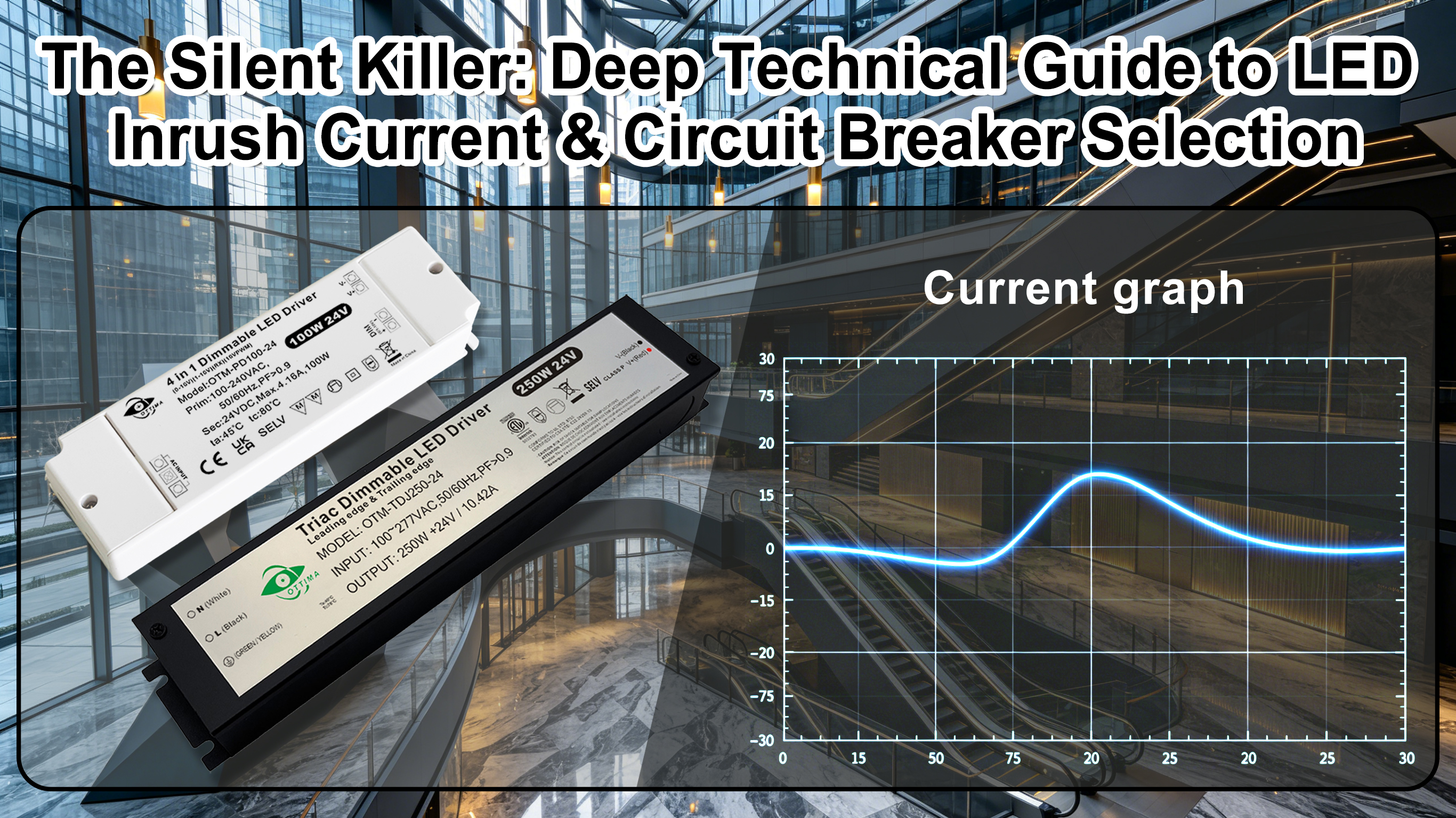
In the world of professional LED installation, there is a phenomenon that frustrates even experienced engineers: The Nuisance Trip.
You’ve finished a high-end commercial project. Hundreds of drivers are installed. Everything looks perfect. But the moment you flip the master switch, "CLICK"—the circuit breaker trips instantly. You flip it back; it works. You try again tomorrow; it trips again.
This is not due to a short circuit or overload. The "ghost" in the system is Inrush Current.
If ignored, this invisible killer will lead to:
Project Delays: Failure to pass inspection due to tripping.
Fused Contacts: Relays and switches welding shut due to arcing.
Equipment Damage: Shortened lifespan of MCBs and drivers.
I. The Physics: Why the "Spike"?
Most modern LED drivers are Switching Mode Power Supplies (SMPS). At the input stage, after the bridge rectifier, they rely on large Electrolytic Bulk Capacitors to smooth out the voltage ripple.
1. The Capacitor Short-Circuit Effect
At the exact moment of power-on (T = 0), these capacitors are completely discharged. According to circuit theory, an uncharged capacitor initially acts as a short circuit with near-zero impedance. The driver draws current as if it were a direct short to the grid.
2. The Critical Role of Phase Angle
The magnitude of the inrush current depends heavily on when in the AC sine wave the switch is closed:
0° Phase (Zero Crossing): Voltage is 0V. The capacitor charges gradually as voltage rises. Inrush is minimal.
90° or 270 Phase (Peak Voltage): Voltage is at its absolute peak (230V×√2 ≈ 325V). Closing the circuit here dumps the maximum voltage onto a near-short-circuit load, creating a massive explosive current spike.
3. The Scale of the Spike
While this event lasts only microseconds (Twidth), its amplitude (Ipeak) can be 50 to 100 times the rated operating current.
Example: A 100W driver rated at 0.5A might draw a cold-start inrush current of 50A.
II. Engineering Metrics: Ipeak & Twidth
When reviewing an LED driver datasheet, do not just look at "Rated Current." You must examine the Inrush Current section for two key values:
1. Ipeak (Peak Current): The maximum amplitude of the spike (Amps).
2. Twidth (Pulse Width): The duration of the spike, usually measured at 50% of Ipeak (microseconds μs).
Why Twidth Matters: The I2t Energy Integral
Circuit breakers don't just react to Amps; the magnetic trip mechanism reacts to Energy.
I2t ≈1/2 · I2peak · Twidth
Even if Ipeak is high, if the pulse is extremely short (Twidth is small), the breaker might ignore it. Conversely, a wider pulse with a lower peak can trigger a trip. Professional selection requires matching this I2t value against the breaker's trip curves.
III. Circuit Breaker Strategy: Type B, C, or D?
The standard reaction to a trip is "Install a bigger breaker" (e.g., swapping 16A for 32A). This is dangerous and violates electrical codes, as the cable may no longer be protected against thermal overload.
The correct engineering solution is to change the Trip Curve, not the rating. According to IEC 60898:
Curve Type | Instant Trip Threshold | Typical Application | LED Recommendation | Analysis |
Type B | 3 - 5 x In | Resistive loads (Heaters), Long cable runs | ✕ Avoid | Too sensitive. Will trip almost immediately with LED loads. |
Type C | 5 - 10 x In | General lighting, Outlets | ! Use with Caution | Industry standard, but requires precise calculation for high-density LED clusters. |
Type D | 10 - 20 x In | High Inductive/Surge Loads (Motors, Transformers) | ✓ Best Choice | Designed specifically to tolerate high inrush currents. Ideal for commercial LED projects. |
Type K | 8 - 12 x In | Industrial Motors | ✓ Industrial | High tolerance, commonly used in industrial settings. |
Pro Tip: For large office, warehouse, or retail projects, specifying Type D breakers (e.g., D16A instead of C16A) is the simplest way to solve nuisance tripping.
IV. The Calculation: How Many Drivers per Breaker?
Stop using "Rules of Thumb" (like "100W per Amp"). In the LED era, this is reckless. Follow this process:
Step 1: Get Ipeak and Twidth from the driver datasheet.
Example: 150W Driver: Ipeak = 60A, Twidth = 300mu μs.
Step 2: Consult the Circuit Breaker Manufacturer's Data.
Brands like ABB, Siemens, and Schneider publish tables specifically for "Max LED Drivers per MCB."
Step 3: Estimation Formula (If no table is available):
N ≈ Min. Instant Trip Current of MCB × Safety Factor (0.8)/ Ipeak
However, because the pulse width is so short, the actual number is usually higher than this simple formula suggests. Rely on the manufacturer's tested data whenever possible.
Important Note: Line Impedance (cable length and gauge) acts as a natural dampener. A driver 50 meters away from the panel will have a significantly lower inrush current than one 5 meters away due to the resistance of the wire.
V. Advanced Solutions: Suppression at the Source
If changing breakers is not an option (e.g., retrofit projects), or the project scale is massive, you must address the issue at the driver level:
1. NTC Thermistor (Passive / Entry-Level)
An NTC resistor is placed in series with the input. High resistance when cold limits current; low resistance when hot allows operation.
The Flaw: "Hot Start" Failure. If lights are turned off and immediately back on, the NTC hasn't cooled down. It offers zero resistance, and the full inrush current hits the breaker.
2. Active Soft Start Circuit (Premium Standard)
High-end drivers (like our Pro Series) feature Active Current Limiting.
Mechanism: Charge occurs through a resistor initially; once voltage stabilizes, a relay or MOSFET bypasses the resistor.
Advantage: Effective limiting (<10A) regardless of whether it's a cold or hot start.
3. Zero-Crossing Technology
The most elegant solution. Used with smart controls (DALI/KNX) or specialized relays.
Mechanism: The system monitors the AC waveform and forces the relay to close exactly at the zero-voltage crossing point (0°).
Result: Physically eliminates the conditions that create high voltage surges, protecting contacts and preventing trips completely.
Conclusion
Inrush current is a natural physical phenomenon, not an uncontrollable disaster.
As a professional contractor or engineer, calculating Ipeak and selecting Type D breakers or Soft-Start drivers is mandatory. It’s not just about technology; it’s about protecting your client's assets and your professional reputation.
Tired of Nuisance Tripping?
Our engineering team offers a full range of Low-Inrush, Soft-Start LED drivers. Contact us today for a free Circuit Breaker Matching Calculation for your specific project.


