
The War of Color Temperature: DALI DT8 (Single Address) vs. 2x 0-10V (Dual Channel) Comparison
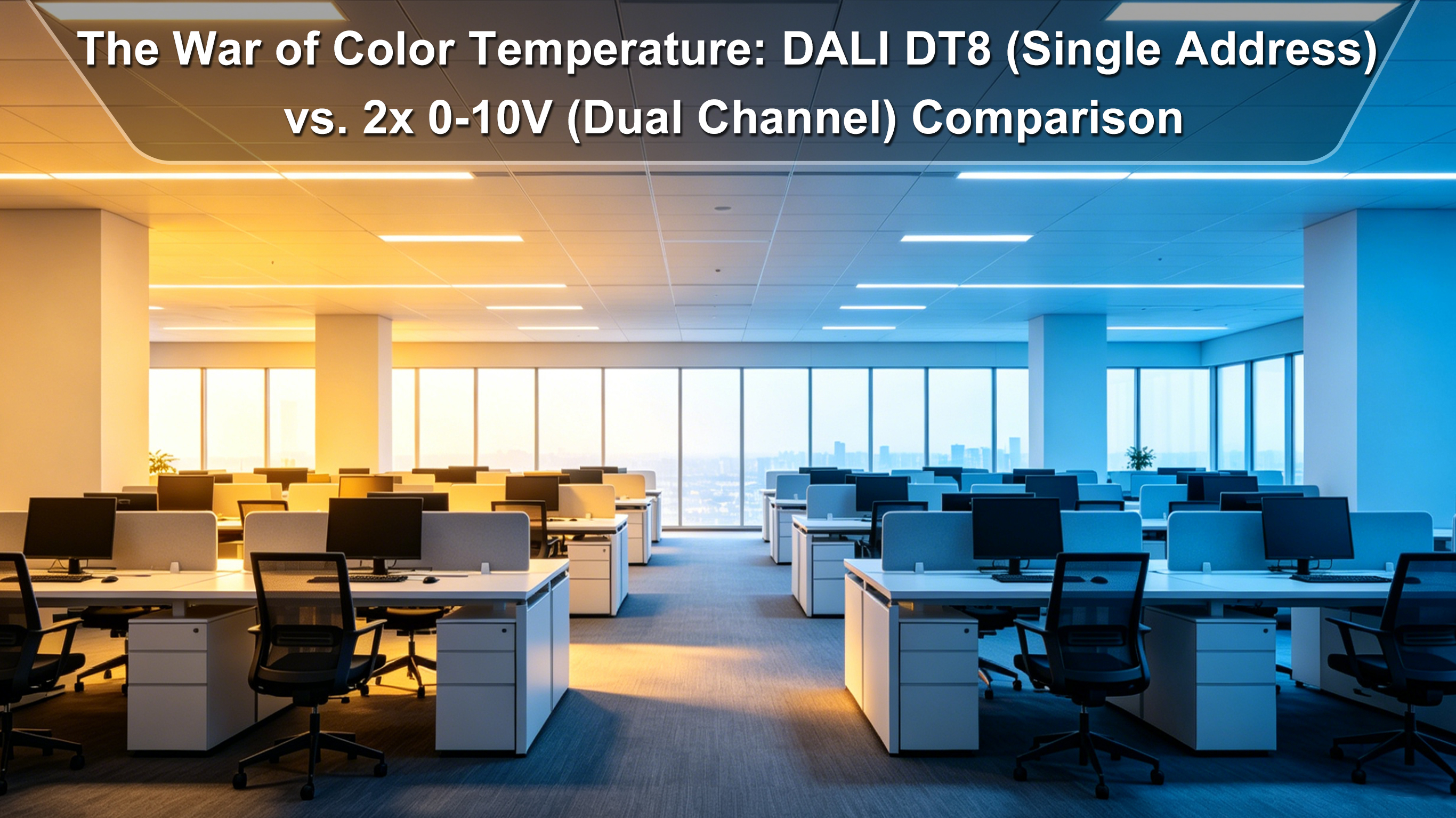
With the widespread adoption of "Human Centric Lighting", simulating natural light transitions from warm morning hues (2700K) to cool midday tones (6500K) has become a standard requirement for modern offices, education, and healthcare facilities.
However, when designs translate into engineering implementation, integrators face a tough choice:
Stick with the traditional Dual Channel 0-10V (2x 0-10V) analog solution, or upgrade to the digital DALI Type 8 (DT8) solution?
On the surface, it's a cost issue; but from an engineering perspective, it's a war over "Who Owns the Control Logic." This article reveals the fundamental differences between these two technology paths from the bottom up.
I. Wiring Topology: Cable Jungle vs. Minimalist Bus
For electrical contractors, these two solutions are physically worlds apart.
1. Dual Channel 0-10V: The Wiring Nightmare
0-10V is an analog signal, where every control channel requires a pair of independent signal wires.
Physical Connection: To achieve Tunable White, you need two sets of signal wires: one for "Warm" brightness and one for "Cool" brightness. Adding the mains power, a single fixture requires at least 5 wires (L, N, DIM1+, DIM1-, DIM2+, DIM2-).
The Pain Point: In an office with hundreds of fixtures, this doubles the cable quantity and the risk of wiring errors. Reversing 0-10V signal wires across different circuits can also lead to severe Ground Loop interference, causing flickering.
2. DALI DT8: The Elegance of Two Wires
DALI is a digital bus.
Physical Connection: Regardless of function complexity (switching, dimming, color tuning), only 2 non-polarized DALI signal wires (DA, DA) are needed.
The Advantage: Installers don't need to distinguish polarity or which wire controls CCT vs. brightness. Cabling and labor costs are drastically reduced.
II. Color Mixing Logic: Who Does the Math?
This is the core difference. Changing from 3000K to 6000K isn't just about adjusting brightness; it's a complex math problem.
1. 2x 0-10V: The Controller is "Guessing"
In the analog scheme, the driver is "dumb." It only executes: Channel 1 output 50%, Channel 2 output 50%.
Logic Ownership: The mixing algorithm must be handled by the external controller (wall panel or central processor).
The Fatal Flaw: The controller doesn't know what brand of fixture is connected, its wattage, or even if the LED chips are physically 2700K or 3000K. It can only assume linear mixing.
The Result: Frequent "CCT Drift" and "Brightness Dip". When adjusting from neutral light (both channels on) to single color (one channel on), the total lumen output often fluctuates wildly, creating a poor visual experience.
2. DALI DT8: The Driver Calculates Precisely
DT8 (IEC 62386-209) is a protocol designed specifically for color control.
Logic Ownership: The mixing algorithm is embedded in the MCU chip inside the LED driver.
The Advantage: The driver knows exactly the physical characteristics of the connected LED load. When the controller sends the command "Output 4000K at 80% Brightness," the driver internally calculates exactly how much current is needed for the cool and warm channels respectively.
The Result: Achieves "Constant Brightness during CCT tuning." Regardless of CCT changes, the total brightness perceived by the human eye remains constant, and the CCT value is precise.
III. Addressing: Limit of 64 vs. System Bottlenecks
2x 0-10V: Consumes 2 physical channels on the control system. If using a 4-channel 0-10V module, it can only drive 2 Tunable White zones. System hardware costs explode linearly with the number of zones.
DALI DT8: Consumes only 1 DALI Short Address. A single DALI bus can control 64 independent Tunable White fixtures. This is extremely efficient for open-plan offices with granular zoning needs.
IV. Bidding & Selection Strategy: When to Use Which?
As a B2B decision-maker, don't blindly chase new tech. Choose based on project attributes:
Scenario A: Recommend Dual Channel 0-10V
Extreme Budget Sensitivity retrofit projects.
No frequent CCT tuning required (e.g., set to cool in summer, warm in winter, static otherwise).
Low fixture count with existing 0-10V wiring in place.
Scenario B: Must Use DALI DT8
WELL Building / Circadian Lighting Projects: Requires continuous, automated light color changes throughout the day.
High-End Commercial Spaces: Demands extreme color consistency and light quality.
Large Space Zoning: Such as open offices requiring independent control for each row of lights.
High Labor Cost Regions: In North America or Europe, the labor savings on wiring far outweigh the driver price difference.
Conclusion
In the "War of Color Temperature," 2x 0-10V wins on unit hardware price but loses on system experience and labor costs. DALI DT8, despite a slightly higher unit price, wins on installation simplicity, control precision, and light quality.
For forward-looking contractors, DT8 is not just a protocol; it is the inevitable path to intelligent, digital lighting.
Want to experience true "Smooth" DT8 mixing?
We offer a full range of DALI-2 Certified DT8 Tunable White drivers (30W-150W) with built-in constant power mixing algorithms. Contact us for a Comprehensive Cost Comparison Table: Dual 0-10V vs. DT8.


