
Beyond Lumens per Watt: Why High-Efficiency LED Drivers are the Linchpin for LEED & WELL Building Certification
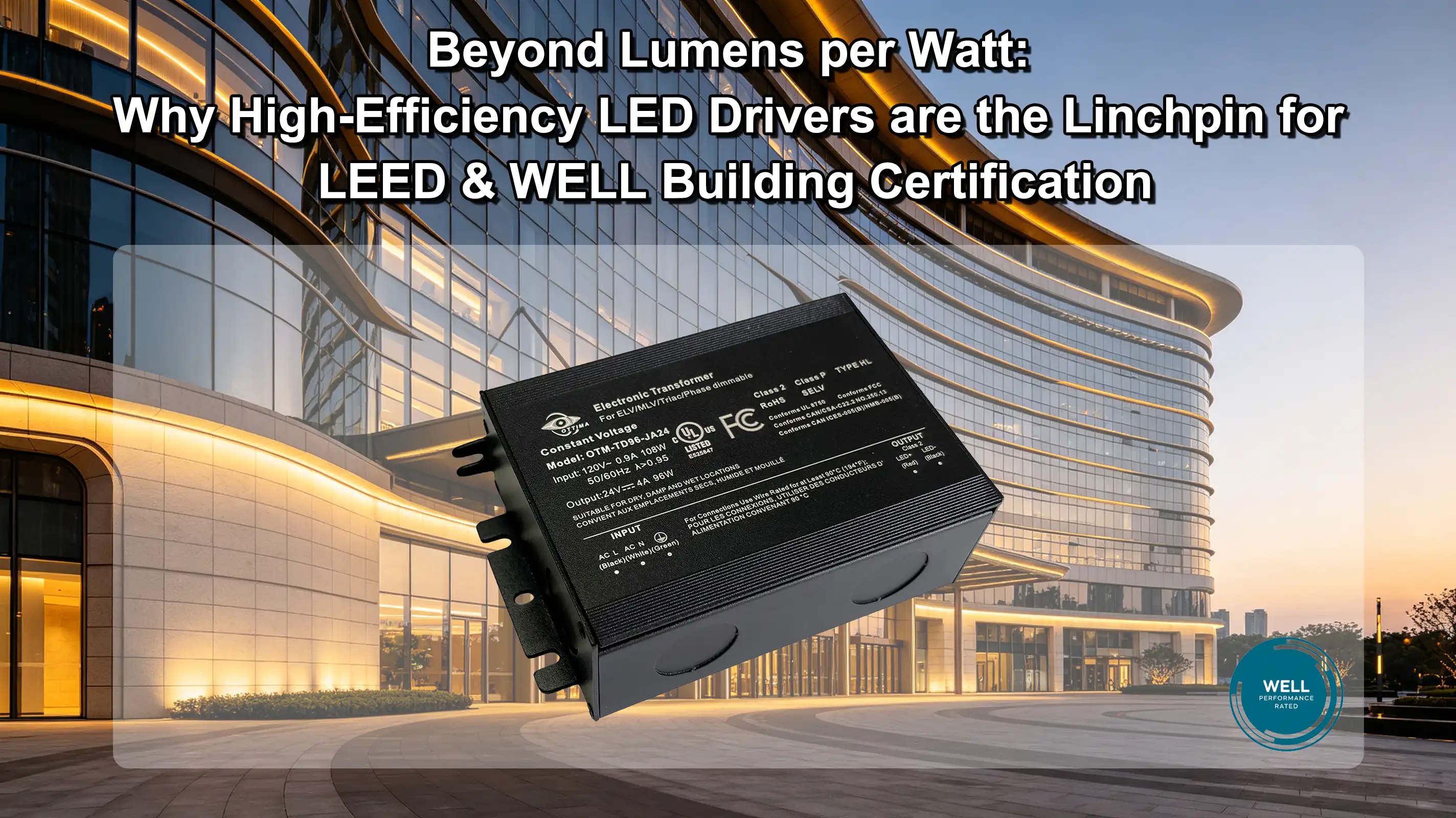
1. Executive Summary: The Paradigm Shift in Green Real Estate
For the past decade, the commercial lighting industry has been overwhelmingly fixated on a single metric: Lumens per Watt (lm/W) at the LED package level. While maximizing light output per unit of electrical power is fundamentally important, this microscopic focus ignores the macro reality of modern smart buildings.
Today, commercial real estate developers, multinational corporations, and institutional investors are driven by ESG (Environmental, Social, and Governance) mandates. Upgrading a building's infrastructure is no longer just about reducing the monthly utility bill; it is about securing premium certifications like LEED (Leadership in Energy and Environmental Design) and the WELL Building Standard. These certifications directly correlate with higher rental yields, increased asset valuation, and enhanced tenant retention.
In this paradigm, the LED driver transitions from a mundane electrical component to the central nervous system of the luminaire. A high-efficiency LED driver is the unsung linchpin that dictates power quality, eliminates "phantom" energy waste, reports real-time carbon data, and safeguards human biological health. This comprehensive engineering whitepaper dissects the specific pathways through which premium LED control gear directly contributes to LEED and WELL certification points.
2. The Illusion of Efficacy: Why System-Level Efficiency Matters
To understand the driver's role, MEP (Mechanical, Electrical, and Plumbing) engineers must shift their specification language from "LED efficacy" to "System Efficacy."
The true efficacy of a luminaire (Esys) is the mathematical product of three distinct efficiencies: Esys = Eled× ηdriver×ηoptic
Eled: The inherent efficiency of the LED chip (e.g., 200 lm/W).
ηoptic: The optical transmission efficiency of the lens/reflector (typically 85-90%).
ηdriver: The electrical conversion efficiency of the LED driver (ranging from 75% in cheap models to >93% in premium models).
If a manufacturer utilizes top-tier 200 lm/W LEDs but pairs them with a low-cost driver operating at 80% efficiency and an 85% optic, the actual system efficacy plummets to a mere 136 lm/W. Furthermore, driver efficiency is not static; it drops significantly when the lights are dimmed. Premium drivers are engineered with advanced topologies (like LLC resonant converters) to maintain >90% efficiency even when dimmed to 50%, a crucial factor for achieving the "Optimize Energy Performance" credit in LEED v4.1.
3. Securing LEED v4.1 Credits: The Electrical Engineering Perspective
LEED certification focuses heavily on the building's impact on the environment and the electrical grid. Specifying the correct LED driver directly influences the Energy and Atmosphere (EA) category.
3.1 Power Quality: Power Factor (PF) and Total Harmonic Distortion (THD)
The electrical grid provides AC power as a pure sine wave. Low-quality LED drivers, which utilize non-linear switching power supplies without proper correction circuits, draw current in sharp spikes. This distorts the grid's sine wave and causes severe inefficiencies at the utility level.
Power Factor (PF): This measures how effectively electrical power is being used. A PF of 1.0 is perfect. Premium LED drivers incorporate active Power Factor Correction (PFC) circuits to maintain a PF > 0.95. If a building uses drivers with a low PF (e.g., 0.70), it draws excess "reactive power." While not registered on standard kW meters, this reactive power strains the building's transformers, requires thicker copper cabling, and often incurs financial penalties from the utility company.
Total Harmonic Distortion (THD): High THD causes overheating in neutral wires and distribution transformers, presenting a fire hazard and reducing the lifespan of the building's electrical infrastructure. To meet the stringent requirements of high-performance buildings, the LED driver must guarantee a THD of strictly < 10% across its entire operating load (not just at 100% brightness).
3.2 The Silent Drain: Eradicating Standby Power
In a modern smart building utilizing DALI-2 or wireless mesh networks (like Bluetooth Mesh or Zigbee), the LED driver is "always on." Even when the lights are turned off, the driver's microcontroller and communication transceiver must remain powered to listen for the next command.
In a commercial skyscraper with 20,000 luminaires, if each driver consumes 1.5W of standby power, the building leaks 30 kW of continuous power 24 hours a day, 365 days a year. This "phantom load" translates to a massive, invisible carbon footprint, severely jeopardizing LEED energy optimization models.
Premium high-efficiency drivers are engineered with ultra-low-power standby circuits, restricting standby consumption to < 0.5W (and in elite models, < 0.3W), complying strictly with the European Ecodesign Directive (ErP) and securing maximum energy model points.
3.3 Environmental Product Declarations (EPD) and Circularity
LEED v4.1 places unprecedented emphasis on the Materials and Resources (MR) category. Projects earn points by using products that have transparent environmental lifecycle data. High-end driver manufacturers now provide Environmental Product Declarations (EPDs), detailing the carbon footprint of the driver from raw material extraction (copper, aluminum, silicon) to manufacturing and eventual recycling. Furthermore, drivers engineered for a 100,000-hour MTBF (Mean Time Between Failures) drastically reduce e-waste, aligning perfectly with circular economy principles.
4. Securing WELL Building Standard Features: The Biological Imperative
While LEED focuses on the building's relationship with the planet, the WELL Building Standard focuses entirely on the building's relationship with its occupants. Lighting is a core concept within WELL, and the LED driver is the gatekeeper of human-centric illumination.
4.1 Feature L07: Visual Lighting Design (Flicker Mitigation)
The WELL standard explicitly penalizes environments that induce visual fatigue. As discussed in our previous technical briefs, low-frequency PWM dimming creates a stroboscopic effect. Even if invisible to the conscious eye, the neurological system registers this flicker, leading to severe migraines, eye strain, and decreased cognitive performance.
To satisfy WELL Feature L07 (Visual Comfort) and pass the IEEE 1789-2015 risk-free criteria, the MEP specification must mandate drivers utilizing Constant Current Reduction (CCR) or ultra-high-frequency PWM (>3,000 Hz). The driver must deliver pure, ripple-free DC current to the LED array to ensure a biologically safe workspace.
4.2 Feature L03: Circadian Lighting Design (EML & Melanopic Ratio)
Humans evolved under the dynamic color temperature and intensity of the sun. Static, artificial lighting disrupts our circadian rhythms, suppressing melatonin production and causing sleep disorders. WELL Feature L03 requires lighting environments that deliver specific Equivalent Melanopic Lux (EML) thresholds at different times of the day.
Achieving this requires Tunable White (Dynamic White) lighting. From a hardware perspective, this necessitates DALI Device Type 8 (DT8) LED drivers. A premium DT8 driver flawlessly mixes warm (e.g., 2700K) and cool (e.g., 6500K) LEDs along the Planckian locus, ensuring that the transition is buttery smooth and perfectly synchronized across the entire office floor without shifting the Duv (tint). Without a highly sophisticated driver algorithm, achieving the precise melanopic ratios demanded by WELL assessors is mathematically impossible.
4.3 Feature S01: Sound Mapping (Acoustic Comfort)
Often overlooked in lighting design is the acoustic footprint. As previously established, poor-quality LED drivers suffer from piezoelectric noise in their ceramic capacitors (MLCCs) and magnetostriction in their inductors, resulting in a high-pitched buzzing or whining noise when dimmed. The WELL Sound Concept strictly limits background HVAC and equipment noise (Noise Criteria/NC ratings). Specifying acoustically dampened, high-frequency LED drivers ensures the lighting system does not inadvertently sabotage the acoustic comfort of quiet zones like libraries or executive boardrooms.
5. The ESG Data Engine: DALI-2 Part 252 & 253
For Corporate Real Estate (CRE) portfolios, obtaining the certification is only step one; maintaining it and reporting on it annually is step two. Driven by global ESG reporting frameworks (like GRESB and the SEC climate disclosure rules), building owners need accurate Scope 2 emissions data.
Modern high-efficiency drivers are no longer just power supplies; they are intelligent IoT edge devices. Drivers compliant with DiiA DALI Part 252 (Energy Data) and Part 253 (Diagnostics & Maintenance Data) report real-time power consumption (kWh) and voltage anomalies directly to the Building Management System (BMS).
This eliminates the need for expensive secondary power meters. The facility manager can prove to WELL or LEED assessors exactly how much energy the lighting system is consuming, and use the diagnostic data to replace aging LED modules before they fail, optimizing the maintenance lifecycle.
6. Conclusion: The Specification Mandate for Engineers
The procurement of LED drivers in commercial real estate must be elevated from a purely CAPEX (Capital Expenditure) conversation to a holistic TCO (Total Cost of Ownership) and Valuation strategy.
Selecting a driver based on a $5 cost-saving per unit is a catastrophic misallocation of priorities when designing a $100 million corporate headquarters aiming for LEED Platinum. Substandard drivers will compromise the energy model through poor power factors and standby leaks, sabotage the WELL acoustic and visual comfort metrics, and fail to provide the granular energy data required by modern ESG investors.
To guarantee certification success, MEP engineers and lighting designers must embed stringent performance thresholds within their tender documents: demanding >90% system efficiency, PF >0.95, THD <10%, <0.5W standby power, IEEE 1789 flicker compliance, and native DALI-2 DT8 integration. The high-efficiency LED driver is not just powering the light; it is empowering the building's sustainable future.


