
The Engineering of Human-Centric Lighting: Mastering DALI DT8 & Tunable White Drivers for Circadian Rhythm Support
1. Executive Summary: The Biological Lighting Revolution
For over a century, the architectural lighting industry was singularly obsessed with visual performance: generating enough lumens to help human eyes read a document, operate machinery, or navigate a hallway safely. Today, commercial real estate is undergoing a biological revolution. We have discovered that light is not just a tool for vision; it is the primary timekeeper for human neurobiology.
Human-Centric Lighting (HCL)—also known as Circadian Lighting—is the science of tuning the spectrum, intensity, and timing of artificial light to mimic the natural solar cycle, thereby synchronizing the human biological clock. For Corporate Real Estate (CRE) developers, healthcare facility managers, and educational institutions, implementing HCL is a strategic investment that directly increases tenant productivity, accelerates patient recovery, and secures premium points in the WELL Building Standard.
However, the gap between biological theory and electrical execution is vast. Achieving seamless Tunable White (Dynamic White) lighting without color distortion, flickering, or catastrophic installation costs requires elite engineering. This comprehensive B2B technical whitepaper explores the deep physiological mechanics of circadian lighting and explains why specifying DALI Device Type 8 (DT8) LED drivers is the only mathematically and financially viable method for large-scale HCL deployment.
2. The Photobiology of Lighting: Beyond Visual Lux
To engineer an HCL system, MEP (Mechanical, Electrical, and Plumbing) consultants must first understand what the human body is actually measuring.
2.1 The Discovery of ipRGCs
In the early 2000s, scientists discovered a third type of photoreceptor in the human retina, distinct from the rods and cones used for vision. These are called intrinsically photosensitive Retinal Ganglion Cells (ipRGCs).
Unlike rods and cones, ipRGCs do not form images. Instead, they act as biological light meters. They contain a photopigment called Melanopsin, which is highly sensitive to short-wavelength visible light (specifically the blue spectrum, peaking around 480nm - 490nm).
2.2 Cortisol vs. Melatonin
When ipRGCs absorb high-intensity blue-enriched light (like morning sunlight), they send a neurological signal directly to the suprachiasmatic nucleus (SCN)—the brain's master clock.
Morning/Midday: High 480nm exposure triggers the release of Cortisol, increasing alertness, heart rate, and cognitive performance. It simultaneously halts the production of sleep hormones.
Evening: As the sun sets, the blue spectrum fades, leaving warmer, longer-wavelength light. The lack of 480nm stimulation signals the pineal gland to secrete Melatonin, initiating the biological wind-down process for deep, restorative sleep.
2.3 The Engineering Metric: Equivalent Melanopic Lux (EML)
Standard lux meters measure light geared towards visual brightness (peaking at green/yellow 555nm). HCL engineering requires measuring Equivalent Melanopic Lux (EML) or Melanopic Equivalent Daylight Illuminance (mEDI). These metrics quantify the biological impact of the light.
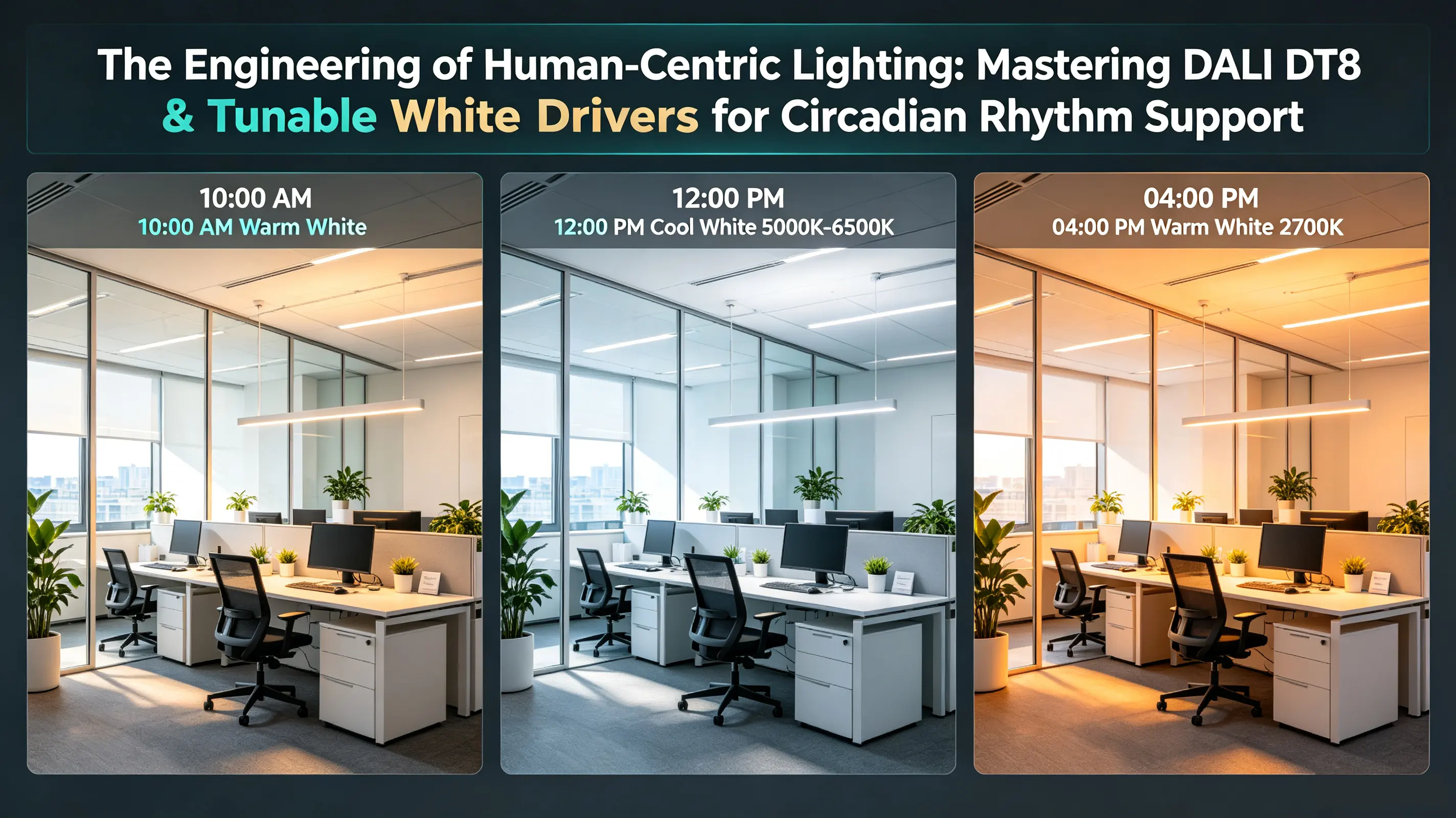
To achieve high EML in an office at 10:00 AM, the lighting system must deliver high-intensity, cool-white light (e.g., 5000K-6500K). To prevent melatonin suppression at 5:00 PM, the system must shift to low-intensity, warm-white light (e.g., 2700K).
3. The Hardware Challenge of Tunable White
Delivering this dynamic shift requires luminaires equipped with two separate LED arrays: Warm White (WW) and Cool White (CW). Blending these two channels is known as Tunable White. But doing it flawlessly is a severe engineering challenge.
3.1 The Planckian Locus and Duv Deviation
If you mathematically draw a straight line between a 2700K LED and a 6500K LED on the CIE 1931 Chromaticity Diagram and mix them linearly (e.g., 50% power to both), the resulting mixed light does not fall on the Black Body Curve (the Planckian Locus).
Instead, it sags below the curve. To the human eye, this 4000K mixed light will appear visibly pinkish or purplish (a negative Duv value).
Low-quality dual-channel drivers perform a simple "dumb" linear mix, resulting in terrible color quality during the transition. Premium Tunable White drivers utilize advanced microprocessors equipped with Isothermal Tracking Algorithms. As the color temperature transitions, the driver dynamically adjusts the PWM (Pulse Width Modulation) duty cycle of each channel to "push" the mixed coordinate back up onto the Planckian locus, ensuring the light remains a pure, crisp white at every single point of the transition.
3.2 Maintaining Constant Intensity
Another hallmark of poor engineering is the "Brightness Dip." When shifting from 6500K to 2700K, cheap drivers often allow the overall lumen output to drop in the middle of the transition. A high-end driver maintains perfectly flat, constant lumen output regardless of the CCT (Correlated Color Temperature), requiring highly sophisticated power-sharing algorithms within the driver's circuitry.
4. Enter DALI DT8 (IEC 62386-209): The Integration Savior
Even if you possess a driver capable of perfect color mixing, the Building Management System (BMS) must communicate with it. Historically, integrators used DALI Device Type 6 (DT6).
4.1 The Legacy Nightmare: DT6 (Two-Address System)
Using DT6 for Tunable White requires assigning two separate DALI addresses per luminaire (one for intensity, one for color temperature).
The Limitation: A single DALI loop maxes out at 64 addresses. Using DT6 halves your loop capacity to a maximum of 32 luminaires.
The Commissioning Chaos: The BMS programmer must write complex algorithms to constantly calculate the mixing ratio between the WW and CW addresses. Transmitting dual commands across the slow 1200 bps DALI bus often results in the "Popcorn Effect"—visible, unsynchronized, choppy fading across a room.
4.2 The Revolution: Device Type 8 (Single Address)
DALI-2 DT8 (IEC 62386-209) is the ultimate solution. A DT8 driver presents itself to the DALI network as a single logical device with a single short address, even though it controls multiple physical outputs.
Tc Mode (Color Temperature): The BMS master controller sends a single command: "Go to 500 lumens and 4500K over 5 seconds." The DT8 driver's internal microprocessor receives this, accesses its internal look-up tables, handles the complex Planckian locus tracking, and executes a flawless, buttery-smooth transition.
Capacity and Cost Savings: Because DT8 only uses one address, engineers can max out the DALI loop with a full 64 Tunable White luminaires. This halves the required DALI Gateways, drastically reduces network cabling, and slashes software commissioning time by up to 70%.
5. Flicker-Free PWM and Biological Comfort
A critical failure point in HCL specification is overlooking the dimming methodology. Tunable White inherently requires profound dimming capabilities, as the driver is constantly dimming the WW and CW channels up and down to achieve the desired mix.
If the driver utilizes low-frequency PWM (<500Hz), the rapid switching can induce a severe stroboscopic effect. Even if the flicker is invisible, the human optic nerve detects it, causing headaches and counteracting the very biological benefits the HCL system was designed to provide.
To specify a truly biological-grade HCL system, the DT8 driver must guarantee IEEE 1789-2015 "Risk-Free" compliance. This requires the driver to utilize either high-frequency PWM (>3,000 Hz) or Constant Current Reduction (CCR / Hybrid Dimming) to ensure the light is 100% ripple-free across the entire dimming and color-tuning curve.
6. Securing WELL Building Standard Certifications
For B2B stakeholders, the ROI of Human-Centric Lighting is increasingly tied to green building certifications, particularly the WELL v2 Building Standard.
Feature L03: Circadian Lighting Design: This feature mandates specific EML or mEDI thresholds at desk level between 9:00 AM and 1:00 PM. Specifying high-efficiency DALI DT8 drivers allows the BMS to automatically ramp up the 5000K-6500K channels during these hours, securing up to 3 points.
Feature L07: Visual Lighting Design (Flicker): Securing this point requires proving that the LED drivers meet strict modulation depth limits. A premium DT8 driver with high-frequency PWM is the only guarantee of compliance.
7. Conclusion: The Blueprint for B2B Success
The transition from static lighting to Human-Centric Lighting is the most significant leap in architectural design since the invention of the LED. However, HCL is not achieved simply by purchasing tunable LEDs; it is achieved through the flawless translation of biological requirements into electronic execution.
For consulting engineers, systems integrators, and CRE developers, mastering DALI DT8 is not optional; it is the fundamental prerequisite for commercial HCL. By specifying DALI-2 DT8 drivers with Isothermal Tracking algorithms, single-address efficiency, and IEEE 1789 flicker compliance, professionals can deliver dynamic, biologically optimized environments that enhance human health while maximizing operational ROI. The future of lighting is not just smart; it is biological.


