
How Luminaire OEMs Can Cut Certification Cycles by 50% Through Strategic Driver Selection
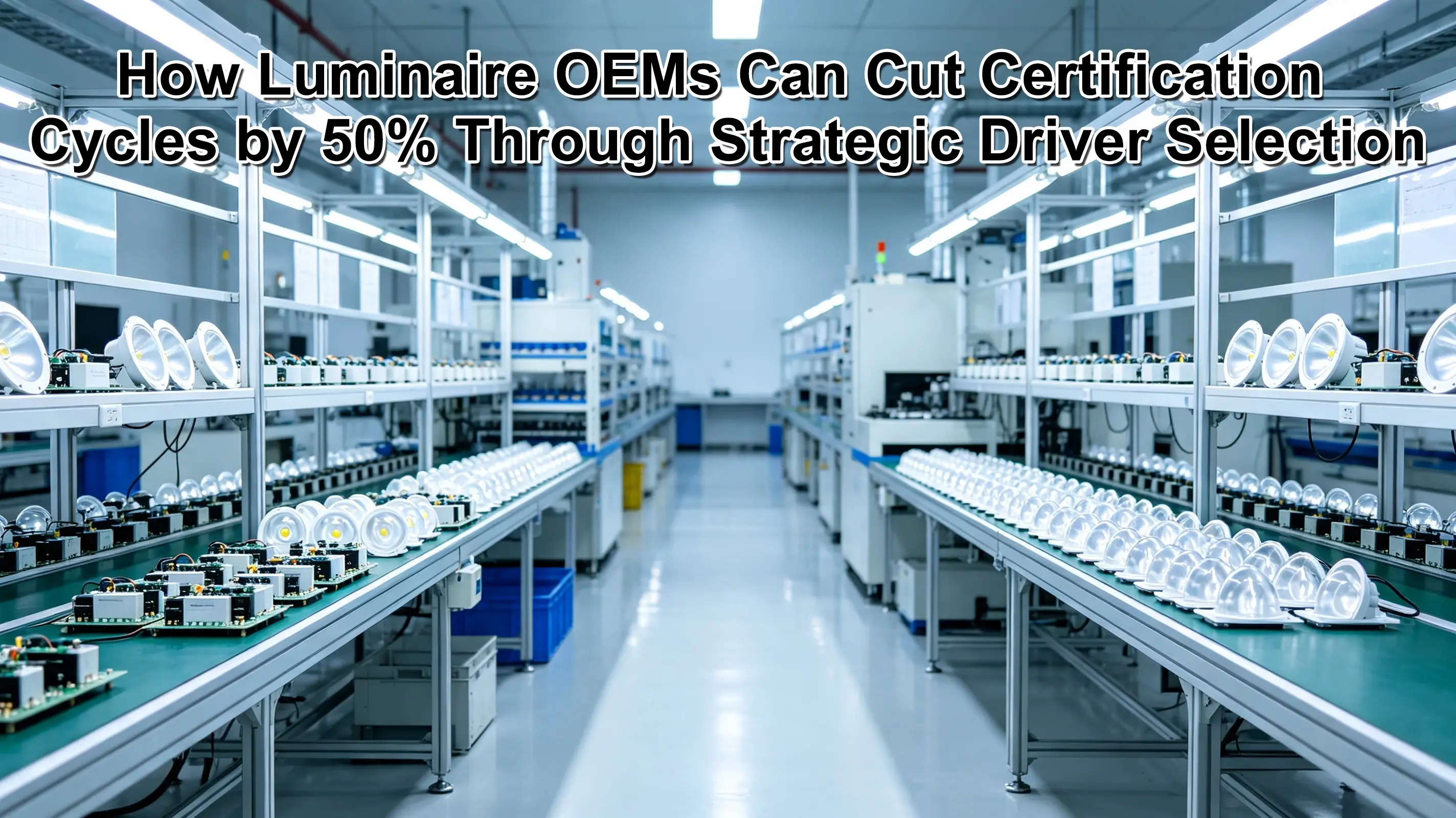
In the highly competitive commercial and industrial LED lighting market, the speed at which a manufacturer can bring a new luminaire to market—or adapt an existing luminaire to meet a specific client’s request—often dictates who wins the bid. However, for decades, Original Equipment Manufacturers (OEMs) of lighting fixtures have been shackled by the rigid and time-consuming processes of safety certification, primarily under the UL 8750 standard.
Historically, the LED driver has been the most strictly evaluated component within a luminaire. Changing a driver due to component shortages, cost optimization, or the need for a different dimming protocol meant submitting the entire fixture back to Underwriters Laboratories (UL) or another Nationally Recognized Testing Laboratory (NRTL) for extensive thermal and electrical re-testing. This administrative and engineering bottleneck could delay production by weeks or even months.
Enter the UL Class P LED Driver Program. Introduced as a revolutionary regulatory pathway, UL Class P has fundamentally transformed luminaire manufacturing. By decoupling the driver's thermal evaluation from the luminaire's system-level testing, the Class P program allows OEMs to interchange LED drivers seamlessly.
This comprehensive technical whitepaper explores the deep engineering mechanics of the UL Class P program, compares it against legacy certification pathways like Type TL, and outlines the strategic, financial, and supply chain benefits that enable luminaire OEMs to slash their certification cycles by more than 50%.
1. The Historical Bottleneck: The Rigidity of Legacy UL Certifications
To understand the magnitude of the Class P innovation, we must first examine the historical constraints of luminaire certification under standard UL 8750 guidelines for Recognized Components.
1.1 The "Recognized Component" Dilemma
Traditionally, LED drivers were evaluated as "Recognized Components" (UR). A Recognized Component is incomplete in its construction or evaluation and requires further testing when integrated into an end product (the luminaire).
When a luminaire OEM utilized a standard Recognized driver, the NRTL required the entire luminaire to undergo an In-Situ Temperature Measurement Test (ISTMT). The laboratory had to place thermocouples on specific components within the driver (such as the transformer, switching MOSFETs, and electrolytic capacitors) to ensure they did not exceed their maximum temperature ratings while operating inside the specific luminaire housing.
1.2 The Cost of Substitution
If an OEM needed to switch from "Driver A" to "Driver B" (even if both drivers had identical wattage, output voltage, and physical dimensions), the luminaire had to be re-evaluated.
Time Cost: Re-testing and updating the UL file typically took 4 to 8 weeks.
Financial Cost: Testing fees, administrative file update fees, and sample shipping costs could easily exceed $2,000 to $5,000 per luminaire family variation.
Opportunity Cost: While waiting for the UL file update, production was halted. If this change was prompted by a supply chain shortage of "Driver A," the OEM risked missing project delivery deadlines, resulting in liquidated damages or lost contracts.
2. Decoding the UL Class P Paradigm
In response to the lighting industry's outcry for greater flexibility, UL collaborated with industry stakeholders to create the Class P LED Driver Program. The "P" conceptually stands for "Protected."
2.1 What is a Class P LED Driver?
A UL Class P LED driver is a Listed or Recognized driver that has been rigorously evaluated for its internal thermal behavior under both normal and abnormal operating conditions. The fundamental principle is that the driver is deemed thermally self-protecting.
Under the Class P evaluation, the driver undergoes extreme fault condition testing—such as component short-circuits, overloads, and blocked ventilation—as a standalone unit. The manufacturer must prove that no matter what catastrophic internal failure occurs, the driver will not pose a fire or shock hazard to the surrounding environment (i.e., the luminaire housing).
2.2 The "Tc Point" Methodology
Instead of requiring the luminaire OEM to measure internal driver components, a Class P driver features a defined Temperature Case (Tc) point on its external enclosure. The driver manufacturer guarantees that as long as the temperature at this specific Tc point does not exceed the rated maximum (e.g., 90°C), the internal components are operating within their safe thermal limits.
When the luminaire is initially certified, the NRTL only measures the temperature at the driver's Tc point. If it passes, the luminaire is approved for use with any Class P driver that meets the required electrical ratings, provided the new driver's Tc rating is equal to or higher than the measured temperature in the luminaire.
3. Type TL vs. Class P: Understanding the Engineering Differences
Before Class P became the gold standard, UL introduced the Type TL (Temperature Limited) program. While Type TL was a step forward, it still possessed limitations compared to Class P.
Type TL Evaluation: A Type TL driver defines a Reference Temperature (Tref) on the case. However, the driver is not fully evaluated for abnormal internal thermal faults. Therefore, when substituting a Type TL driver, the OEM must still ensure that the new driver's Tref rating matches or exceeds the thermal profile of the luminaire, but the substitution process is slightly more complex administratively than Class P.
Class P Evaluation: Class P drivers incorporate integrated thermal protection (such as thermal foldback circuits or thermal fuses). Because they are inherently fail-safe under abnormal conditions, UL grants them maximum substitution flexibility. Class P represents the ultimate "plug-and-play" certification status for LED drivers.
4. The Mechanism of 50% Time Reduction: How Substitution Actually Works
How does an OEM leverage Class P to cut their certification cycle by 50% or more? The efficiency lies in the administrative bypass of laboratory testing.
4.1 The Initial Luminaire Certification
When an OEM submits a new luminaire for UL listing, they specify that it uses a Class P driver. The lab conducts the standard ISTMT and records the maximum temperature at the driver's Tc point—let's say it reaches 75°C in the worst-case ambient environment.
4.2 The Seamless Substitution Process
Six months later, the original driver supplier announces a 20-week lead time, threatening a major project delivery. The OEM finds an alternative Class P driver from a different manufacturer.
To substitute the driver without re-testing, the OEM merely needs to verify that the new driver meets the Conditions of Acceptability:
1. Class P Certification: The new driver must bear the UL Class P mark.
2. Electrical Ratings: The input voltage, output voltage, and output current must be compatible with the luminaire's original ratings and the LED array's requirements.
3. Tc Rating: The new driver's maximum rated Tc must be equal to or greater than the 75°C measured during the original luminaire test. (For instance, an 85°C or 90°C rated Class P driver is perfectly acceptable).
4. Environmental Rating: If the luminaire is rated for "Wet Locations," the driver must also hold an appropriate environmental rating, or be suitably enclosed.
If these conditions are met, the OEM can implement the new driver immediately through a simple paper update to their UL file. No physical samples need to be sent to the lab. A process that once took 6 weeks now takes 6 days—or less.
5. Strategic Business Advantages of Selecting Class P Drivers
For purchasing directors, engineering managers, and supply chain executives at lighting OEMs, mandating Class P drivers is no longer a technical preference; it is a critical business strategy.
5.1 Supply Chain Resilience (Dual Sourcing)
The global supply chain shocks of recent years have proven that relying on a single component supplier is a massive operational risk. Class P allows OEMs to establish a Dual-Sourcing Strategy. An OEM can qualify Drivers from Brand A, Brand B, and Brand C within the same UL file without exorbitant testing costs. If Brand A experiences a microchip shortage, the OEM seamlessly pivots to Brand B, keeping the assembly lines moving.
5.2 Accelerated Customization and Bid Winning
Commercial lighting projects often require last-minute customizations. A client might suddenly request a DALI-2 dimmable driver instead of a standard 0-10V driver. If the OEM uses Class P architecture, they can swap in a Class P DALI-2 driver instantly, commit to the delivery schedule, and win the bid. Competitors using legacy drivers will have to quote an additional 6 weeks for UL re-certification, automatically losing the project.
5.3 Massive Reduction in Compliance Costs (OPEX)
Consider a luminaire manufacturer with a portfolio of 50 distinct fixture families. Over a 5-year cycle, drivers will inevitably reach their End of Life (EOL) and require updating.
Without Class P: 50 families × $3,000 re-testing fee = $150,000 in compliance maintenance costs.
With Class P: The administrative update for a Class P substitution is a fraction of this cost, often bundled into routine file maintenance, saving the OEM over $100,000 in OPEX.
6. How to Implement a Class P Sourcing Strategy
To fully unlock the 50% time-to-market reduction, luminaire OEMs should adopt the following procurement guidelines:
1. Rewrite Supplier Specifications: Update internal procurement documents to mandate "UL Class P Listing" as a non-negotiable requirement for all new North American projects.
2. Prioritize High Tc Ratings: When selecting the initial driver for luminaire certification, choose one with the highest possible Tc rating (e.g., 90°C). This establishes a robust baseline, making it infinitely easier to find substitute drivers in the future.
3. Evaluate Advanced Features: Ensure the chosen Class P drivers also carry relevant modern certifications, such as D4i for IoT applications, or NFC programmability, which further reduces SKU complexity.
Conclusion
The UL Class P program is arguably the most empowering regulatory update for the LED lighting industry in the 21st century. By shifting the burden of internal thermal fault evaluation onto the driver manufacturer, UL has granted luminaire OEMs unprecedented agility.
Sourcing UL Class P drivers is the definitive pathway to insulating your manufacturing operations against supply chain disruptions, slashing certification costs, and ensuring that your engineering team spends their time innovating new lighting designs rather than waiting on redundant laboratory test reports. In the modern B2B lighting sector, agility is profitability, and Class P is the engine that drives it.


