
Preventing VOC Degassing and Electrochemical Migration in LED Drivers for High-Humidity Greenhouses & Chemical Environments
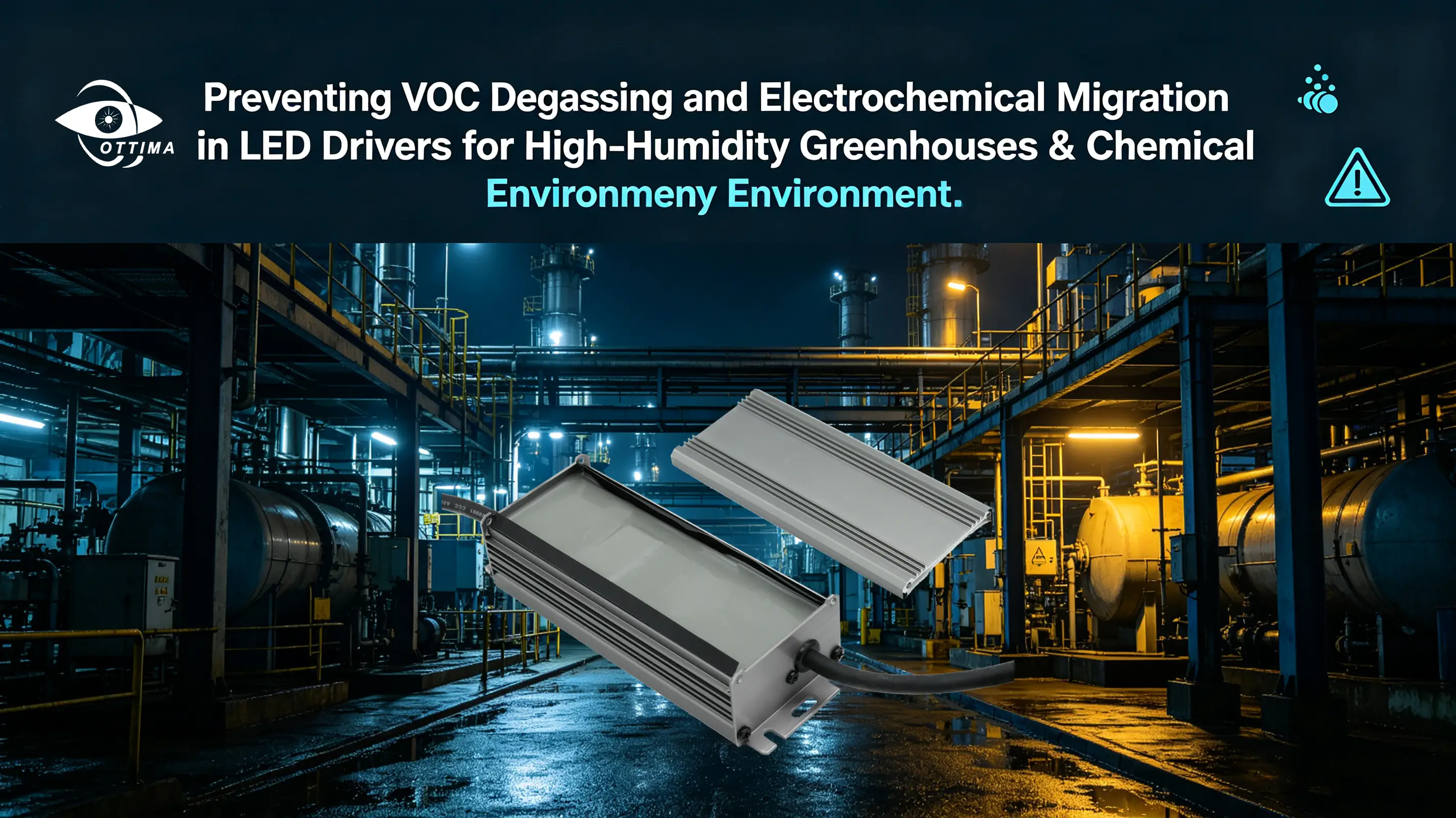
1. Executive Summary: The "IP67 Illusion" in Agricultural & Industrial Lighting
For EPC contractors, greenhouse system integrators (SIs), and facility managers in heavy chemical plants, the mass failure of LED lighting fixtures 12 to 18 months post-installation is a recurring nightmare. The industry standard response is to demand power supplies with an IP67 waterproof rating, assuming this provides absolute environmental immunity.
This is a dangerous oversimplification.
While IP67 guarantees protection against macroscopic liquid water ingress and dust particles, it provides zero guarantees against Vapor Permeability. In modern agricultural greenhouses, vertical farms, and chemical processing plants, the ambient air is saturated with Volatile Organic Compounds (VOCs), sulfur-based fertilizers, pesticide aerosols, and chlorine gases. These corrosive gas molecules easily diffuse through standard mechanical seals and cheap potting compounds.
This technical whitepaper exposes the hidden mechanisms of LED driver deterioration—specifically Sulfuration and Electrochemical Migration (ECM). We will scientifically dismantle the "IP67 illusion" and introduce Ottima's multi-layered defense architecture, utilizing high-density silicone potting and proprietary conformal coating to guarantee longevity in the world's most corrosive atmospheres.
2. The Physics of Gas Diffusion: Why IP67 Fails
To understand why standard drivers fail in greenhouses, we must differentiate between liquid fluid dynamics and gas-phase diffusion.
Water droplets have high surface tension and relatively large physical volumes, allowing silicone gaskets to block them. However, corrosive gases (like Hydrogen Sulfide, H2S, and Sulfur Dioxide, SO2) behave entirely differently.
2.1 Fick's Law and Vapor Permeability
The penetration of corrosive gases through a polymer (such as cheap polyurethane potting commonly used in standard LED drivers) is governed by Fick's First Law of Diffusion:
J = -D·dc/dx
Where:
J is the diffusion flux (the amount of gas passing through a unit area).
D is the diffusion coefficient (dependent on the potting material's molecular density).
dc/dx is the concentration gradient of the gas across the barrier.
In a greenhouse, the concentration of sulfur-rich pesticides outside the driver is high, while inside it is zero. This creates a relentless concentration gradient (dc/dx) that forces sulfur gas molecules to permeate straight through the molecular matrix of cheap plastics and standard potting resins.
3. The Chemistry of Destruction: Sulfuration and ECM
Once these VOCs and corrosive gases bypass the outer casing and penetrate the PCB layer, they attack the most vulnerable electronic components: Surface Mount Device (SMD) resistors and LED semiconductor lead frames.
3.1 The Silver Sulfuration Reaction
Standard SMD resistors utilize silver (Ag) as the inner electrode material due to its exceptional conductivity. However, silver is highly reactive to sulfur. When sulfur gas penetrates the microscopic gaps between the resistor's protective glass coating and the external electrode, a catastrophic chemical reaction occurs:
2Ag + H2S + 1/2·O2 → Ag2S + H2O
The Consequences of Silver Sulfide (Ag2S):
1. Volume Expansion: Silver sulfide is a crystalline structure that occupies significantly more volume than pure silver. As it forms, it physically cracks the ceramic substrate of the resistor.
2. Insulation: Unlike conductive silver, Ag2S is an electrical insulator. As the electrode converts to silver sulfide, the resistor’s internal resistance skyrockets toward infinity, resulting in an open circuit.
3. Visual Symptom: This reaction turns the shiny silver components black—a phenomenon frequently misdiagnosed as "heat damage" by inexperienced technicians.
3.2 Electrochemical Migration (ECM)
In environments with 90%+ Relative Humidity (RH) alongside VOCs, ionic contaminants dissolve into a thin film of water on the PCB. Under the influence of the DC voltage bias within the driver, metallic ions (like copper or silver) migrate from the anode to the cathode, growing conductive metallic dendrites. Over 12 to 18 months, these dendrites bridge the gap between component pads, causing a localized short circuit and a fiery failure.
4. The Ottima Countermeasure: Defense in Depth
To combat molecular-level corrosion, Ottima abandons the industry-standard single-layer protection model. Instead, we employ a highly engineered, dual-barrier architecture specifically designed for horticultural and heavy industrial applications.
4.1 Step 1: High-Density, Two-Component Silicone Potting
Instead of standard Polyurethane (PU) or Epoxy (which suffer from micro-cracking under thermal stress and high vapor transmission rates), Ottima utilizes a premium Two-Component Thermally Conductive Silicone Elastomer.
High Cross-Link Density: The molecular structure of our proprietary silicone mix presents an exponentially lower diffusion coefficient ( D ), severely choking the flux ( J ) of sulfur and chlorine gases.
Thermal Expansion Matching: Unlike hard epoxies that pull and tear SMD components during extreme temperature swings (common in chemical plants), our silicone maintains a pliable modulus from -40℃ to +105℃, ensuring zero physical stress on the PCBA.
4.2 Step 2: Proprietary Conformal Coating (The Ultimate Shield)
Before the potting compound is even applied, the entire PCBA undergoes an automated, UV-traced Conformal Coating process.
We utilize a highly specialized Acrylic/Polyurethane hybrid resin (Type AR/UR) that wraps every single solder joint, IC pin, and SMD resistor in a continuous, impermeable dielectric film.
This acts as the final vapor barrier. Even if trace amounts of H2S manage to penetrate the silicone potting over a 5-year lifespan, the conformal coating prevents the gas from ever making physical contact with the silver electrodes.
5. Empirical Validation: Accelerated Aging Data
Engineering claims mean nothing without rigorous laboratory validation. Ottima drivers designed for harsh environments are subjected to punishing accelerated aging tests that standard commercial drivers fail within 48 hours.
Test Standard | Environment Conditions | Generic IP67 Driver Result | Ottima Driver Result |
IEC 60068-2-42 (SO2 Test) | 25 ppm SO2, 75% RH, 25℃, 21 Days | Massive resistor sulfuration, open circuits on control IC. | PASS: 0% variance in output voltage; zero visual blackening. |
IEC 60068-2-52 (Salt Mist) | 5% NaCl spray, 35℃, cyclic humidity for 720 hours. | Severe PCB delamination and electrolytic corrosion. | PASS: Potting adhesion intact; conformal coating blocks all ECM. |
Thermal Shock (VOC Outgassing) | -40℃ to +85℃, 500 cycles | Potting cracks, allowing trapped VOCs to condense on PCB. | PASS: Silicone elasticity maintained; no micro-fissures detected. |
6. The B2B Economic Reality: Preventing Post-Harvest Disasters
For commercial greenhouse operators, the profit margins are tied directly to yield consistency. Supplemental LED lighting (DLI - Daily Light Integral) must operate flawlessly.
When a generic LED driver fails due to sulfuration after 12 months, the consequences are disastrous:
Yield Loss: Plant growth stunting due to sudden light deprivation in specific crop zones.
Replacement Labor: Hiring specialized technicians to replace overhead drivers in an active, humid, biosecure agricultural environment.
Brand Reputation: For EPCs and SIs, massive recall rates obliterate client trust and future contracts.
Investing in Ottima’s anti-sulfuration, conformal-coated LED drivers shifts the economic model from high-risk reactive maintenance to zero-maintenance operational predictability.
7. Engineering Specifications for Tender Documents
To protect your next horticultural or industrial chemical project, MEP consultants and procurement directors must elevate their tender specifications beyond basic IP ratings. Mandate the following:
Anti-Corrosion Technical Specification Requirement: "The LED control gear must not only comply with IP67 mechanical standards but must explicitly feature dual-layer chemical protection. The PCBA must be completely treated with a UV-verifiable conformal coating (Type UR, AR, or SR) prior to final encapsulation. The primary encapsulation material must be a two-component thermally conductive silicone with certified low moisture vapor transmission rates. The driver must provide documented test reports passing IEC 60068-2-42 (Sulfur Dioxide) and IEC 60068-2-52 (Salt Mist) to guarantee immunity against sulfuration and electrochemical migration."
Do not let your multimillion-dollar agricultural or industrial facility fall victim to the "IP67 illusion." By understanding the vapor physics of the Sulfur Trap and demanding Ottima's defense-in-depth chemical shielding, you guarantee uninterrupted luminosity in the most toxic atmospheres on Earth.


