
Integrated Auxiliary Power Rails (12V/24V) in LED Drivers: Powering Smart Microwave and PIR Sensors Without External Power Packs
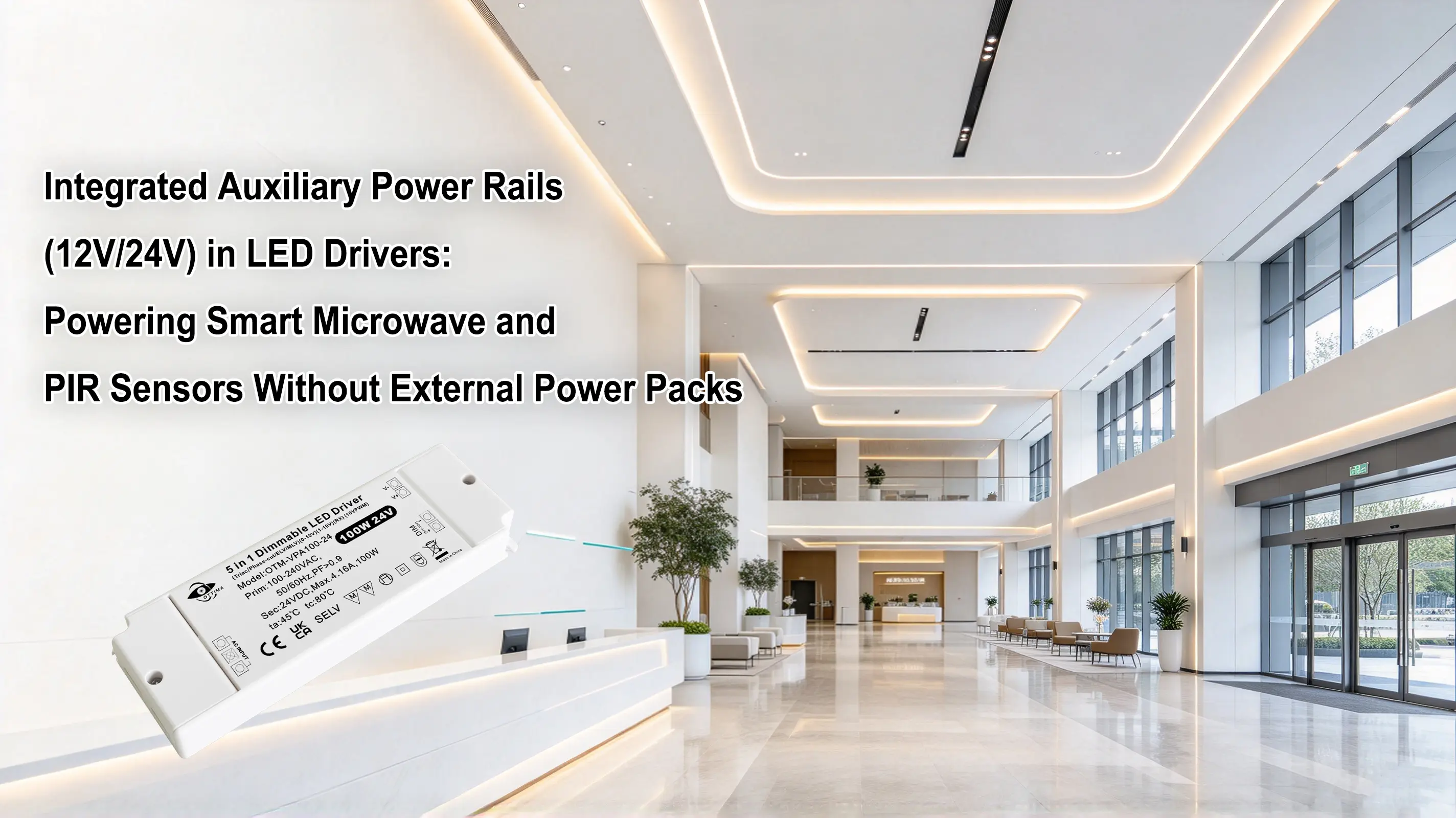
The Evolution of Smart Commercial Lighting and the Junction Box Bottleneck
The commercial lighting landscape has shifted. Luminaires are no longer static illumination devices designed merely to satisfy photopic lux levels; they are now active nodes in intelligent building ecosystems. Modern smart commercial luminaires routinely incorporate sophisticated occupancy detection via Passive Infrared (PIR) and high-frequency microwave sensors, daylight harvesting photocells, and wireless communication sub-systems operating on Bluetooth Mesh, Zigbee, or Matter protocols.
While this convergence of lighting and IoT delivers unprecedented energy efficiency and granular data collection, it introduces a complex hardware integration challenge: How do you reliably and cost-effectively power these low-voltage auxiliary sensors and transceivers without compromising the thermal and mechanical integrity of the fixture?
For years, the industry relied on an awkward workaround: external auxiliary power packs tucked into junction boxes or hidden inside luminaire cavities. This article provides a hardcore engineering dissection of why this legacy approach is obsolete and explores the advanced internal Auxiliary Power Supply (APS) topology—specifically integrated 12V/24V DC rails delivering 50mA to 100mA directly from the LED driver—that is redefining B2B commercial fixture manufacturing.
The External Power Pack Problem: A Hidden Liability in Luminaire Design
To understand the engineering breakthrough of integrated power rails, one must first examine the systemic failures associated with traditional external power packs.
In conventional setups, a primary constant-current LED driver supplies power to the LED array, while a separate, modular auxiliary power supply (or "power pack") is wired in parallel or series within the fixture's wiring compartment to step down mains voltage or convert secondary AC to 12V/24V DC for sensors. This architecture creates three severe vulnerabilities for fixture manufacturers and lighting designers:
1. Thermal Stress and Reduced MTBF (Mean Time Between Failures): Enclosing an extra power conversion block inside a confined junction box or driver compartment drastically increases localized thermal accumulation. Electrolytic capacitors inside these auxiliary packs suffer from accelerated Arrhenius-law degradation when exposed to elevated ambient temperatures, creating a weak link that frequently causes premature field failures.
2. Component Count and Labor Bottlenecks on the Assembly Line: Extra wires, wire nuts, mounting brackets, and auxiliary modules inflate the Bill of Materials (BOM). More critically, they translate to higher labor costs during assembly. Every additional connection point increases the statistical probability of miswiring or assembly line bottlenecks.
3. Mechanical Bulk and Aesthetics: Modern architectural lighting demands sleek, minimalist form factors. Bulky junction boxes required to house auxiliary power packs ruin the clean aesthetic of linear pendants, high bays, and architectural troffers.
Inside the Internal APS Topology: Architecting 12V/24V Rails Within the LED Driver
The engineering solution to the external power pack problem is the Integrated Auxiliary Power Supply (APS) topology. By embedding a secondary low-power conversion stage directly onto the primary printed circuit board (PCB) of the LED driver, manufacturers can deliver regulated 12V or 24V DC output (typically rated for 50mA to 100mA continuous load) straight through the driver’s output wiring harness or dedicated auxiliary terminals.
1. Circuit Topologies and Power Stage Integration
Achieving a reliable internal APS requires meticulous power electronics design. Most advanced LED drivers utilize a flyback topology for the main constant-current stage. Engineers can leverage this by adding a secondary auxiliary winding on the primary transformer or by integrating a high-efficiency auxiliary step-down (Buck) or flyback sub-converter operating off the bulk storage capacitor voltage.
Auxiliary Winding Tap vs. Dedicated Sub-Converter: While tapping an auxiliary winding on the main transformer is cost-effective, maintaining tight cross-regulation when the main LED load is dimmed (especially down to 0.1% via DALI-2 or 0-10V) presents a challenge. Premium LED drivers utilize a dedicated quasi-resonant or pulse-frequency modulation (PFM) auxiliary sub-converter to ensure that the 12V/24V rail remains impeccably stable regardless of the primary LED load state or dimming depth.
Transient Voltage Suppression (TVS): Because external sensors connected via long wires are susceptible to electrostatic discharge (ESD) and lightning surges (IEC 61000-4-5), robust internal APS designs incorporate multi-stage transient suppression, including bidirectional TVS diodes and ferrite beads on the auxiliary output terminals.
2. Safety, Isolation, and Regulatory Compliance (SELV and Class 2)
Integrating low-voltage sensor power rails inside a high-voltage LED driver requires strict adherence to international safety standards. The APS circuit must maintain reinforced or double insulation between the high-voltage AC mains input and the low-voltage DC auxiliary output, ensuring compliance with SELV (Safety Extra-Low Voltage) and UL Class 2 / IEC 61347-2-13 standards.
Creepage and clearance distances on the PCB must be meticulously engineered, often requiring physical isolation slots or high-grade insulating barriers between the primary switching nodes and the secondary APS output stage. This guarantees that even during severe overvoltage events, user-accessible sensor wiring remains completely safe from electric shock.
Quantifying B2B Value: Why Fixture Manufacturers Are Migrating to Integrated APS
For commercial lighting OEMs, adopting LED drivers with integrated auxiliary power rails delivers measurable financial and operational advantages across the entire product lifecycle:
BOM Cost Reduction: Eliminating the external power pack, associated interconnect cabling, and secondary enclosures cuts direct material costs by 15% to 25% for smart luminaire variants.
Streamlined Manufacturing & Lower Labor Costs: Factory assembly is simplified. Wiring errors are virtually eliminated because sensors plug directly into standardized secondary terminals or harness leads provided by the intelligent driver.
Enhanced Reliability and Extended Warranty Confidence: Removing enclosed heat sources and reducing solder joints significantly lowers field failure rates. Manufacturers can offer extended 5-to-10-year warranties on smart fixtures with lower RMA (Return Merchandise Authorization) overhead.
Superior Aesthetic Flexibility: Slim-profile luminaires can now incorporate advanced microwave and PIR sensors without sacrificing sleek industrial design.
Future-Proofing Luminaire Design for IoT Ecosystems
As smart buildings evolve toward fully integrated IoT infrastructures, sensor power requirements are shifting. While standard PIR and microwave presence detectors typically consume 15mA to 30mA at 12V/24V, next-generation edge-computing sensors and multi-sensor arrays (combining occupancy, ambient light, CO2, and BLE beacons) demand robust auxiliary power budgets up to 100mA.
LED drivers equipped with high-performance 100mA internal APS rails provide the electrical headroom necessary to power these advanced smart payloads without requiring external boosters. By standardizing on integrated APS drivers, lighting manufacturers future-proof their product portfolios, ensuring seamless compatibility with emerging smart building protocols (such as Zhaga Book 18/20 and DALI+ standards).


