
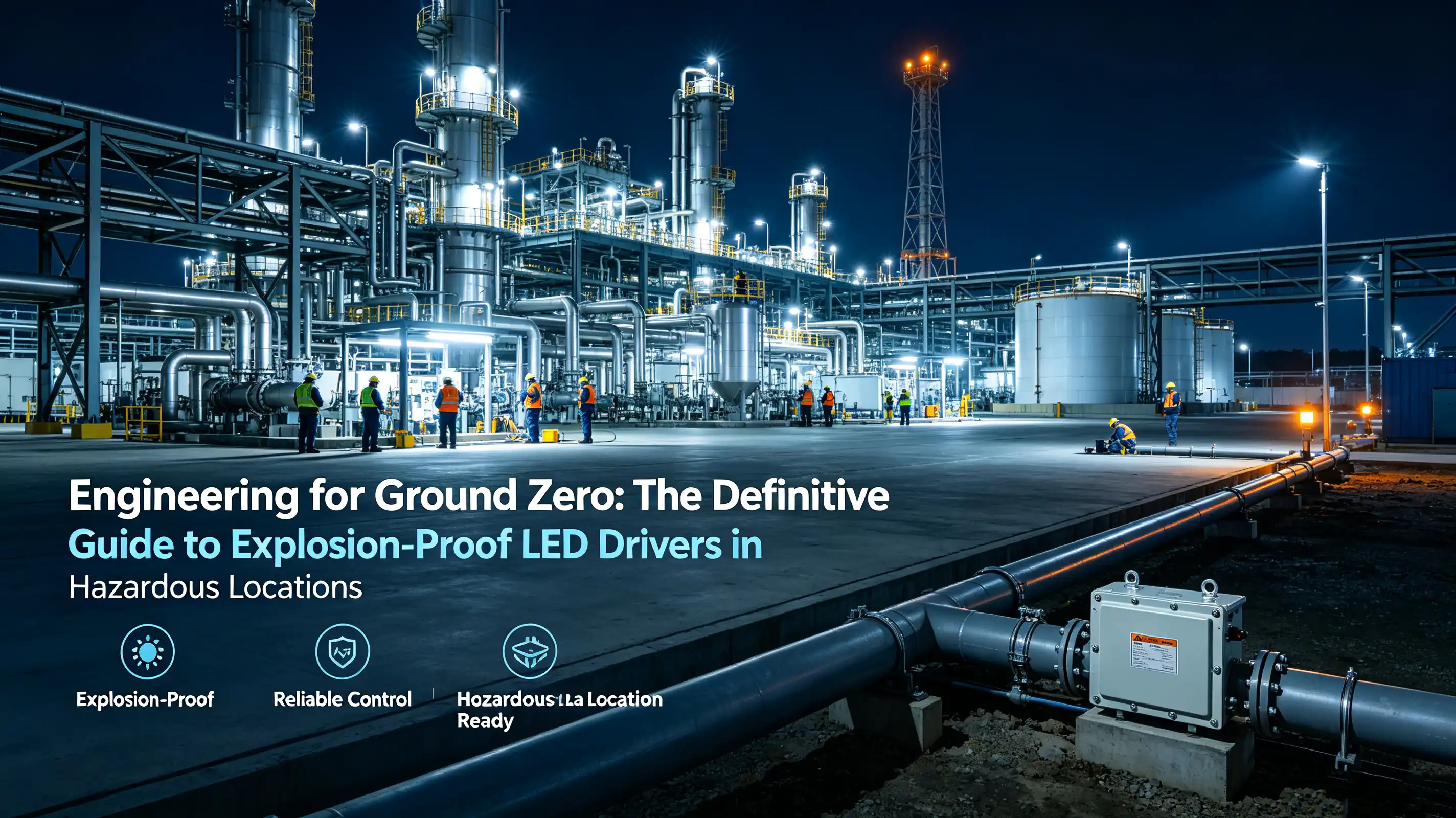
Engineering for Ground Zero: The Definitive Guide to Explosion-Proof LED Drivers in Hazardous Locations
1. Executive Summary: Lighting at the Edge of Catastrophe
In commercial real estate, a failing LED driver results in a dark room and a frustrated tenant. In a petrochemical refinery, an offshore oil rig, a grain silo, or a subterranean coal mine, a failing LED driver can ignite a catastrophic explosion. These environments are classified as Hazardous Locations (HazLoc), where the atmosphere is routinely or periodically saturated with flammable gases, volatile vapors, or combustible dust.
For Health, Safety, and Environment (HSE) Directors, facility managers, and MEP (Mechanical, Electrical, and Plumbing) engineers, specifying lighting for these environments is the ultimate exercise in risk mitigation. The LED driver—the electrical heart of the luminaire—is inherently a device that switches high voltages, manages massive currents, and generates heat. Unprotected, it is a perfect ignition source.
This comprehensive technical whitepaper dissects the extreme engineering required to design and specify Explosion-Proof LED Drivers. We will demystify the global certification alphabet soup (ATEX, IECEx, NEC), explore the physics of spark suppression via Intrinsic Safety and encapsulation, and tackle the severe environmental challenge of -40°C cold start inrush currents. For B2B stakeholders in heavy industry, mastering these concepts is not merely about achieving operational efficiency; it is a strict legal mandate for life safety.
2. Decoding the Global HazLoc Certification Matrix
The first hurdle in hazardous location engineering is navigating the complex legal frameworks that govern equipment safety. The world is primarily divided into two overarching classification systems: the North American system and the International/European system.
2.1 The North American System (NEC / CEC)
Governed by the National Electrical Code (NEC) and Canadian Electrical Code (CEC), this system categorizes hazards into Classes and Divisions.
Classes (The Nature of the Hazard):
Class I: Flammable Gases, Vapors, and Liquids (e.g., refineries, paint spray booths).
Class II: Combustible Dusts (e.g., grain elevators, coal handling facilities).
Class III: Ignitable Fibers and Flyings (e.g., textile mills, woodworking plants).
Divisions (The Probability of the Hazard):
Division 1: The hazardous substance is present continuously or frequently under normal operating conditions.
Division 2: The hazardous substance is present only under abnormal conditions (e.g., an accidental pipe rupture).
Engineering Context: Specifying a Class I Div 1 LED driver requires significantly more robust (and expensive) protective engineering than a Class I Div 2 driver.
2.2 The International System (ATEX / IECEx)
Adopted by Europe (ATEX Directives) and widely accepted globally (IECEx), this system uses a "Zone" classification based on time metrics.
Zone 0 (Gas) / Zone 20 (Dust): Explosive atmosphere is present continuously or for long periods (>1000 hours/year).
Zone 1 (Gas) / Zone 21 (Dust): Explosive atmosphere is likely to occur occasionally in normal operation (10 to 1000 hours/year).
Zone 2 (Gas) / Zone 22 (Dust): Explosive atmosphere is not likely to occur, and if it does, will persist for a very short period (<10 hours/year).
Mapping the Systems: Broadly speaking, Zone 1 is equivalent to Division 1, and Zone 2 is equivalent to Division 2. However, certifications are strictly non-transferable without rigorous cross-testing.
3. The Ignition Triangle and LED Driver Vulnerabilities
An explosion requires three elements: Fuel (gas/dust), Oxygen, and an Ignition Source. In a HazLoc environment, the fuel and oxygen are already present. The LED driver must absolutely be prevented from becoming the ignition source.
A standard commercial LED driver can trigger an ignition via two distinct mechanisms:
1. Electrical Arcing/Sparking: When internal components switch, or if a short circuit occurs, electrical arcs are generated. If flammable gas permeates the driver casing, a spark will ignite it.
2. Thermal Runaway (Surface Temperature): Even without a spark, if the outer casing of the driver or the luminaire reaches the auto-ignition temperature of the surrounding gas or dust, the atmosphere will spontaneously combust.
4. Engineering Defense Mechanisms: How Drivers Prevent Explosions
To neutralize these vulnerabilities, HazLoc LED drivers employ specific protection concepts, legally denoted by "Ex" markings.
4.1 Ex d (Flameproof / Explosion-Proof Enclosures)
The oldest and most brutal protection method. The concept here is containment. The LED driver is housed inside a massive, heavy-duty cast aluminum or steel enclosure. The engineering assumption is that explosive gas will enter the enclosure and will ignite. However, the enclosure is built to withstand the explosive pressure, and the microscopic gaps (flame paths) between the joints are precision-machined to cool the escaping exhaust gases below the ignition temperature of the outside atmosphere.
Drawback: These enclosures are incredibly heavy, expensive, and difficult to maintain.
4.2 Ex m (Encapsulation / Potting)
A highly effective method for LED power supplies. The entire circuitry of the driver is submerged and cured in a thermally conductive, flame-retardant epoxy or silicone resin (potting).
The Physics: By completely encapsulating the PCB, oxygen and explosive gases are physically blocked from ever reaching the electronic components. Furthermore, the potting compound acts as an exceptional thermal bridge, pulling heat away from the MOSFETs and preventing dangerous surface temperatures.
4.3 Ex i (Intrinsic Safety)
The absolute gold standard of hazardous engineering. Intrinsic safety is based on energy limitation. The circuitry is meticulously engineered so that the total electrical and thermal energy available in the system is so low that it is physically incapable of causing an ignition, even in the event of a catastrophic double-fault (like a severed cable).
Driver Application: Intrinsically safe LED drivers use highly complex Zener diode barriers and galvanic isolation to cap the output voltage and current. These are often mandatory for Zone 0 / Class I Div 1 environments.
5. The Ultimate Thermal Challenge: T-Ratings (Temperature Class)
Preventing sparks is useless if the driver cooks the surrounding atmosphere. Every HazLoc LED driver is awarded a T-Rating (Temperature Class), indicating the absolute maximum surface temperature it will reach under worst-case fault conditions at its maximum rated ambient temperature.
T1: ≤ 450°C
T2: ≤ 300°C
T3: ≤ 200°C
T4: ≤ 135°C
T5: ≤ 100°C
T6: ≤ 85°C
The Engineering Reality: Different fuels have different auto-ignition temperatures. Methane ignites at 536°C (T1 is safe). However, Diethyl Ether ignites at 160°C. If a chemical plant utilizes Diethyl Ether, the lighting system must be strictly rated T4, T5, or T6.
High-efficiency LED drivers are critical here. A cheap driver with 80% efficiency wastes 20% of its energy as heat, dangerously raising its surface temperature. A premium HazLoc driver operating at 94% efficiency remains significantly cooler, easily passing rigorous T5 or T6 audits.
6. Extreme Environments: The -40°C Cold Start Inrush Crisis
Hazardous locations are not just explosive; they are often subject to extreme climatic conditions, such as oil rigs in the North Sea or pipelines in Alaska operating at -40°C (-40°F).
While standard electronics fail in heat, they face a bizarre and destructive phenomenon in extreme cold: Massive Inrush Current.
When a large array of LED drivers is powered on, the internal bulk capacitors instantly draw a massive spike of current (Inrush Current) to charge up. In standard drivers, engineers use a Negative Temperature Coefficient (NTC) thermistor to limit this spike.
The Cold Weather Failure: An NTC thermistor’s resistance increases as it gets colder. At -40°C, the NTC acts almost like an insulator. When the power is flipped on, the resistance is so high that the circuit cannot start, or worse, the prolonged voltage drop causes the driver's internal relay to chatter and weld shut.
The HazLoc Solution: Premium extreme-environment LED drivers abandon cheap NTCs in favor of active Electronic Inrush Current Limiters (ICL) utilizing MOSFETs. These active circuits ensure a controlled, safe power-up sequence regardless of whether the ambient temperature is +60°C or -40°C, preventing the facility’s main circuit breakers from tripping during a critical system reboot.
7. The Business Case: Compliance, Liability, and TCO
For procurement officers and EPC (Engineering, Procurement, and Construction) contractors, the sticker shock of ATEX or Class I Div 1 certified LED drivers can be daunting—often costing 300% to 500% more than commercial-grade drivers. However, evaluating this through a Total Cost of Ownership (TCO) and liability lens completely alters the financial equation.
1. Insurance Premiums: Heavy industrial facilities face astronomical insurance premiums. Installing certified, ultra-reliable Ex m or Ex i LED drivers often qualifies the facility for substantial insurance discounts, which can offset the CAPEX difference within 24 months.
2. Maintenance Downtime (OPEX): In a Zone 1 chemical facility, a maintenance crew cannot simply open a fixture to replace a dead driver. They must apply for a "Hot Work Permit," shut down a section of the production line, and verify the atmosphere is clear of gas. This operational downtime costs tens of thousands of dollars per hour. Specifying a potted, 100,000-hour MTBF driver guarantees uninterrupted production.
3. Corporate Liability: In the event of a catastrophic industrial accident, forensic investigators will scrutinize every component. If an uncertified or improperly T-rated LED driver is found to be the ignition source, the corporate officers face devastating criminal liability and the invalidation of corporate insurance policies.
8. Conclusion: The Margin of Error is Zero
Specifying lighting for hazardous locations is the pinnacle of electrical engineering responsibility. The LED driver is the frontline defense against industrial catastrophe.
By demanding rigorous ATEX/IECEx or Class/Div certifications, understanding the thermal imperative of T-Ratings, prioritizing silicone-encapsulated (Ex m) topologies, and solving the -40°C cold start dilemma, B2B engineering teams can build lighting infrastructure that is as indestructible as the heavy industry it serves. In the realm of explosion-proof lighting, the margin of error is absolute zero.against industrial catastrophe.


