
How 12V/24V Auto-Sensing CV Drivers Solve the Distributor's "Inventory Nightmare"?
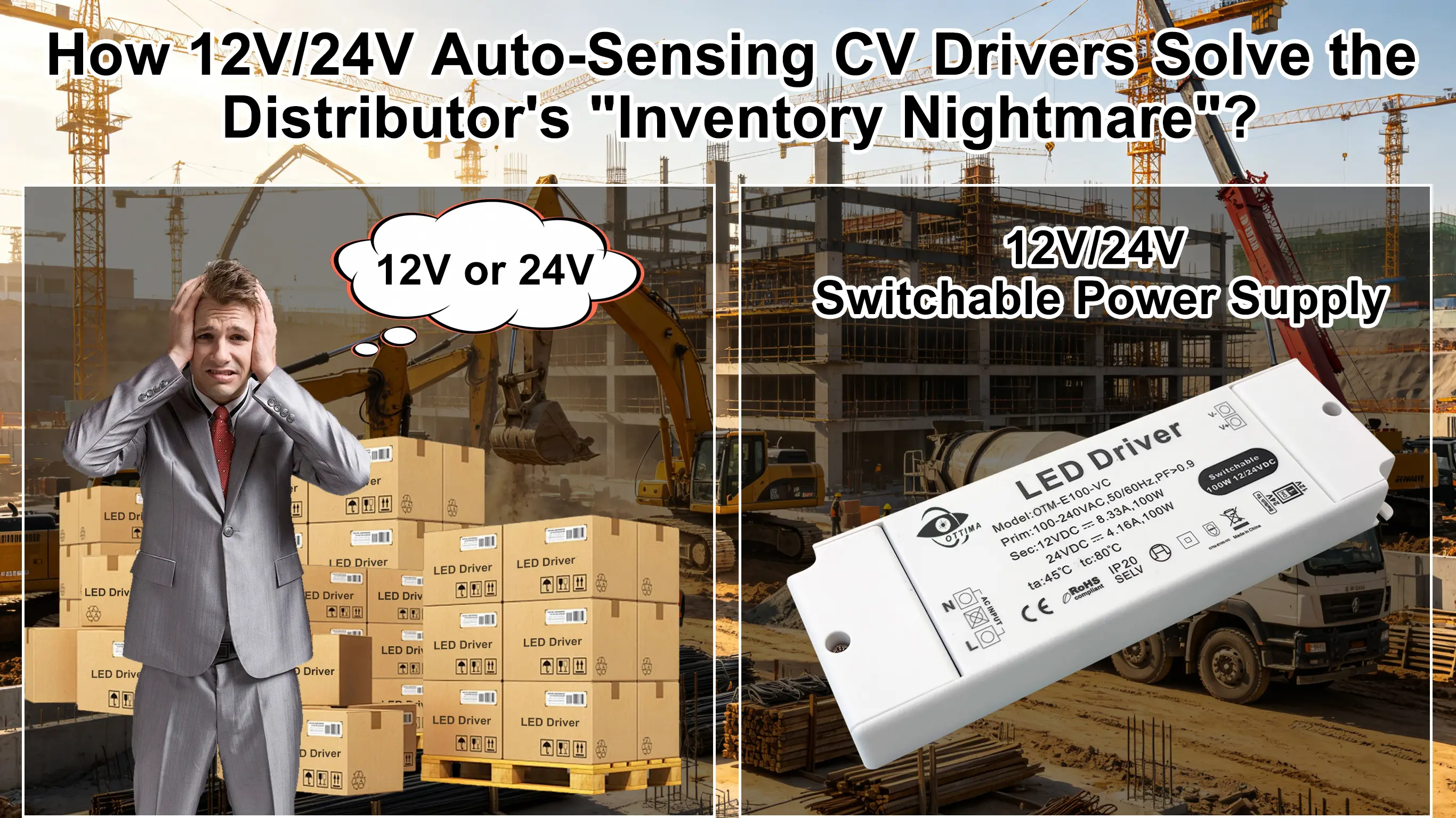
In the supply chain of Constant Voltage (CV) LED lighting, there exists a multi-million dollar pain point that is rarely discussed.
This is the hidden cost of "Voltage Fragmentation."
For a typical lighting distributor, serving downstream contractors and electricians requires maintaining a massive inventory. Why? Because you never know if the next customer walking through the door has an LED strip project that is 12V (typically for short runs, cabinetry, furniture lighting) or 24V (typically for long runs, linear lighting, architectural lighting).
The Inventory Gamble: Stock too much 12V, and if customers shift to 24V projects, your capital turns into dead stock. Stock too little, and customers turn to your competitors.
The Job Site Disaster: Under the pressure of tight deadlines, an electrician grabs a power supply from the truck—unfortunately, he connects a 24V driver to a 12V LED strip. The moment power is applied, the LEDs burn out instantly due to overvoltage, followed by wall demolition, rework, compensation, and a damaged reputation.
The market urgently needs a solution to end this chaos.
This article dissects a game-changing technology: 12V/24V Smart Load Detection & Auto-Switching Technology. We reveal how it uses underlying chip logic to help wholesalers cut SKUs by 50% and help contractors achieve "zero-error" installations.
I. The Tech Black Box: How Does It "Know" the Strip Voltage?
"Adjustable voltage power supplies" on the market typically rely on physical Dip Switches. This is not true intelligence because it still relies on human operation—and human operation means potential errors.
Our new generation of Smart-Sensing Drivers completely eliminates physical switches. The core lies in a microscopic "handshake" process that occurs within 500 milliseconds before startup.
1. Impedance Scanning
The moment the driver connects to mains power, it does not immediately output full power voltage. The internal MCU chip first outputs an extremely low-energy Test Pulse.
12V Load Signature: Due to different circuit structures, 12V LED modules exhibit different physical impedance characteristics compared to 24V modules under low current.
Loop Detection: The chip captures the feedback signal and compares it via an algorithm to determine the load's rated voltage attribute in milliseconds.
2. Soft Lock & Hard Output
Once the MCU determines a 12V load, it immediately locks the PWM controller's output reference to 12V before turning on the main power MOSFET for a Soft Start.
Safety Mechanism: This process is extremely fast and low-energy. Even if the wrong strip is connected, the energy of the test pulse is far too low to burn out the LEDs.
Memory Function: High-end models feature power-off memory for even faster secondary startups.
Technical Conclusion: This isn't magic; it is an Active Safety Defense System based on microelectronic control technology.
II. The Wholesaler's Ledger: How to Conquer Two Markets with One Product?
For B2B wholesalers, SKU (Stock Keeping Unit) is not just a number; it is the culprit tying up cash flow.
Let's do the math. Suppose you need to cover three power ranges: 60W, 100W, and 150W, all requiring 5-in-1 dimming capabilities:
Traditional Model (Inventory Fragmentation):
You need to purchase:
60W-12V, 60W-24V
100W-12V, 100W-24V
150W-12V, 150W-24V
Total: 6 SKUs. You need to set Safety Stock for each of these 6 models. If 12V doesn't move, that is real capital stagnation.
Smart Switching Model (Inventory Consolidation):
You only need to purchase:
60W-Auto-Sensing
100W-Auto-Sensing
150W-Auto-Sensing
Total: 3 SKUs.
Deep Business Value Analysis:
Double Inventory Turnover: All your inventory can be sold to any customer walking through the door, whether they are doing cabinetry or ceiling coves. Dead stock risk is reduced by 90%.
Procurement Bargaining Power: By consolidating purchase volume from two models into one, you can negotiate better Volume Pricing with the factory.
Zero Error Return Rate: You will never again encounter an angry electrician running back with a burnt strip complaining, "You sent the wrong goods!"
III. The Contractor's Weapon: 5-in-1 Dimming & The "Skeleton Key"
Having solved the voltage problem, we must also solve the Dimming Compatibility problem.
In retrofit projects or complex commercial spaces, contractors often face unpredictable control systems. It could be old-school rotary dimmers (Triac), modern 0-10V systems, or high-end DALI systems.
This driver integrates a 5-in-1 Universal Dimming Chip, supporting:
DALI-2 / D4i: Precise digital control that not only dims but also reads driver temperature and runtime data (optional DALI module required).
0-10V / 1-10V / 10V PWM: Mainstream standards for analog dimming, compatible with Lutron, Leviton, Hunt, and other major controllers.
Resistor Dimming: A minimalist, low-cost solution.
Triac / ELV / MLV (Phase-Cut): Perfectly compatible with legacy phase-cut dimmers, solving the stubborn issues of LED "flicker" and "dead travel."
Application Scenario:
As a contractor, you only need to keep this one driver in your truck. On-site, no matter what voltage strip you encounter, and no matter what brand of dimming system is installed, this single driver adapts. This is the "Skeleton Key" of the job site.
IV. Bidding Advantage: How to Persuade the Owner with "Technology"?
When bidding for projects, competing solely on low price often leads to thin margins. You can use the "Fault Tolerance" of this driver as a core selling point:
To the Owner: "Mr. Smith, our proposal uses Smart Voltage-Sensing Drivers. Even if your facility electrician accidentally swaps in a different voltage strip during future maintenance, this driver automatically adapts. It will never burn out fixtures due to operational errors, protecting your asset safety."
To the Designer: "Whether your design uses 12V here or 24V there, we use the same driver model throughout. Dimming curves and light color consistency are perfectly guaranteed, avoiding brightness discrepancies caused by different driver brands."
V. Conclusion: Universality is Productivity
In the LED industry, "Specialized" represents performance, but "Universal" represents Efficiency and Profit.
The 12V/24V Auto-Sensing Switching Driver is not just a hardware upgrade; it effectively provides distributors with a tool for Lean Inventory Management and contractors with an Installation Safety Net.
In the competitive landscape of 2025, whoever solves the most problems with the fewest SKUs wins.


